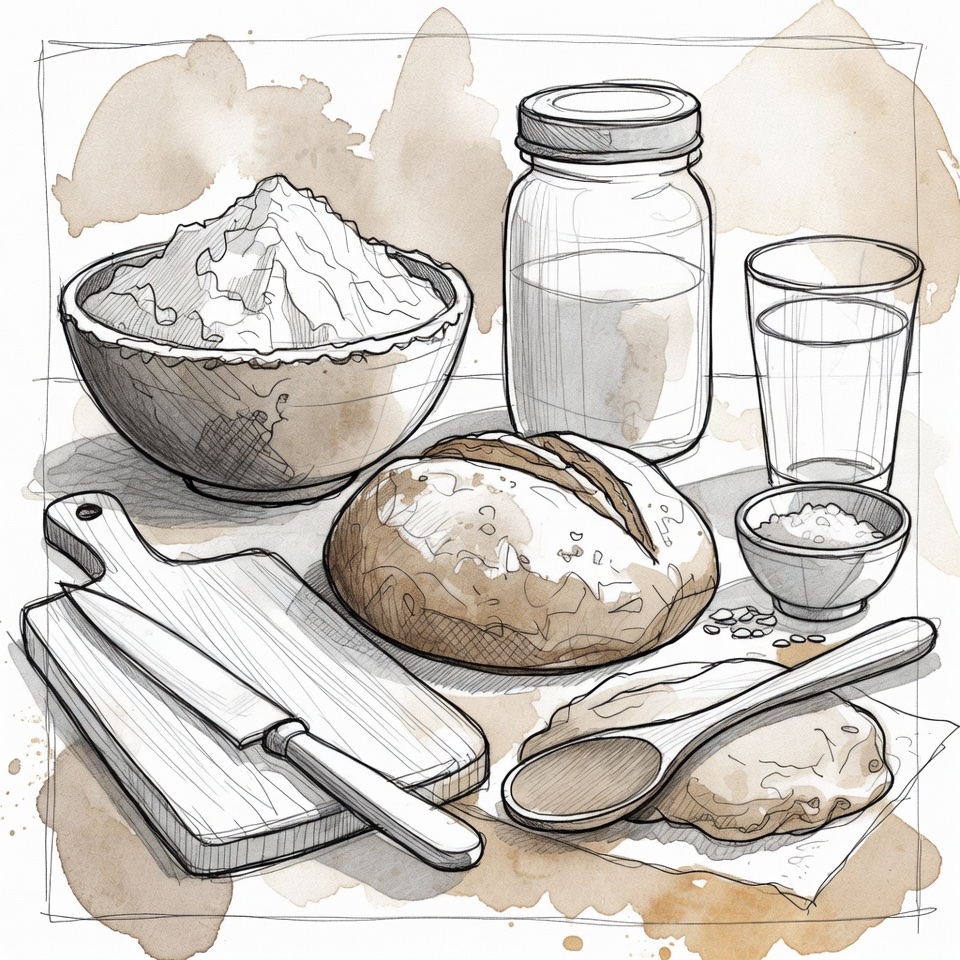
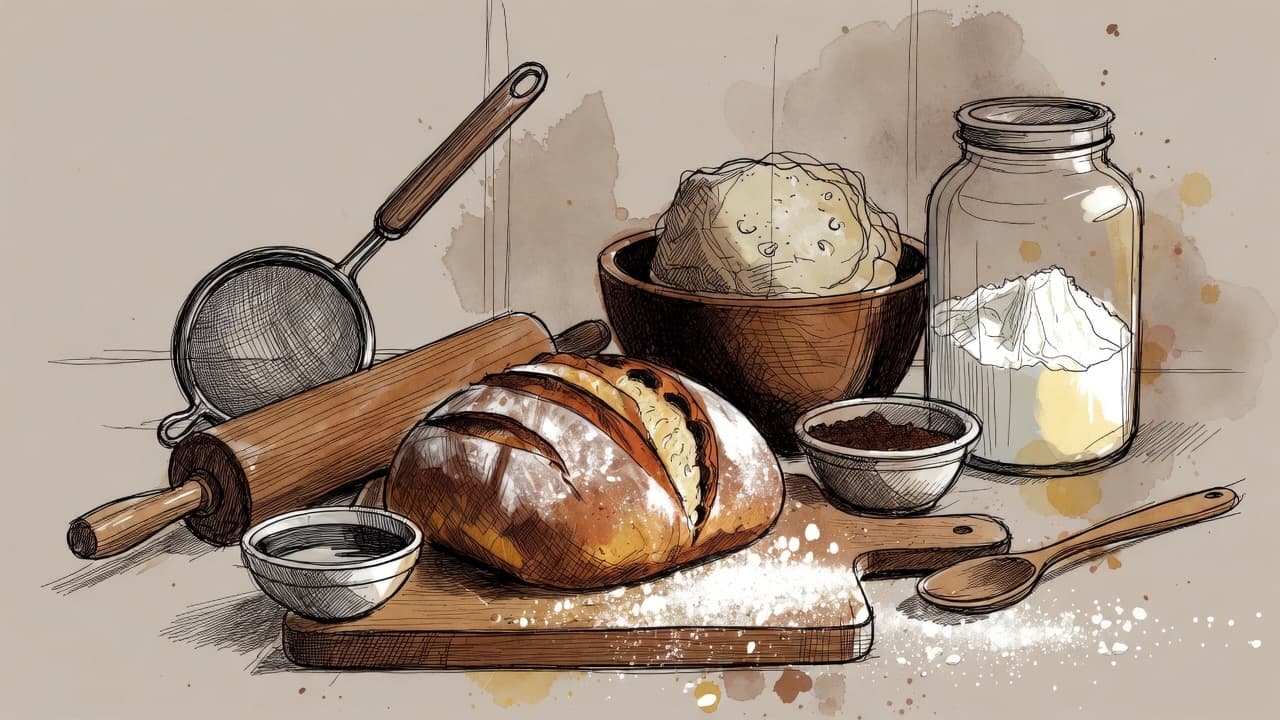
A beginner sourdough boule, by the gram
The recipe we hand new bakers — 1 kilo of dough, a 24-hour timeline, and a finished crumb that doesn't try to be anything heroic.
If you're starting out, the temptation is to chase a 90% hydration country loaf with a wide-open crumb the first weekend. That's not the recipe to use. The recipe below is what we hand new bakers — 1 kilo of dough, 75% hydration, a 24-hour timeline that's mostly waiting, and a finished crumb that's even, tender, and doesn't try to be anything heroic. Master this one and the more ambitious bakes feel like small adjustments instead of leaps of faith.
What you'll need
- Bread flour
- 475 g
- Whole wheat flour
- 25 g (5%)
- Water
- 375 g (75% hydration)
- Active starter
- 100 g (20% inoculation)
- Fine sea salt
- 10 g (2%)
Total dough weight: 985 g — round to one boule. A digital scale is non-negotiable. Volume measurements introduce ~10% variance per ingredient, which is enough to wreck a 75% hydration dough.
The 24-hour timeline
Pick your state and product — instant verdict before market day.
- Day 1, 8 AM — feed the starter (1:5:5 ratio, e.g. 20g starter / 100g flour / 100g water). It should peak at room temperature in 4-6 hours.
- Day 1, 1 PM — autolyse: mix flour + water only, cover, rest 1 hour. The dough will look shaggy and slightly sticky.
- Day 1, 2 PM — add starter (when it's at peak) and salt. Pinch and fold to integrate, then rest 30 minutes.
- Day 1, 2:30-6:30 PM — bulk ferment with 4 sets of stretch-and-folds, 30 minutes apart. By the last fold, the dough should be smooth, slightly bouncy, and pulling away from the sides of the bowl.
- Day 1, 6:30 PM — pre-shape into a loose round on a lightly floured surface. Rest 20 minutes.
- Day 1, 7 PM — final shape (boule form), seam-side up into a floured banneton. Cover.
- Day 1, 8 PM — into the fridge for cold proof. 14-18 hours.
- Day 2, 9 AM — preheat oven with Dutch oven inside to 500°F (260°C) for 45 minutes.
- Day 2, 9:45 AM — score and bake covered for 20 minutes at 500°F, then uncovered for 22-25 minutes at 450°F (230°C).
- Day 2, 10:30 AM — cool on a wire rack for at least 1 hour before slicing. Yes, an hour. The crumb is still setting.
Common first-bake problems
Dough is too wet to handle
Either your starter wasn't ripe enough (so the gluten didn't develop), the kitchen was too warm (over 78°F speeds fermentation past structure), or you skipped the autolyse. Adding flour mid-bulk is a band-aid; trust the process and let the gluten do its work via the stretch-and-folds.
Loaf is dense and gummy
Almost always under-fermentation. The bulk needs to be long enough that the dough has visibly risen ~50% and shows surface bubbles. If your kitchen is below 70°F, add 1-2 hours to the bulk.
Crust is pale
Oven not hot enough or you skipped the covered phase. The Dutch oven trapping steam for the first 20 minutes is what gives you the dramatic crust color and the oven spring. Don't skip it.
When this loaf works for you three weekends in a row, you're ready for higher hydration, longer cold proofs, and inclusions. We'll cover those next.
Crosodo Journal entries are recipe, craft, and cottage-food notes for home bakers. Recipes assume an active starter and basic equipment. Cottage food sales are governed by your state's law — start with the free state directory, check a product with Can I sell this?, or grab a label template. Not legal advice.