Delaware Cottage Food Law PDF 2026 — Full Legal Text + Annotations
Full statute text, allowed foods, registration, sales cap None, and all 3 Delaware counties with zoning + health department links. 19-page PDF with official sources. Free preview below — buy the complete guide for $44.
This page shows the first 2 pages + statute excerpt. One-time $44 · Yours to keep · Stripe checkout · Guide (PDF) emailed with receipt.
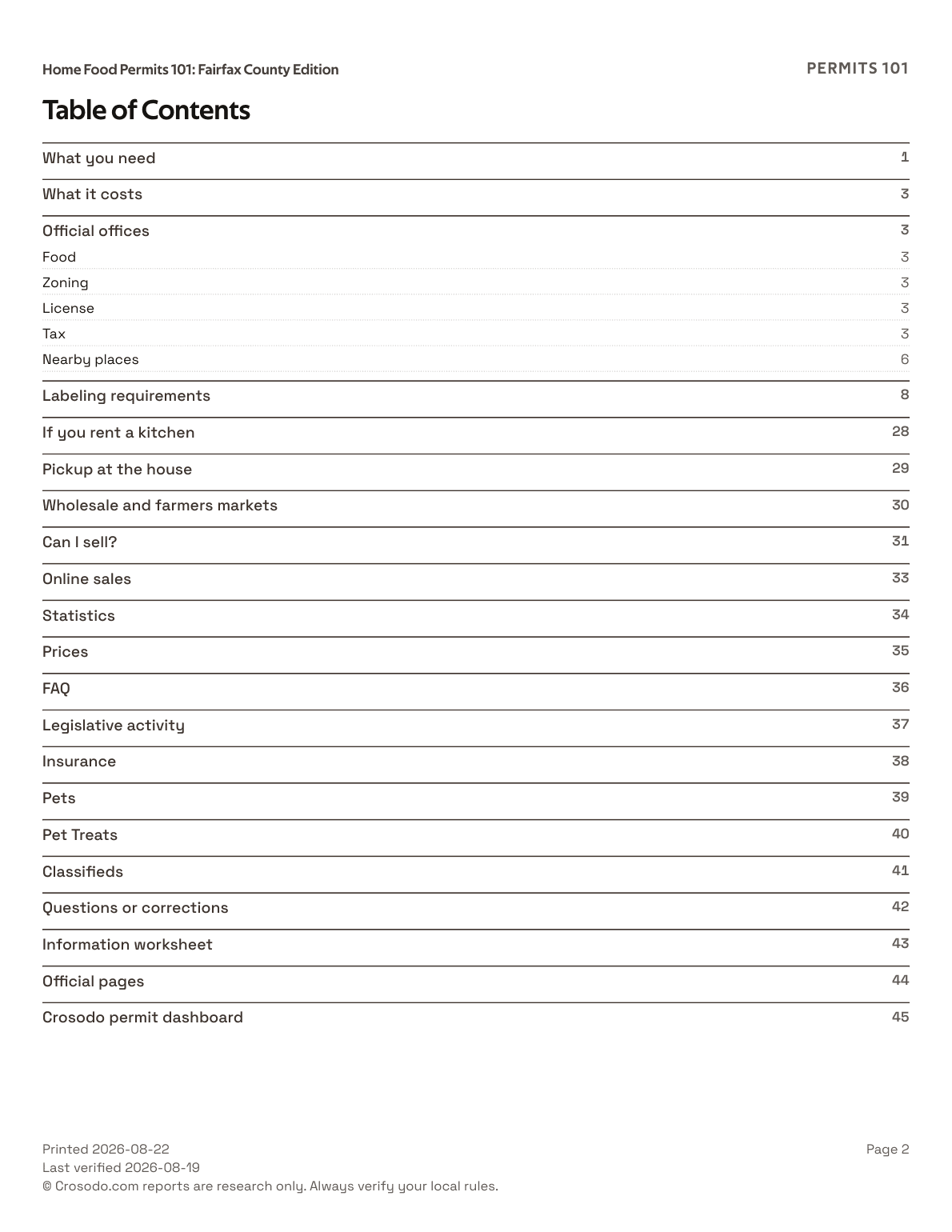
- Full Delaware statute text with key provisions and official citation
- Allowed and prohibited foods, labeling rules, sales cap (None)
- Registration and permit steps with direct state-agency links
- All 3 Delaware counties with zoning + health department links
- 19-page guide with every official source URL, licensed to your address
What exactly am I buying?
The complete Delaware License & Permit Guide — not the free 2-page preview above.
How do I receive it?
Stripe checkout. We email a cover letter, paid receipt, and the guide (PDF) licensed to your address.
Is it current?
Every report lists its official sources so you can verify against the current statute. See also the research-verified Delaware guide.
Not ready? Get free Delaware cottage-food updates instead.
State of Delaware Cottage Food Regulations (16 Del. Admin. Code 4458A §§ 1-9)
Verbatim Excerpt1.1 Preamble. These regulations shall be known as the State of Delaware Cottage Food Regulations (Cottage Food Regs). 1.2 Purpose. Delaware Department of Health and Social Services adopts these regulations pursuant to the authority vested by 16 Del.C. §122. These regulations establish registration procedures and standards of practice for conducting food processing operations in home-style kitchens that safeguard public health and provide to consumers food that is safe, unadulterated, and honestly presented. 1.4 Exemptions 1.4.1 Establishments registered as food establishments in Delaware shall be exempt from the Cottage Food Regulations. 1.4.2 Establishments registered under these regulations shall be exempt from the Delaware Food Code. 1.4.3 Products offered at 'bake sales' or private events as described in the definition of food establishment in the Delaware Food Code shall be exempt from these regulations. 3.1.3.1 CFE are only permitted to engage in direct sales with consumers in the State of Delaware.
Source: nationalaglawcenter.org/wp-content/uploads/assets/cottagefood/Delaware.pdf →
Delaware allows certain non-potentially hazardous foods including specific baked goods (breads, cakes, cookies, pies, pastries), candy, jams, jellies, and other fruit preserves. Other non-PHF foods may be allowed after confirmation from the health department.
Prohibited items include most perishable foods, low-acid and acidified canned foods, ketchup, mustards, nut butters, oils, pickles, salsas, sauces, dried fruits and vegetables, herbs, mixes, pasta noodles, spices, tea leaves, fermented foods, juices, and meat jerkies. TCS (time/temperature control for safety) foods are not permitted.
Labels must include the town or city (format: 'City, Delaware'), either an email address or phone number, product name, ingredients in descending order of weight, and net weight/volume. Home address on label was removed as a requirement in December 2023.
None
Good (IJ Grade F)
3
Delaware Counties (3)
Cottage food registration usually happens at the county level. Click any county for local zoning, health department, and planning department links.
Where to verify Delaware's rules
Data compiled from primary sources. Cottage food laws change — verify with your state agency before relying on this information.
Cottage food laws are amended every year. This is a starting reference, not legal advice. Verify with Delaware Department of Health and Social Servicesand your local health department before relying on this data.