Washington Cottage Food Law PDF 2026 — Full Legal Text + Annotations
Full statute text, allowed foods, registration, sales cap None, and all 39 Washington counties with zoning + health department links. 136-page PDF with official sources. Free preview below — buy the complete guide for $44.
This page shows the first 2 pages + statute excerpt. One-time $44 · Yours to keep · Stripe checkout · Guide (PDF) emailed with receipt.
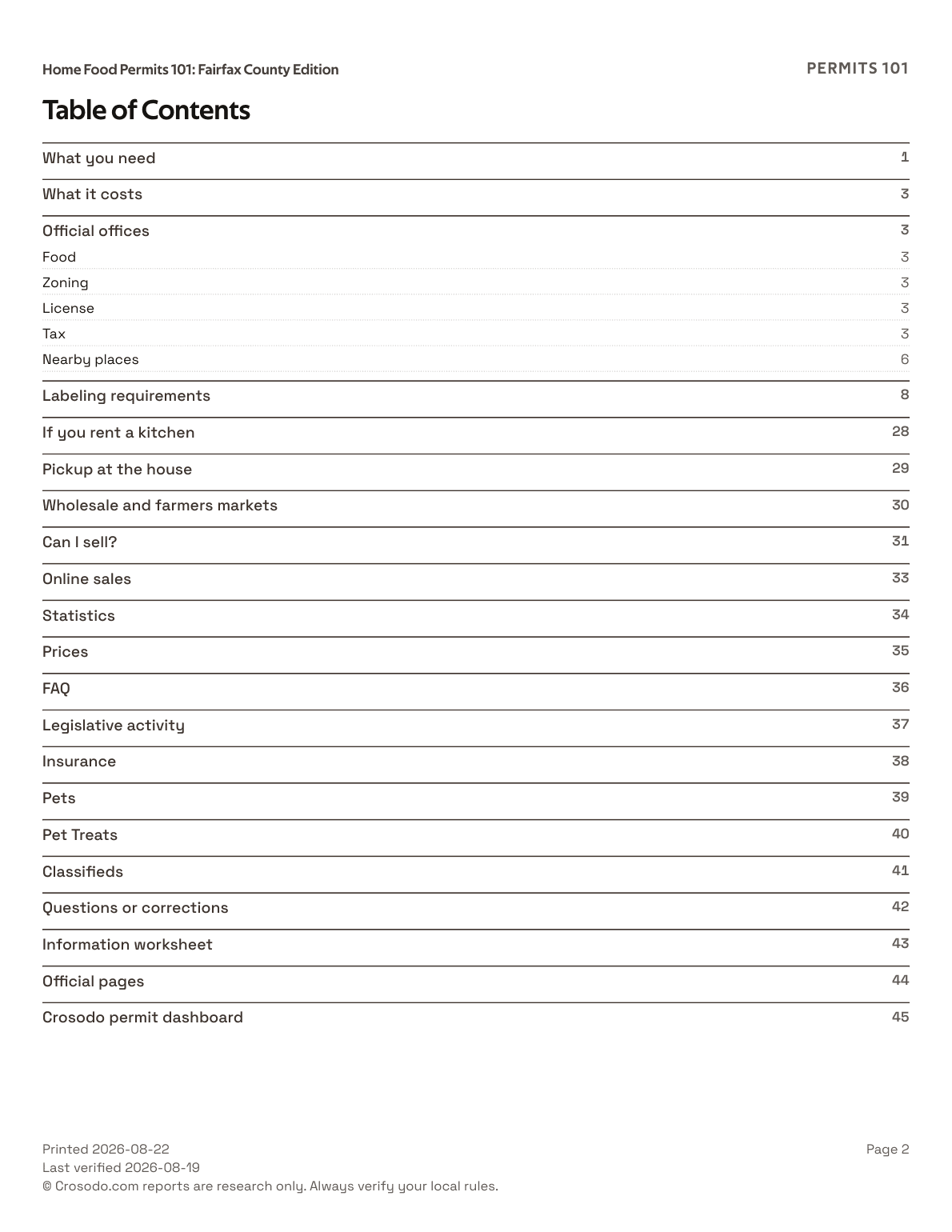
- Full Washington statute text with key provisions and official citation
- Allowed and prohibited foods, labeling rules, sales cap (None)
- Registration and permit steps with direct state-agency links
- All 39 Washington counties with zoning + health department links
- 136-page guide with every official source URL, licensed to your address
What exactly am I buying?
The complete Washington License & Permit Guide — not the free 2-page preview above.
How do I receive it?
Stripe checkout. We email a cover letter, paid receipt, and the guide (PDF) licensed to your address.
Is it current?
Every report lists its official sources so you can verify against the current statute. See also the research-verified Washington guide.
Not ready? Get free Washington cottage-food updates instead.
Revised Code of Washington, Title 69 Food, Drugs, Cosmetics, and Poisons, Chapter 69.22 Cottage Food Operations
Verbatim ExcerptRCW 69.22.010 Definitions. (1) "Cottage food operation" means a person who produces cottage food products only in the home kitchen of that person's primary domestic residence in Washington and only for sale directly to the consumer. (2) "Cottage food products" means nonpotentially hazardous baked goods; baked candies and candies made on a stovetop; jams, jellies, preserves, and fruit butters as defined in 21 C.F.R. Sec. 150 as it existed on July 22, 2011; and other nonpotentially hazardous foods identified by the director in rule. No ingredient containing a tetrahydrocannabinol concentration of 0.3 percent or greater may be included as an ingredient in any cottage food product. RCW 69.22.020(3) A cottage food operation must place on the label of any food it produces or packages, at a minimum, the following information: (a) The name and permit number issued under RCW 69.22.030 of the business of the cottage food operation; (b) The name of the cottage food product; (c) The ingredients of the cottage food product, in descending order of predominance by weight; (d) The net weight or net volume of the cottage food product; (e) Allergen labeling as specified by the director in rule; (f) If any nutritional claim is made, appropriate labeling as specified by the director in rule; (g) The following statement printed in at least the equivalent of eleven-point font size in a color that provides a clear contrast to the background: "Made in a home kitchen that has not been subject to standard inspection criteria." (4) Cottage food products may only be sold directly to the consumer and may not be sold by internet, mail order, or for retail sale outside the state. RCW 69.22.030(1) All cottage food operations must be permitted every two years by the department on forms developed by the department. All permits and permit renewals must be made on forms developed by the director and be accompanied by an inspection fee as provided in RCW 69.22.040, a $75 public health review fee, and a $30 processing fee.
Source: app.leg.wa.gov/RCW/default.aspx?cite=69.22.010 →
Nonpotentially-hazardous baked goods; baked candies and stovetop candies; jams, jellies, preserves, and fruit butters (as defined in 21 C.F.R. §150); and other nonpotentially hazardous foods identified by the director by rule. No THC ingredients (0.3% or greater) permitted. No dollar sales cap is specified in the statute.
Potentially hazardous (TCS) foods are prohibited. Products cannot be sold via internet, mail order, or for retail sale outside the state. No one other than the permittee or persons under their direct supervision may handle cottage food products or be in the kitchen during processing.
Every package must display: (1) business name and permit number; (2) product name; (3) ingredients in descending weight order; (4) net weight or volume; (5) allergen labeling per director's rules; (6) nutritional claim labeling if applicable; and (7) the statement 'Made in a home kitchen that has not been subject to standard inspection criteria.' in at least 11-point font in a contrasting color. Products must be stored only in the primary domestic residence.
None
Good (IJ Grade D)
39
Washington Counties (39)
Cottage food registration usually happens at the county level. Click any county for local zoning, health department, and planning department links.
Where to verify Washington's rules
Data compiled from primary sources. Cottage food laws change — verify with your state agency before relying on this information.
Cottage food laws are amended every year. This is a starting reference, not legal advice. Verify with Washington State Department of Agricultureand your local health department before relying on this data.