
West Virginia Cottage Food Law PDF 2026 — Full Legal Text + Annotations
Full statute text, allowed foods, registration, sales cap None, and all 55 West Virginia counties with zoning + health department links. 180-page PDF with official sources. Free preview below — buy the complete guide for $44.
This page shows the first 2 pages + statute excerpt. One-time $44 · Yours to keep · Stripe checkout · Guide (PDF) emailed with receipt.
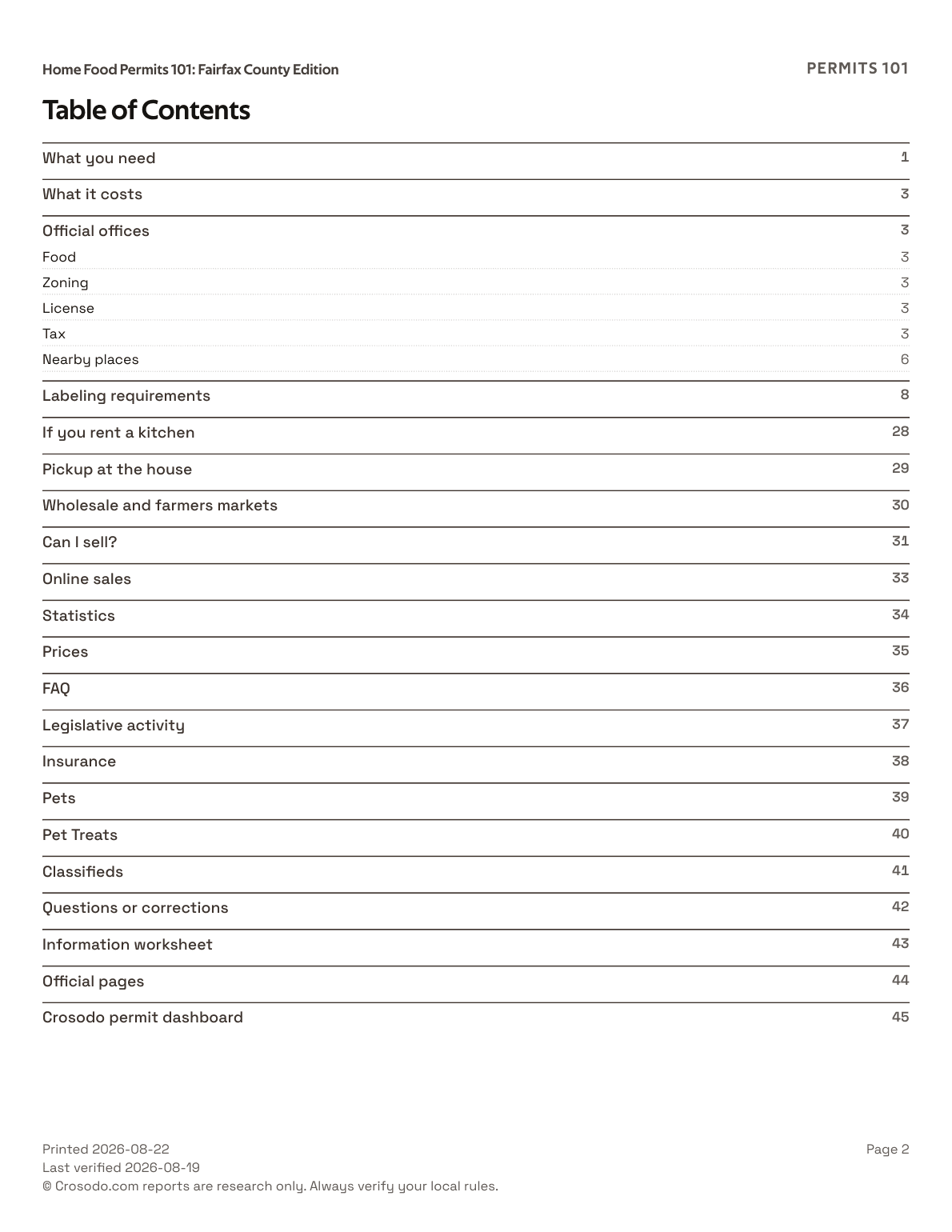
- Full West Virginia statute text with key provisions and official citation
- Allowed and prohibited foods, labeling rules, sales cap (None)
- Registration and permit steps with direct state-agency links
- All 55 West Virginia counties with zoning + health department links
- 180-page guide with every official source URL, licensed to your address
What exactly am I buying?
The complete West Virginia License & Permit Guide — not the free 2-page preview above.
How do I receive it?
Stripe checkout. We email a cover letter, paid receipt, and the guide (PDF) licensed to your address.
Is it current?
Every report lists its official sources so you can verify against the current statute. See also the research-verified West Virginia guide.
Not ready? Get free West Virginia cottage-food updates instead.
Code of West Virginia, Chapter 19 Agriculture, Article 40 Cottage Foods (SB 44, 2026 Regular Session, enacted March 27, 2026, effective June 12, 2026)
Verbatim ExcerptARTICLE 40. COTTAGE FOODS. §19-40-1. Definitions. "Cottage food" means a food item intended for human consumption that is produced and, if packaged, packaged at the residential property of the producer and sold directly to a consumer. The term includes nonpotentially hazardous foods, but excludes meat, meat products, poultry, poultry products, seafood, and Grade A dairy products. "Cottage food vendor" means a home-based business producing and selling cottage foods. §19-40-2. Potentially hazardous cottage food vendor permits. (a) Except as provided in subsection (d) of this section, a person wanting to sell potentially hazardous cottage food shall apply for a potentially hazardous cottage food vendor permit from the department. (b) A potentially hazardous cottage food vendor permit, once issued, is valid in all counties in this state. A cottage food produced pursuant to this article shall be sold only within the geographic boundaries of the State of West Virginia. (c) Notwithstanding any other provisions of code or rule to the contrary, a potentially hazardous cottage food vendor permittee is not required to obtain a food establishment permit to sell from home. (d) The following are exempt from obtaining a potentially hazardous cottage food vendor permit: (1) A person selling fresh, uncut produce; (2) A person selling nonpotentially hazardous foods; and (3) A person selling other farm and food products that are identified by the department. §19-40-6. Nonpotentially hazardous foods. The production and sale of a nonpotentially hazardous food, when done in conformity with §19-35-6 and the accompanying legislative rules, is not subject to the provisions of this article.
Source: wvlegislature.gov/Bill_Status/bills_text.cfm?billdoc=sb44%20sub1%20enr.htm&yr=2026&sesstype=RS&i=44 →
Nonpotentially hazardous cottage foods are fully exempt from licensing, permitting, and inspection (§19-40-6 and §19-35-6). Potentially hazardous cottage foods (those requiring temperature control for safety) require a permit from the WV Department of Agriculture but do not require a separate food establishment permit for home sales. All sales must occur within West Virginia.
Meat, meat products, poultry, poultry products, seafood, and Grade A dairy products are excluded from the cottage food definition. Cottage foods cannot be sold outside West Virginia. Foods served in commercial food establishments must comply with standard licensing requirements.
Under the parallel §19-35-6 framework for nonpotentially hazardous foods, labels must include product content, sources, and potential allergens, plus the statement: 'This product was made in a non-commercial kitchen that may not be subject to inspection and may contain cross-contact allergens not included in the allergen statement.' For potentially hazardous cottage foods, labeling standards will be set by the Department of Agriculture by legislative rule.
None
Good (IJ Grade B)
55
West Virginia Counties (55)
Cottage food registration usually happens at the county level. Click any county for local zoning, health department, and planning department links.
Where to verify West Virginia's rules
Data compiled from primary sources. Cottage food laws change — verify with your state agency before relying on this information.
Cottage food laws are amended every year. This is a starting reference, not legal advice. Verify with West Virginia Department of Health and Human Resourcesand your local health department before relying on this data.