
Connecticut Cottage Food Law PDF 2026 — Full Legal Text + Annotations
Full statute text, allowed foods, registration, sales cap 50000, and all 8 Connecticut counties with zoning + health department links. 34-page PDF with official sources. Free preview below — buy the complete guide for $44.
This page shows the first 2 pages + statute excerpt. One-time $44 · Yours to keep · Stripe checkout · Guide (PDF) emailed with receipt.
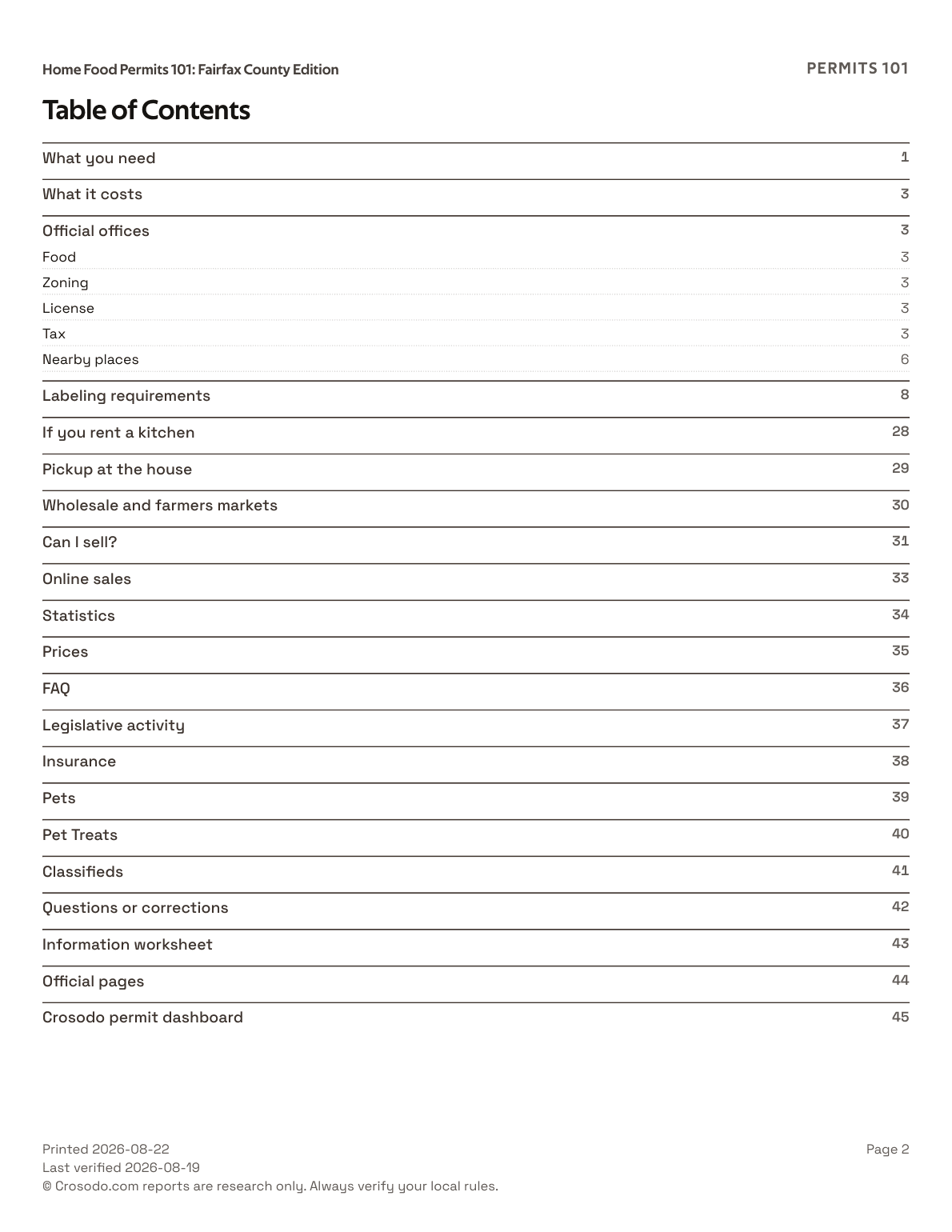
- Full Connecticut statute text with key provisions and official citation
- Allowed and prohibited foods, labeling rules, sales cap (50000)
- Registration and permit steps with direct state-agency links
- All 8 Connecticut counties with zoning + health department links
- 34-page guide with every official source URL, licensed to your address
What exactly am I buying?
The complete Connecticut License & Permit Guide — not the free 2-page preview above.
How do I receive it?
Stripe checkout. We email a cover letter, paid receipt, and the guide (PDF) licensed to your address.
Is it current?
Every report lists its official sources so you can verify against the current statute. See also the research-verified Connecticut guide.
Not ready? Get free Connecticut cottage-food updates instead.
Connecticut Cottage Food Operation Law (PA 18-141)
Verbatim ExcerptSec. 21a-62a-1. Definitions. (2) "Cottage food operation" means a person who produces cottage food products only in the home kitchen of that person's private residential dwelling and only for sale directly to the consumer, but does not operate as a food service establishment pursuant to 19a-36 or regulations promulgated pursuant to 21a-101, or a food retailer, distributor or manufacturer as defined in 21a-92(b) and 21a-151. (3) "Cottage food products" means non-potentially hazardous baked goods, jams, jellies, and other non-potentially hazardous foods produced by a cottage food operation. (5) "Private residential dwelling" means an owner or resident occupied dwelling. A private residential dwelling does not include any group or communal residential setting within any type of structure, or outbuilding, shed, barn, or other similar structure. Sec. 21a-62a-2. Prerequisite Requirements. (a) All cottage food operations must be licensed annually by the commissioner of Consumer Protection. The license application form will be developed by the commissioner. The license will specify the food products allowed to be produced by the cottage food operation. The annual license fee for cottage food operations shall be set by the commissioner of Consumer Protection; however, such fee shall not exceed $100.00. (b) Prior to licensing, the commissioner shall, within existing resources, examine the premises of the cottage food operation to determine it to be in compliance with Sections 21a-62a-1 through to Section 21a-62a-7 of the Regulations of Connecticut State Agencies.
Source: eregulations.ct.gov/eRegsPortal/Search/getDocument?guid={50AF7258-0000-C5F0-8C16-E8B672186E56} →
Allowed foods include non-perishable baked goods, candies, jams and jellies (not fruit butters), dried goods, pasta, spices, and other non-potentially hazardous shelf-stable foods from the official approved foods list. Products must be sold directly to consumers at events, farmers markets, roadside stands, at-home sales, or online (local delivery only).
Prohibited foods include all perishable baked goods, acidified foods, low-acid canned goods, pickles, salsas, sauces, ketchup, juices, carbonated drinks, kombucha, and meat jerkies. Sales are also prohibited at long-term care facilities, group homes, day care facilities, and schools.
Labels must use the physical home address (not a P.O. box), include all standard label information, and be on large items (e.g., wedding cakes) when delivering with the invoice. License must be displayed at all points of sale.
50000
Okay (IJ Grade D)
8
Connecticut Counties (8)
Cottage food registration usually happens at the county level. Click any county for local zoning, health department, and planning department links.
Where to verify Connecticut's rules
Data compiled from primary sources. Cottage food laws change — verify with your state agency before relying on this information.
Cottage food laws are amended every year. This is a starting reference, not legal advice. Verify with Connecticut Department of Consumer Protectionand your local health department before relying on this data.