
Connecticut cottage food law
Last updated: · Research verified · Full guide $44 lifetime (34 pages)
Tier: Okay. Sales caps under $25,000 and/or limited sales channels. Operable for a side business but you'll likely outgrow the rules at scale.
Full Connecticut License & Permit Guide (34 pages). Statute, every county we have researched, and official source URLs. Stripe checkout. Cover letter, paid receipt, and the guide (PDF) licensed to your address.
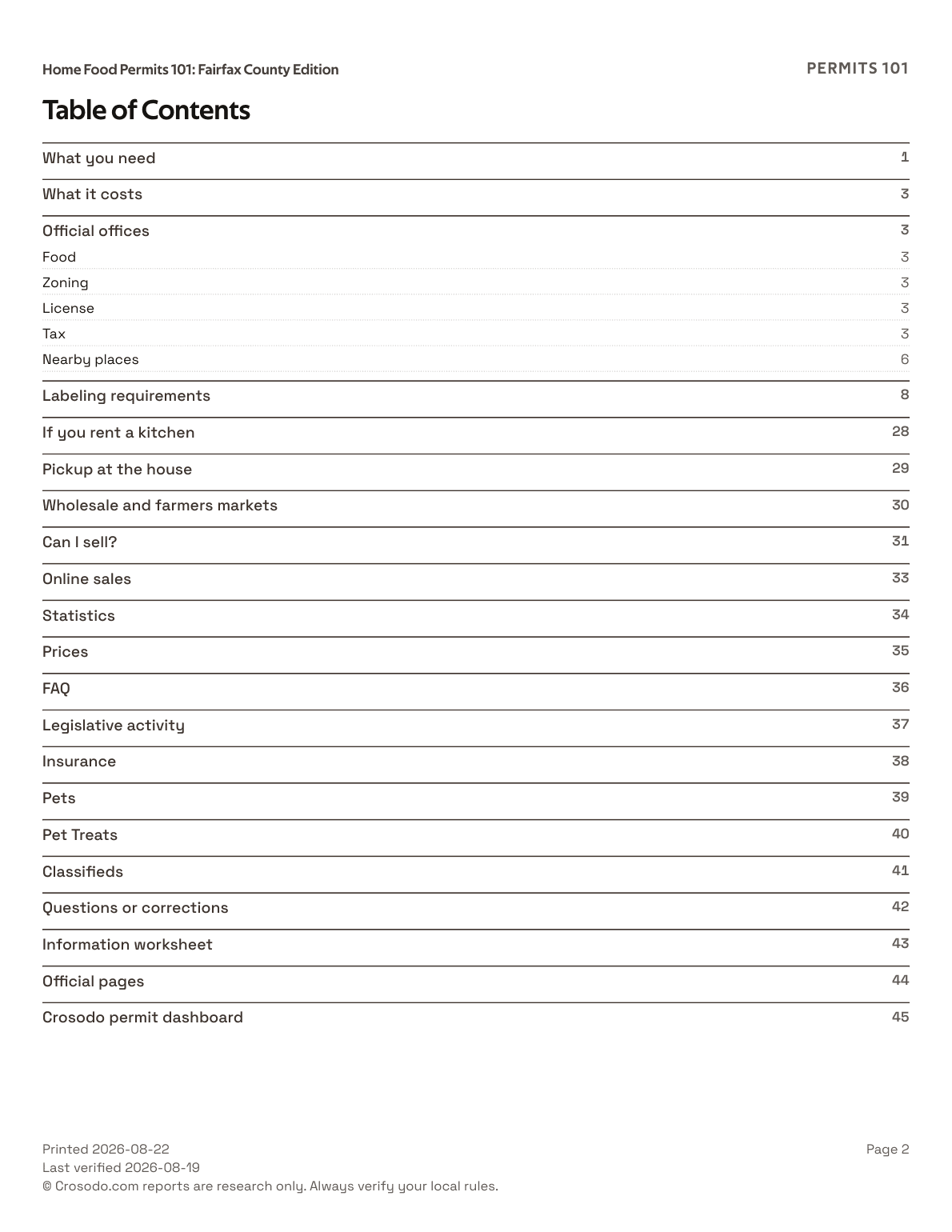
Unlimited Pass. Your journey to getting permitted for cottage food sales. Premium dashboard tools, unlimited state and county reports, and the 50-state label report. Lifetime access. Includes the full Connecticut License & Permit Guide (34 pages).
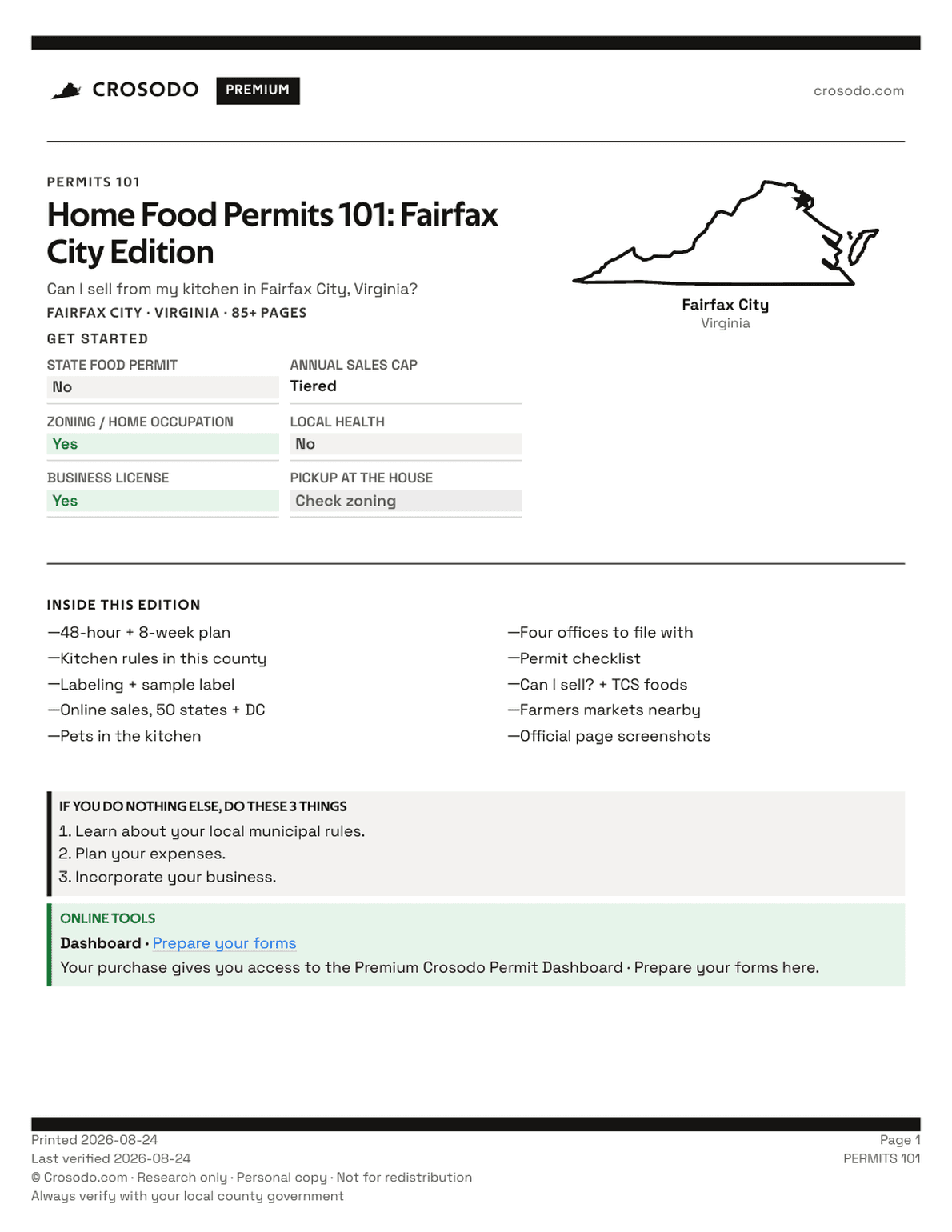
How to start in Connecticut
A practical path from “am I allowed?” to first sale. Not legal advice — confirm every step with Connecticut agencies and your local offices.
Confirm your products are allowed
Connecticut allows Allowed foods include non-perishable baked goods, candies, jams and jellies (not fruit butters), dried goods, pasta, spices, and other non-potentially hazardous shelf-stable foods from the official approved foods list. Products must be sold directly to consumers at events, farmers markets, roadside stands, at-home sales, or online (local delivery only).. High-risk or refrigerated foods usually need a commercial kitchen — not a cottage exemption.
Choose sales channels you can actually use
Sales cap: $50,000. Indirect / wholesale-style sales: No. Farmers markets and direct-to-consumer pickup are the usual start. Check county and city rules before advertising porch pickup.
Clear local zoning, licenses, and tax IDs
State cottage food rules are the floor. Your city or county may still require a business license, home occupation approval, HOA permission, or sales tax registration. Do this before you print an address on Instagram.
Registration, training, and kitchen rules
State registration: Yes. Food handler / training: Yes (specific course). Kitchen inspection: Yes. Complete certificates the market or agency will ask for.
Build compliant labels
Use the Connecticut label requirements on this site (and the free template). Match disclaimer language to the statute or agency guide before you print a batch.
Soft-launch, then first paid sales
Keep a simple sales log from day one so you stay under any annual cap. Soft-launch with pre-orders before a full market day.
Verify with official sources
Re-check the state cottage food page and your local health / planning office before you invest in equipment or marketing. Rules change.
What usually goes on the package
- Product name (common or usual name of the food)
- Business or producer name
- Producer address (or address alternative your state allows)
- Ingredients in descending order by weight
- Major allergen disclosures (e.g. wheat, milk, eggs, soy, tree nuts, peanuts, fish, shellfish, sesame)
- Net weight or quantity
- Home-kitchen disclaimer: “Made in a Cottage Food Operation that is not Subject to Routine Government Food Safety Inspection.”
This is a planning checklist compiled for home bakers. It is not legal, tax, or zoning advice.
Connecticut vs neighboring cottage food laws
Tier and sales-cap snapshot for Connecticut and nearby states. Click through for full rules, labeling, and county pages.
| State | Tier | Sales cap | Guide |
|---|---|---|---|
| ConnecticutYou are here | Okay | 50000 | This page |
| Massachusetts | Okay | None | Massachusetts law → |
| New York | Good | None | New York law → |
| Rhode Island | Poor | 50000 | Rhode Island law → |
Need a compliant product label for Connecticut? Open the Connecticut label mockup.
50000
Allowed foods include non-perishable baked goods, candies, jams and jellies (not fruit butters), dried goods, pasta, spices, and other non-potentially hazardous shelf-stable foods from the official approved foods list. Products must be sold directly to consumers at events, farmers markets, roadside stands, at-home sales, or online (local delivery only).
Registration: Yes. Food handler cert: Yes (specific course).
Connecticut Cottage Food Operation Law (PA 18-141)
Verbatim excerptSec. 21a-62a-1. Definitions. (2) "Cottage food operation" means a person who produces cottage food products only in the home kitchen of that person's private residential dwelling and only for sale directly to the consumer, but does not operate as a food service establishment pursuant to 19a-36 or regulations promulgated pursuant to 21a-101, or a food retailer, distributor or manufacturer as defined in 21a-92(b) and 21a-151. (3) "Cottage food products" means non-potentially hazardous baked goods, jams, jellies, and other non-potentially hazardous foods produced by a cottage food operation. (5) "Private residential dwelling" means an owner or resident occupied dwelling. A private residential dwelling does not include any group or communal residential setting within any type of structure, or outbuilding, shed, barn, or other similar structure. Sec. 21a-62a-2. Prerequisite Requirements. (a) All cottage food operations must be licensed annually by the commissioner of Consumer Protection. The license application form will be developed by the commissioner. The license will specify the food products allowed to be produced by the cottage food operation. The annual license fee for cottage food operations shall be set by the commissioner of Consumer Protection; however, such fee shall not exceed $100.00. (b) Prior to licensing, the commissioner shall, within existing resources, examine the premises of the cottage food operation to determine it to be in compliance with Sections 21a-62a-1 through to Section 21a-62a-7 of the Regulations of Connecticut State Agencies.
Source: eregulations.ct.gov/eRegsPortal/Search/getDocument?guid={50AF7258-0000-C5F0-8C16-E8B672186E56} →
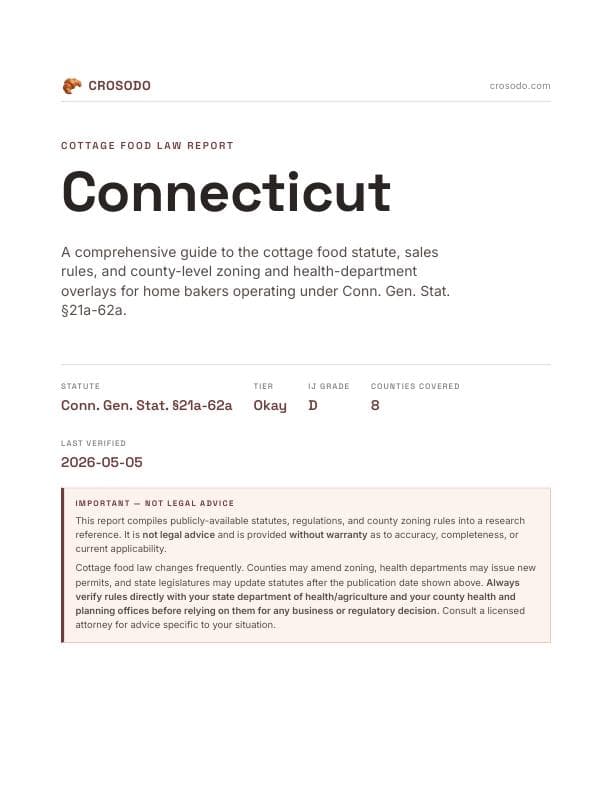
Connecticut Cottage Food Law — 34 pages and 8 counties
The long report for this state (34 pages): statute, every county we've researched, and official source URLs. Stripe checkout. We email a cover letter, paid receipt, and the guide (PDF) licensed to your address.
Print Connecticut labels for your first market
After the law page, this is the next thing most bakers need: a print-ready mockup with the Connecticut home-kitchen disclaimer, allergen line, and net-weight fields.
Made in a Cottage Food Operation that is not Subject to Routine Government Food Safety Inspection.
- Product name, producer, and address (or allowed alternative)
- Ingredients by weight and major allergens
- Net weight / quantity
- Connecticut home-kitchen / “not inspected” disclaimer
Not legal advice. Verify wording with the state agency before a production print run.
Where to verify Connecticut's rules
Cottage Food in Connecticut — A Guide for Cottage Food Operators
Official agency guidance changes without notice. The text below is reproduced for reference only — always confirm current rules on the agency website before relying on it.
- Connecticut Department of Consumer Protection (DCP)https://portal.ct.gov/-/media/DCP/News-Releases-from-the-Department-of-Consumer-Protection/COTTAGE_FOOD_MANUAL.pdf
Cottage food is food that is made in your home for direct sale to consumers. Public Act 18-141 sets limits on what you may sell in the State of Connecticut. Cottage food operators in Connecticut may apply for a cottage food license and sell once their license is approved. Cottage food must be held to the highest safety standards, and production and sales practices must follow laws and regulations outlined by the State of Connecticut and the Food and Drug Administration (FDA).
License Requirements
- Obtain, and keep written confirmation, that your space is compliant with local zoning laws.
- If you have a private water supply, the water supply must be tested prior to receiving a license to demonstrate that the water supply is safe to drink. Subsequent testing may be required.
- Complete a food safety training program that includes training in food processing and packaging. A list of acceptable courses can be found at www.portal.ct.gov/cottagefood.
- Apply for a license through DCP, and pay the application fee of $50.00.
- When you apply for your license, you must be prepared to tell DCP what type of food you will be producing.
Types of Food
- Some examples of potentially acceptable cottage food are: loaf breads, rolls and biscuits; non-potentially hazardous cakes including celebration cakes (e.g. birthday cake, but not cheesecake); non-potentially hazardous pastries and cookies; candies and confections; fruit pies (not pumpkin); jams, jellies and preserves (must meet the Standard of Identity in 21CFR150); dried fruits; dry herbs, seasonings and mixtures; non-potentially hazardous cereals, trail mixes and granola; coated or uncoated nuts; vinegar and flavored vinegars; popcorn and popcorn balls; cotton candy.
- PLEASE NOTE: This list is not inclusive. Products on this list are not automatically approved, and the list above is subject to change.
- The allowable products list is based on the food safety risk level associated with certain types of food. People who operate a licensed and inspected food processing business have to meet more rigorous requirements for training, food safety and handling, which is why they may make and sell a broader range of food.
- No. Cooked vegetables, whether fresh or canned, usually are made from a combination of low acid and acidified food, and are considered a potentially hazardous food. Cooked vegetables must be kept either hot (above 135°F) or cold (below 41°F). They cannot be stored safely at room temperature.
- Yes. You may roast and sell whole bean coffee or ground coffee. However, beverages may not be sold, so you may not sell ready-made coffee.
- No. Fruit butters have significantly less sugar than a traditional jam or jelly. It is the combination of acid, sugar, pectin and heat that assures the safety of jams or jellies. In fruit butters, the combination of sugar and pectin is not sufficient to assure that the fruit butter is safe.
- No. Beverages, including apple cider, are not allowed to be produced and sold.
- No. Meat and poultry are a potentially hazardous food and may not be produced and sold as cottage food.
Labeling
- Yes, you are required to label your cottage food. The basic information that must be on the label is as follows:
- Name and address of the cottage food operation.
- Name of the cottage food product.
- The ingredients in the cottage food product in descending order of predominance by weight. If you use a prepared item in your recipe, you must list the sub ingredients as well.
- The net weight or net volume of the cottage food product (must also include the metric equivalent).
- Allergen labeling as specified in federal labeling requirements.
- The following statement must be printed in at least ten-point type in a clear and conspicuous manner: "Made in a Cottage Food Operation that is not Subject to Routine Government Food Safety Inspection."
- You must use the physical address of your home kitchen on your product label, not a post office box. Including an address on a product label enables authorities to locate a business in case of a recall or trace back associated with a foodborne illness complaint or outbreak.
Local Zoning & Location Requirements
- Yes. Cottage food operators should contact their municipal government to determine if there are local regulations that will impact their business. You must keep a written record of zoning approval, and be able to produce it if requested by DCP.
- No. Cottage food products must be made in the licensed kitchen in your home and stored in the permitted area of your home.
- No. A cottage food license is only for food produced in your home kitchen. If you rent time at a commercial kitchen, you will need a food establishment license to sell your products, even if the rented kitchen is a licensed facility.
Reproduced from the official Connecticut DCP Cottage Food Manual. Verify current rules with DCP at www.portal.ct.gov/cottagefood.
Connecticut Counties
8 counties tracked. Pick yours for the local zoning + health department links.
View all 8 counties →City zoning rules in Connecticut
City zoning rules apply on top of the state cottage food law — home occupation, customer pickup, signage, and employees.
Permit Guide 101 — $26
This page is the free Connecticut statute. Permit Guide 101 is the paid county packet — pick your county or independent city for the permit stack that is not on this directory page.
Pick your Connecticut county
The Cottage Baker's Field Guide (PDF)
A 6-page reference covering all 51 jurisdictions with methodology and tier explainers — same data as this directory, ready to print and tape to your wall.
Download the PDFWas this page helpful?
Connecticut cottage food law — FAQ
Do I need a license or permit to sell homemade food in Connecticut?
Yes — Yes. Food handler certification: Yes (specific course).
What foods can I sell under the Connecticut cottage food law?
Allowed foods include non-perishable baked goods, candies, jams and jellies (not fruit butters), dried goods, pasta, spices, and other non-potentially hazardous shelf-stable foods from the official approved foods list. Products must be sold directly to consumers at events, farmers markets, roadside stands, at-home sales, or online (local delivery only).
Is there a sales cap for cottage food in Connecticut?
50000
How good is Connecticut's cottage food law?
Connecticut is a Okay-tier cottage food state by Crosodo's rating criteria. Sales caps under $25,000 and/or limited sales channels. Operable for a side business but you'll likely outgrow the rules at scale.
Keep exploring Connecticut
Labels, product checks, county zoning, and local discuss — so one state page becomes a full readiness plan.
Market-day tees from the Crosodo collection — for the craft, not the algorithm.

What bakers ask about Connecticut
Seed threads for markets, zoning, and labels — join the channel or ask the directory.
Farmers market process in Connecticut?
Which markets welcome cottage bakers, what they charge, and label checks on day one.
Good label printers in Connecticut?
Local print shops or home setups that handle home-kitchen disclaimers cleanly.
Zoning experience in Connecticut counties?
Home occupation, pickup traffic, signage — what did your planning office actually require?
How I got legal in Connecticut
Registration portal tips, food handler cert, and the county step nobody publishes.
Connecticut label wording that passed review
Share real labels (blur personal info) and any county extras beyond the state minimum.
You might like these too
While you're deep in Connecticut rules — vintage-varsity tees for booth days and bake nights.
Resources for cottage food and home bakers
Supplies, courses, insurance, farmers markets, kitchen rentals, and local services. To advertise here, visit crosodo.com/advertise. Browse all classifieds.
Advertise here
Packaging, labels, baking tools, bulk ingredients, and equipment for cottage food operators. Reach home bakers across the country.
crosodo.com/advertiseAdvertise here
Baking classes, cottage food business training, workshops, and food safety education. Reach home bakers across the country.
crosodo.com/advertiseAdvertise here
Product liability, home bakery, market vendor, and small food business insurance. Reach home bakers across the country.
crosodo.com/advertiseAdvertise in Connecticut
Reach home bakers in Connecticut. Supply stores, farmers markets, kitchen rentals, co-packer referrals, and bakery services are welcome.
Learn about placementsYour business here
Local cottage food listings, community kitchens, farmers market dates, and non-profit events can be submitted for review.
Submit a community listingAds are paid placements. Crosodo does not endorse listed vendors. Verify all product, service, course, insurance, and legal information independently.
Cottage food laws are amended every year. This is a starting reference, not legal advice. Verify with Connecticut Department of Consumer Protection and your local health department before relying on this data.