
District of Columbia Cottage Food Law PDF 2026 — Full Legal Text + Annotations
Full statute text, allowed foods, registration, sales cap None, and all 1 District of Columbia counties with zoning + health department links. 13-page PDF with official sources. Free preview below — buy the complete guide for $44.
This page shows the first 2 pages + statute excerpt. One-time $44 · Yours to keep · Stripe checkout · Guide (PDF) emailed with receipt.
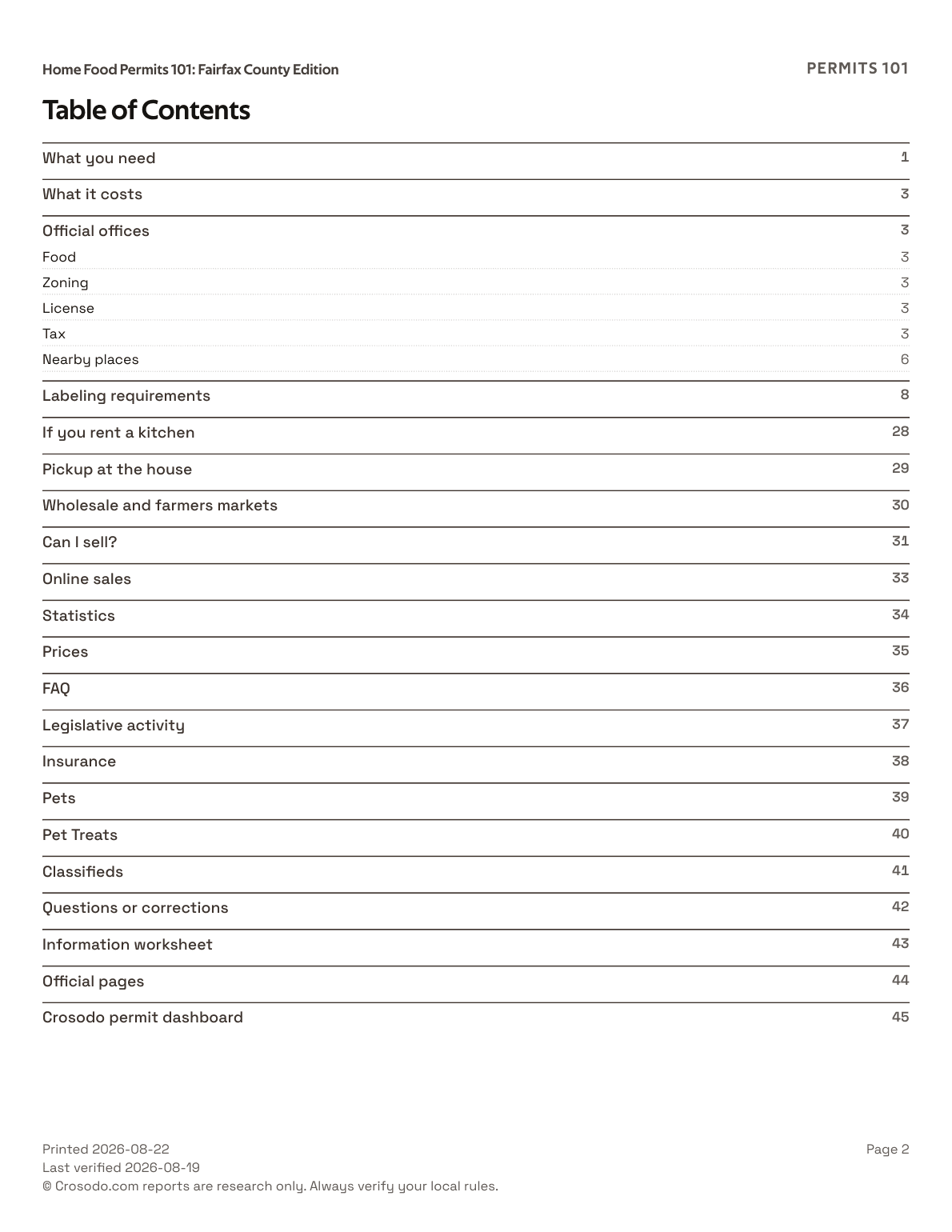
- Full District of Columbia statute text with key provisions and official citation
- Allowed and prohibited foods, labeling rules, sales cap (None)
- Registration and permit steps with direct state-agency links
- All 1 District of Columbia counties with zoning + health department links
- 13-page guide with every official source URL, licensed to your address
What exactly am I buying?
The complete District of Columbia License & Permit Guide — not the free 2-page preview above.
How do I receive it?
Stripe checkout. We email a cover letter, paid receipt, and the guide (PDF) licensed to your address.
Is it current?
Every report lists its official sources so you can verify against the current statute. See also the research-verified District of Columbia guide.
Not ready? Get free District of Columbia cottage-food updates instead.
Code of the District of Columbia §7-742.02 (Cottage food businesses); implementing Cottage Food Amendment Act of 2013 (D.C. Law 20-63)
Verbatim Excerpt(b)(1) A cottage food business shall register with the Cottage Food Business Registry within the Department before beginning operation. (2) The Department may perform an inspection of the cottage food business before that business may sell its cottage food products. (3) The Department shall issue a cottage food business identification number and certificate to each registered cottage food business. Upon receipt of a cottage food business identification number and certificate, the cottage food business shall be authorized to produce, package, and sell the temperature control for safety food products on the approved food products list issued by the Department, set forth in section 103.5 of Title 25-K of the District of Columbia Municipal Regulations (25-K DCMR 103.5). The cottage food business shall not produce, package, or sell any food products that are not allowed by the Department nor use any processes and activities that are not allowed by the Department. (c) The owner of a cottage food business may sell only cottage food products that are: (1) Stored on the premises of the cottage food business; and (2) Prepackaged with a label that contains the following information: (A) The cottage food business identification number; (B) The name of the cottage food product; (C) The ingredients of the cottage food product in descending order of the amount of each ingredient by weight; (D) The net weight or net volume of the cottage food product; (E) Allergen information as specified by federal labeling requirements; (G) The following statement printed in 10-point or larger type in a color that provides a clear contrast to the background of the label: 'Made by a cottage food business that is not subject to the District of Columbia's food safety regulations.'
Source: code.dccouncil.gov/us/dc/council/code/sections/7-742.02.html →
DC allows most non-potentially hazardous foods including baked goods, candies, condiments (honey, syrups, vinegars), dry goods, pastries, preserves, and snacks. The approved food list is specified in 25-K DCMR 103.5. Products not on the approved list may be submitted for department review with lab testing.
Prohibited items include perishable baked goods, acidified foods, low-acid canned foods, pickles, fruit butters, salsas, sauces, ketchup, mustards, juices, meat jerkies, and pet food. All TCS (time/temperature control for safety) foods are prohibited.
Labels must include the cottage food business identification number, product name, ingredients in descending order by weight, net weight/volume, allergen information per federal requirements, and the statement 'Made by a cottage food business that is not subject to the District of Columbia's food safety regulations' in at least 10-point contrasting type.
None
Okay (IJ Grade D)
1
District of Columbia Counties (1)
Cottage food registration usually happens at the county level. Click any county for local zoning, health department, and planning department links.
Where to verify District of Columbia's rules
Data compiled from primary sources. Cottage food laws change — verify with your state agency before relying on this information.
Cottage food laws are amended every year. This is a starting reference, not legal advice. Verify with DC Department of Healthand your local health department before relying on this data.