
Massachusetts Cottage Food Law PDF 2026 — Full Legal Text + Annotations
Full statute text, allowed foods, registration, sales cap None, and all 14 Massachusetts counties with zoning + health department links. 51-page PDF with official sources. Free preview below — buy the complete guide for $44.
This page shows the first 2 pages + statute excerpt. One-time $44 · Yours to keep · Stripe checkout · Guide (PDF) emailed with receipt.
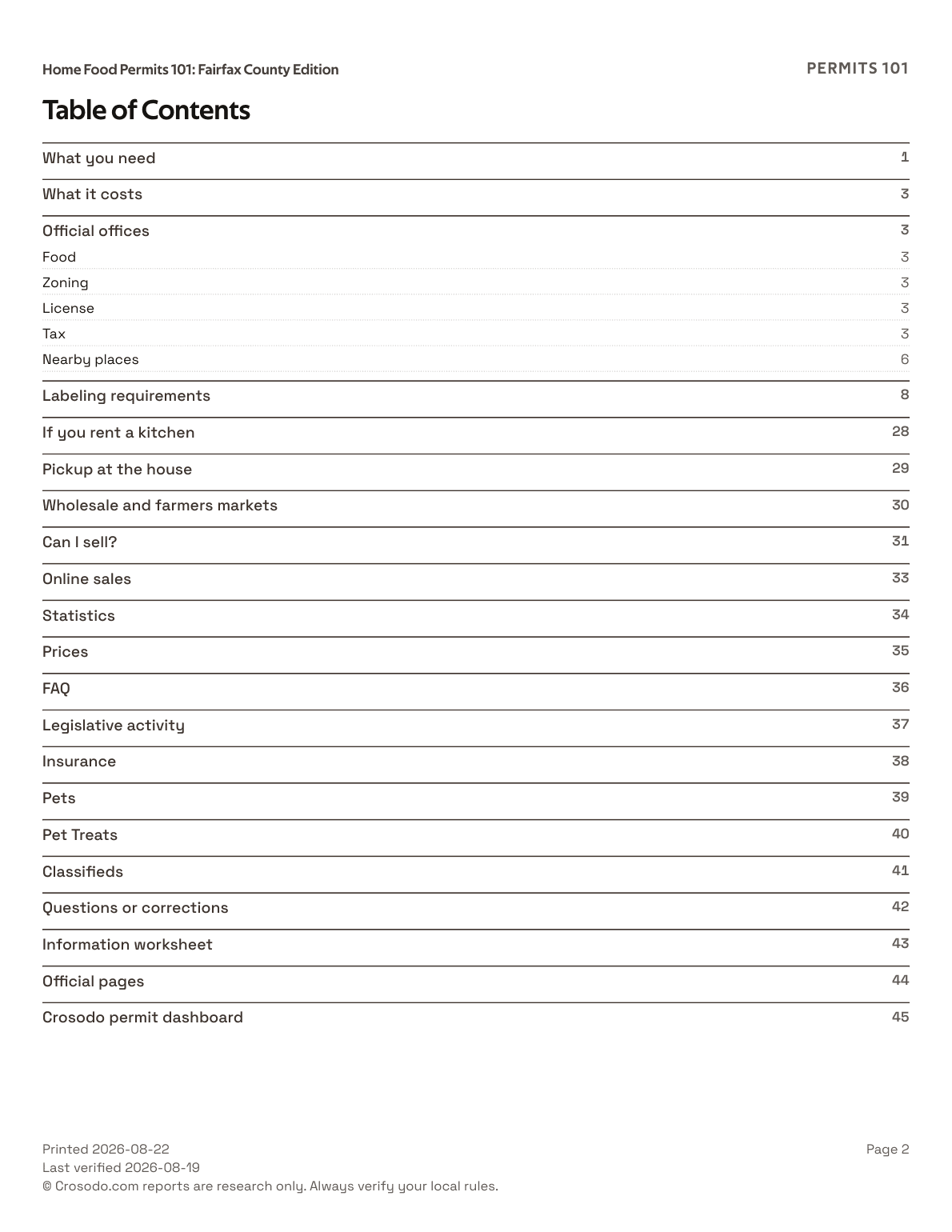
- Full Massachusetts statute text with key provisions and official citation
- Allowed and prohibited foods, labeling rules, sales cap (None)
- Registration and permit steps with direct state-agency links
- All 14 Massachusetts counties with zoning + health department links
- 51-page guide with every official source URL, licensed to your address
What exactly am I buying?
The complete Massachusetts License & Permit Guide — not the free 2-page preview above.
How do I receive it?
Stripe checkout. We email a cover letter, paid receipt, and the guide (PDF) licensed to your address.
Is it current?
Every report lists its official sources so you can verify against the current statute. See also the research-verified Massachusetts guide.
Not ready? Get free Massachusetts cottage-food updates instead.
105 CMR 590.000: State Sanitary Code Chapter X - Minimum Sanitation Standards for Food Establishments, Section 590.009(D)(2)-(3) Residential Kitchens
Verbatim Excerpt105 CMR 590.009 Special Requirements (D)(2) Residential Kitchens: Retail Sale. (a) A food establishment permit shall be required if food is prepared in or distributed from a residential kitchen for retail sale except as exempted under the definition of food establishment in 105 CMR 590.002 and shall comply with the minimum requirements of 105 CMR 590.009(D) as well as the Administration and Enforcement (105 CMR 590.010 through 590.021), except they shall be exempt from 105 CMR 590.043, 'Plan Submission and Approval' in which case only an intended list of food to be prepared or distributed shall be submitted to the board of health with their application for permit. (b) Food Preparation and Protection: Residential Kitchen for Retail Sale. 1. Only non-potentially hazardous foods and foods which do not require refrigeration and a variance in accordance with 105 CMR 590.010(H) shall be prepared in or distributed from a residential kitchen for retail sale to the public except as exempted under the definition of food establishment in 105 CMR 590.002. Ingredients that are potentially hazardous foods, such as milk, cream, and eggs, may be used in food preparation for the public provided that the final product is not a potentially hazardous food. 2. Wholesale operations requiring a food processor registration by the Department shall not be conducted in an establishment holding a residential kitchen permit. 3. Only immediate family members residing in the household may prepare food for retail sale in a residential kitchen.
Source: carlislema.gov/DocumentCenter/View/716 →
Non-potentially hazardous foods that do not require refrigeration, including baked goods (breads, cookies, cakes, cupcakes, macarons, donuts, muffins, pies), candies and confections (including chocolate, fudge, buttercream frosting), jams and jellies, dry goods (cereals, coffee, herbs, spices, tea), snacks (granola, caramel corn, popcorn, nuts), and pastries. Ingredients that are potentially hazardous may be used if the final product is non-PHF.
Potentially hazardous foods requiring refrigeration are prohibited, as are pickles, sauces, fermented foods, and any food requiring a variance. Wholesale operations may not be conducted under a residential kitchen permit. Mail order is prohibited; catering is prohibited.
Labels must include all ingredients in order of amount by volume, a list of allergens, the name of the residential kitchen, address and/or phone number, and a sell-by date if required. Full requirements are governed by 105 CMR 520.000 Massachusetts Labeling Regulations. No specific cottage-food disclaimer statement is required by statute, though local boards of health may impose additional requirements.
None
Okay (IJ Grade C)
14
Massachusetts Counties (14)
Cottage food registration usually happens at the county level. Click any county for local zoning, health department, and planning department links.
Where to verify Massachusetts's rules
Data compiled from primary sources. Cottage food laws change — verify with your state agency before relying on this information.
Cottage food laws are amended every year. This is a starting reference, not legal advice. Verify with Massachusetts Department of Public Healthand your local health department before relying on this data.