
Nebraska Cottage Food Law PDF 2026 — Full Legal Text + Annotations
Full statute text, allowed foods, registration, sales cap None, and all 93 Nebraska counties with zoning + health department links. 211-page PDF with official sources. Free preview below — buy the complete guide for $44.
This page shows the first 2 pages + statute excerpt. One-time $44 · Yours to keep · Stripe checkout · Guide (PDF) emailed with receipt.
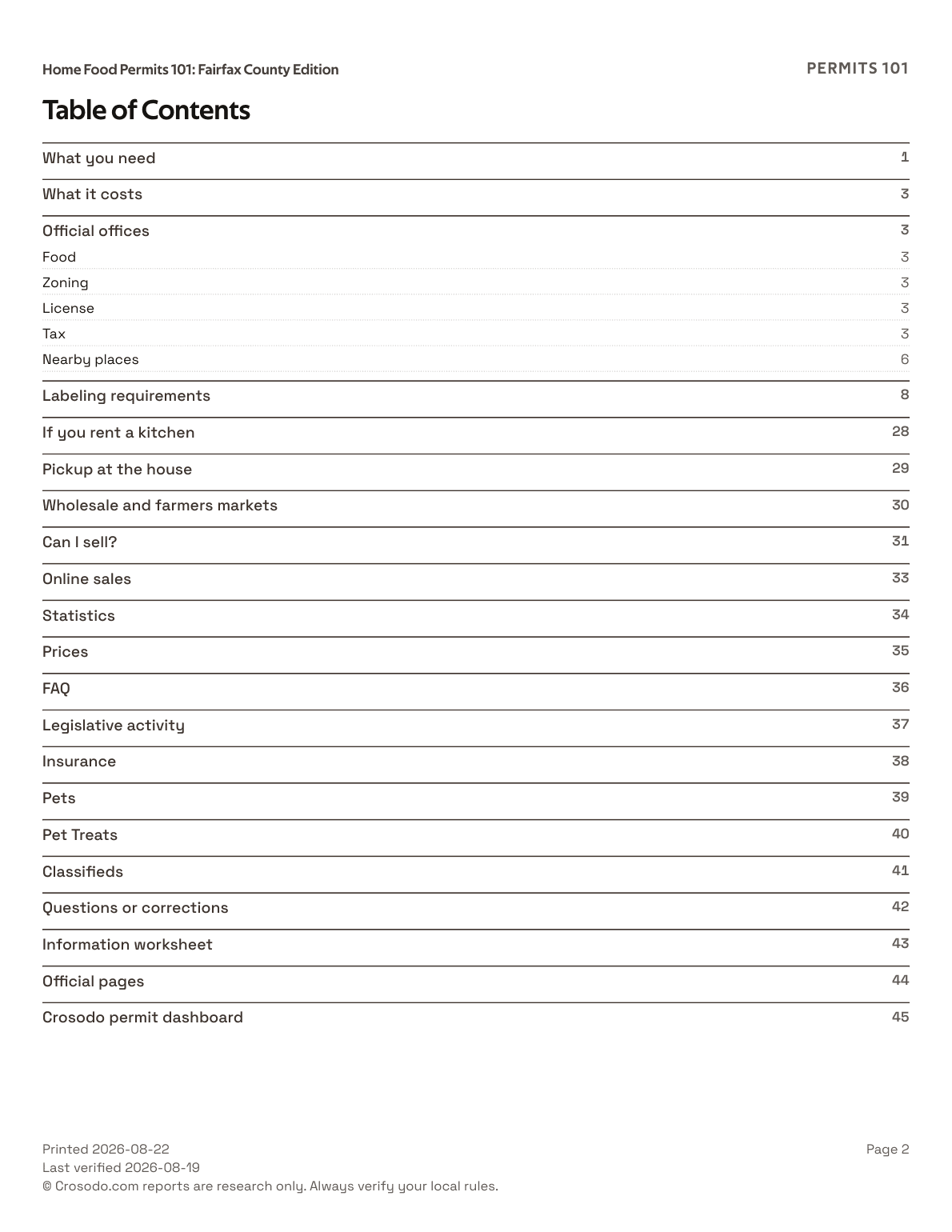
- Full Nebraska statute text with key provisions and official citation
- Allowed and prohibited foods, labeling rules, sales cap (None)
- Registration and permit steps with direct state-agency links
- All 93 Nebraska counties with zoning + health department links
- 211-page guide with every official source URL, licensed to your address
What exactly am I buying?
The complete Nebraska License & Permit Guide — not the free 2-page preview above.
How do I receive it?
Stripe checkout. We email a cover letter, paid receipt, and the guide (PDF) licensed to your address.
Is it current?
Every report lists its official sources so you can verify against the current statute. See also the research-verified Nebraska guide.
Not ready? Get free Nebraska cottage-food updates instead.
Nebraska Revised Statutes Chapter 81, Section 81-2,280 — Producer of Food at Private Home; Requirements; Registration; Contents (Nebraska Pure Food Act)
Verbatim Excerpt81-2,280. Producer of food at private home; requirements; registration; contents. (1) A producer of food at a private home as described in subdivision (7) of section 81-2,245.01 shall meet the requirements of this section. (2) Such producer shall only provide food that is not adulterated and is not any of the following types of time/temperature control for safety food: (a) Any part of an animal, vertebrate or invertebrate, or animal by-product; (b) Fluid milk or milk products as defined in the Grade A Pasteurized Milk Ordinance adopted by reference in the Nebraska Milk Act; (c) Raw eggs; (d) Unpasteurized juice; (e) Infused oils or honey; (f) Sprouts; (g) Low-acid canned food and hermetically sealed acidified food; (h) Tofu, tempeh, or similar meat substitutes; or (i) Kimchi, kombucha, or similar fermented foods. (3) Prior to conducting any food sales, the producer, other than a producer selling food that is not time/temperature control for safety food directly to the consumer at a farmers market, shall successfully complete a nationally accredited food safety and handling education course. (4) The producer shall register with the department prior to conducting any sales of food. (5)(a) The producer shall inform the consumer by a clearly visible notification that the food was prepared in a kitchen that is not subject to regulation and inspection by a regulatory authority; and may contain allergens. (6) The producer shall label the food so that the name and address of the producer is provided to the consumer on the package or container label. (8) The provisions of this section supersede and preempt any ordinance, rule, regulation, or resolution regulating food safety and handling adopted or enacted by a political subdivision that is not in conformance with this section.
Source: nebraskalegislature.gov/laws/statutes.php?statute=81-2%2C280 →
Non-time/temperature-control-for-safety (non-TCS) foods prepared in a private home may be sold directly to consumers at farmers markets, fairs, festivals, craft shows, and other public events, or via home pickup and delivery. As of LB262 (effective July 19, 2024), some TCS foods are also permitted with additional handling requirements. There is no annual sales cap.
TCS foods with the greatest risk are prohibited: animal parts, raw milk products, raw eggs, unpasteurized juice, infused oils or honey, sprouts, low-acid canned/hermetically sealed acidified foods, tofu/tempeh, and kimchi/kombucha. Wholesale to restaurants or grocery stores is not allowed under this framework.
Labels must include the producer's name and address on every package or container. TCS foods must additionally list ingredients in descending order of predominance. A clearly visible notification must inform consumers that the food was prepared in a kitchen not subject to regulation/inspection and may contain allergens.
None
Good (IJ Grade B-)
93
Nebraska Counties (93)
Cottage food registration usually happens at the county level. Click any county for local zoning, health department, and planning department links.
Where to verify Nebraska's rules
Data compiled from primary sources. Cottage food laws change — verify with your state agency before relying on this information.
Cottage food laws are amended every year. This is a starting reference, not legal advice. Verify with Nebraska Department of Agricultureand your local health department before relying on this data.