
Nevada Cottage Food Law PDF 2026 — Full Legal Text + Annotations
Full statute text, allowed foods, registration, sales cap 35000, and all 17 Nevada counties with zoning + health department links. 52-page PDF with official sources. Free preview below — buy the complete guide for $44.
This page shows the first 2 pages + statute excerpt. One-time $44 · Yours to keep · Stripe checkout · Guide (PDF) emailed with receipt.
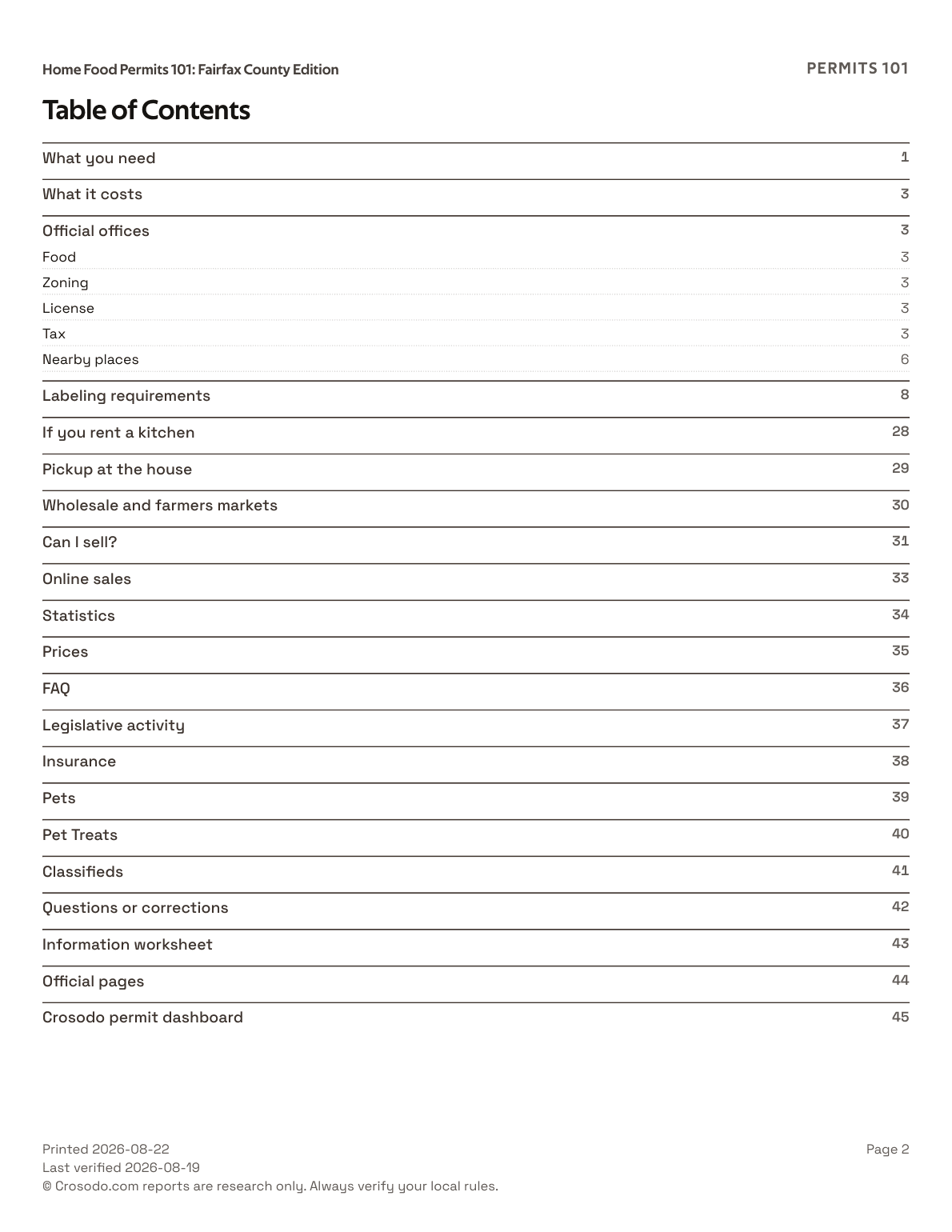
- Full Nevada statute text with key provisions and official citation
- Allowed and prohibited foods, labeling rules, sales cap (35000)
- Registration and permit steps with direct state-agency links
- All 17 Nevada counties with zoning + health department links
- 52-page guide with every official source URL, licensed to your address
What exactly am I buying?
The complete Nevada License & Permit Guide — not the free 2-page preview above.
How do I receive it?
Stripe checkout. We email a cover letter, paid receipt, and the guide (PDF) licensed to your address.
Is it current?
Every report lists its official sources so you can verify against the current statute. See also the research-verified Nevada guide.
Not ready? Get free Nevada cottage-food updates instead.
Nevada Revised Statutes Chapter 446 — Food Establishments, Section 446.866: Exemption from certain requirements; certain local governing bodies prevented from prohibiting cottage food operations; registration; fee; inspection. [Repealed 2025 — see AB352, Statutes of Nevada 2025, chapters 420 and 512]
Verbatim ExcerptNRS 446.866 Exemption from certain requirements; certain local governing bodies prevented from prohibiting cottage food operations; registration; fee; inspection. 1. A cottage food operation which manufactures or prepares a food item by any manner or means whatsoever for sale, or which offers or displays a food item for sale, is not a "food establishment" pursuant to paragraph (h) of subsection 2 of NRS 446.020 if each such food item is: (a) Sold on the private property of the natural person who manufactures or prepares the food item or at a location where the natural person who manufactures or prepares the food item sells the food item directly to a consumer, including, without limitation, a farmers' market licensed pursuant to chapter 244 or 268 of NRS, flea market, swap meet, church bazaar, garage sale or craft fair, by means of an in-person transaction that does not involve selling the food item by telephone or via the Internet; (b) Sold to a natural person for his or her consumption and not for resale; (c) Affixed with a label which complies with the federal labeling requirements set forth in 21 U.S.C. §343(w) and 9 C.F.R. Part 317 and 21 C.F.R. Part 101; (d) Labeled with "MADE IN A COTTAGE FOOD OPERATION THAT IS NOT SUBJECT TO GOVERNMENT FOOD SAFETY INSPECTION" printed prominently on the label for the food item; (e) Prepackaged in a manner that protects the food item from contamination during transport, display, sale, and acquisition by consumers; and (f) Prepared and processed in the kitchen of the private home of the natural person who manufactures or prepares the food item or, if allowed by the health authority, in the kitchen of a fraternal or social clubhouse, a school or a religious, charitable, or other nonprofit organization.
Source: dpbh.nv.gov/mpd-home/cottage-food-registration-home/dta/environmental-health-cottage-food-registration-faq →
Non-potentially-hazardous foods prepared in the kitchen of the operator's primary private home (or approved nonprofit kitchen) may be sold directly to consumers in person. Under the pre-2025 law, allowed items included baked goods, candy, jams, dried foods, and other non-TCS foods. AB352 (2025) expands the definition to include certain acidified foods and raises the sales cap to $100,000; the new law also allows phone and internet sales with in-person or mail/delivery service fulfillment.
Potentially hazardous foods (time/temperature control for safety foods) are prohibited under the cottage food framework. Under the pre-2025 law, online and phone sales were prohibited (in-person only). The operation must be run by a natural person (not an organization). Products cannot be sold wholesale to distributors, retailers, or restaurants.
Labels must comply with federal labeling requirements (21 U.S.C. §343(w), 9 C.F.R. Part 317, 21 C.F.R. Part 101) and must prominently state: 'MADE IN A COTTAGE FOOD OPERATION THAT IS NOT SUBJECT TO GOVERNMENT FOOD SAFETY INSPECTION.' Labels must also include the product name, ingredient list in descending order by weight (with sub-ingredients), allergen information, and the name and physical address of the producer.
35000
Okay (IJ Grade C-)
17
Nevada Counties (17)
Cottage food registration usually happens at the county level. Click any county for local zoning, health department, and planning department links.
Where to verify Nevada's rules
Data compiled from primary sources. Cottage food laws change — verify with your state agency before relying on this information.
Cottage food laws are amended every year. This is a starting reference, not legal advice. Verify with Nevada Division of Public and Behavioral Healthand your local health department before relying on this data.