
Pennsylvania Cottage Food Law PDF 2026 — Full Legal Text + Annotations
Full statute text, allowed foods, registration, sales cap None, and all 67 Pennsylvania counties with zoning + health department links. 200-page PDF with official sources. Free preview below — buy the complete guide for $44.
This page shows the first 2 pages + statute excerpt. One-time $44 · Yours to keep · Stripe checkout · Guide (PDF) emailed with receipt.
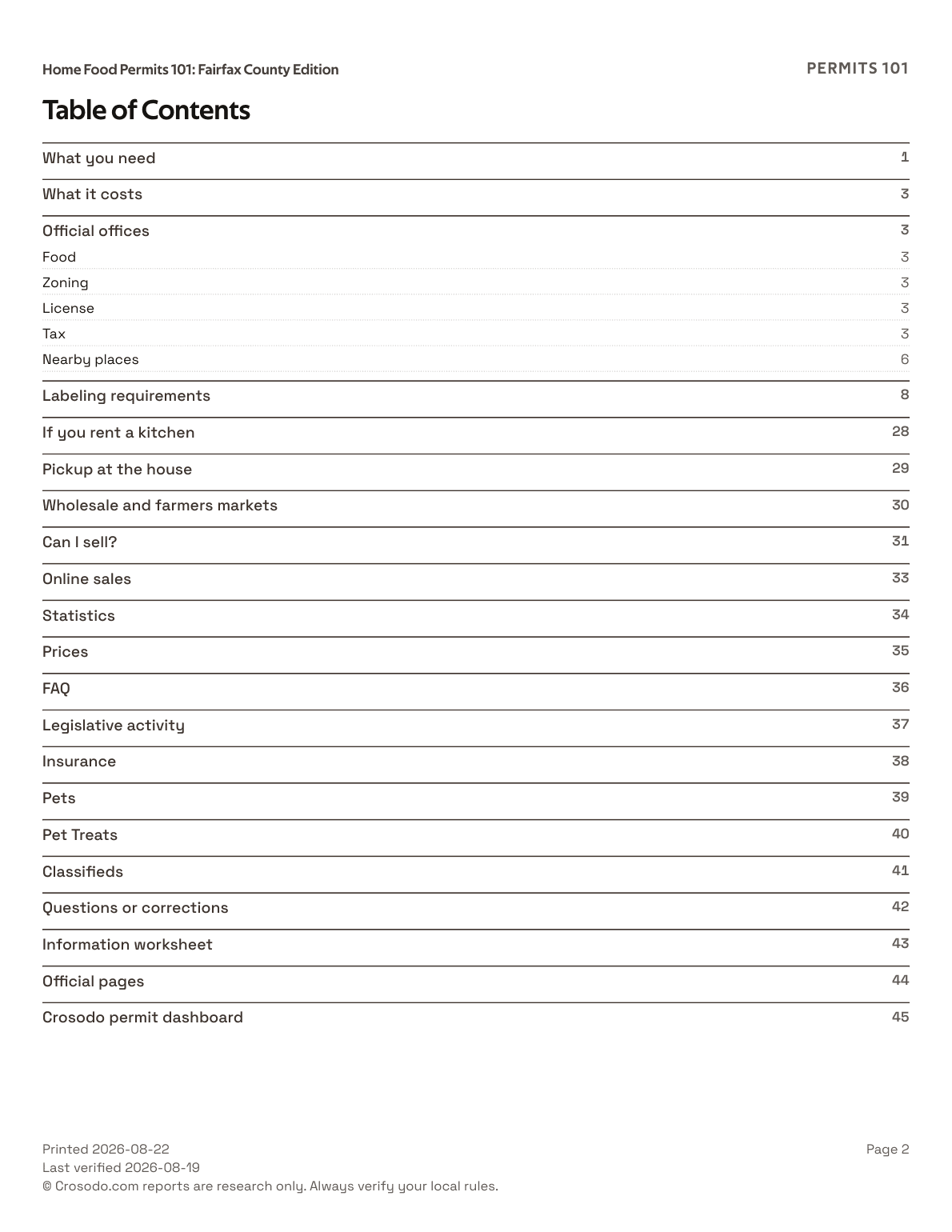
- Full Pennsylvania statute text with key provisions and official citation
- Allowed and prohibited foods, labeling rules, sales cap (None)
- Registration and permit steps with direct state-agency links
- All 67 Pennsylvania counties with zoning + health department links
- 200-page guide with every official source URL, licensed to your address
What exactly am I buying?
The complete Pennsylvania License & Permit Guide — not the free 2-page preview above.
How do I receive it?
Stripe checkout. We email a cover letter, paid receipt, and the guide (PDF) licensed to your address.
Is it current?
Every report lists its official sources so you can verify against the current statute. See also the research-verified Pennsylvania guide.
Not ready? Get free Pennsylvania cottage-food updates instead.
Pennsylvania Consolidated Statutes, Title 3 – Agriculture, Chapter 57 – Food Protection, Subchapter B – Food Safety, Sections 5721–5737 (Food Safety Act)
Verbatim ExcerptAccording to the Pennsylvania Department of Agriculture's Limited Food Establishment Application Packet (Rev 3/2024): "According to the Food Safety Act (3 Pa.C.S.A. §§5721 – 5737) '…it shall be the duty of every person operating a food establishment within this Commonwealth to register…'" The Limited Food Establishment program registers home-based and noncommercial food production sites that meet specific guidelines. In this program, we refer to 'limited food processors' or 'residential-style kitchens' as any kitchen meant for home use, regardless of location. These kitchens can only make non-hazardous foods that do not require refrigeration of the finished product. Given the restrictions and possible testing for home kitchens, close monitoring is essential. Registration involves inspection of the food production site on a routine basis by the Department. Registration includes sales direct from the production site including internet sales; however, businesses aiming to sell across state lines might also need FDA registration. A Retail Food Facility License may also be required for sales at an event or Farmer's Market. *This registration is not permitted in Philadelphia County.
Source: pa.gov/agencies/pda/food/food-safety/limited-food-establishment-.html →
Non-potentially hazardous (non-TCS) foods that do not require refrigeration of the finished product are allowed, including baked goods, jams and jellies, beverages and drinks, acid/acidified/fermented foods (with specific testing requirements), candy, and other shelf-stable foods. Each food category has specific requirements detailed in the application packet.
Any food that requires refrigeration (temperature control) for the finished product is prohibited under the Limited Food Establishment registration. Low-acid canned foods (LACF) have additional requirements. Meat, poultry, and dairy products are generally not permitted without additional licensing. The program is not available in Philadelphia County.
Labeling must comply with applicable federal and state requirements. Products must include product name, manufacturer/packer/distributor name and address, net weight or volume, ingredient list, and lot dates or numbers. Products must be properly labeled prior to sale. Specific commodity requirements for baked goods, jams and jellies, beverages, canned foods, and candy are detailed in the application packet.
None
Good (IJ Grade B)
67
Pennsylvania Counties (67)
Cottage food registration usually happens at the county level. Click any county for local zoning, health department, and planning department links.
Where to verify Pennsylvania's rules
Data compiled from primary sources. Cottage food laws change — verify with your state agency before relying on this information.
Cottage food laws are amended every year. This is a starting reference, not legal advice. Verify with Pennsylvania Department of Agricultureand your local health department before relying on this data.