
South Dakota Cottage Food Law PDF 2026 — Full Legal Text + Annotations
Full statute text, allowed foods, registration, sales cap None, and all 66 South Dakota counties with zoning + health department links. 211-page PDF with official sources. Free preview below — buy the complete guide for $44.
This page shows the first 2 pages + statute excerpt. One-time $44 · Yours to keep · Stripe checkout · Guide (PDF) emailed with receipt.
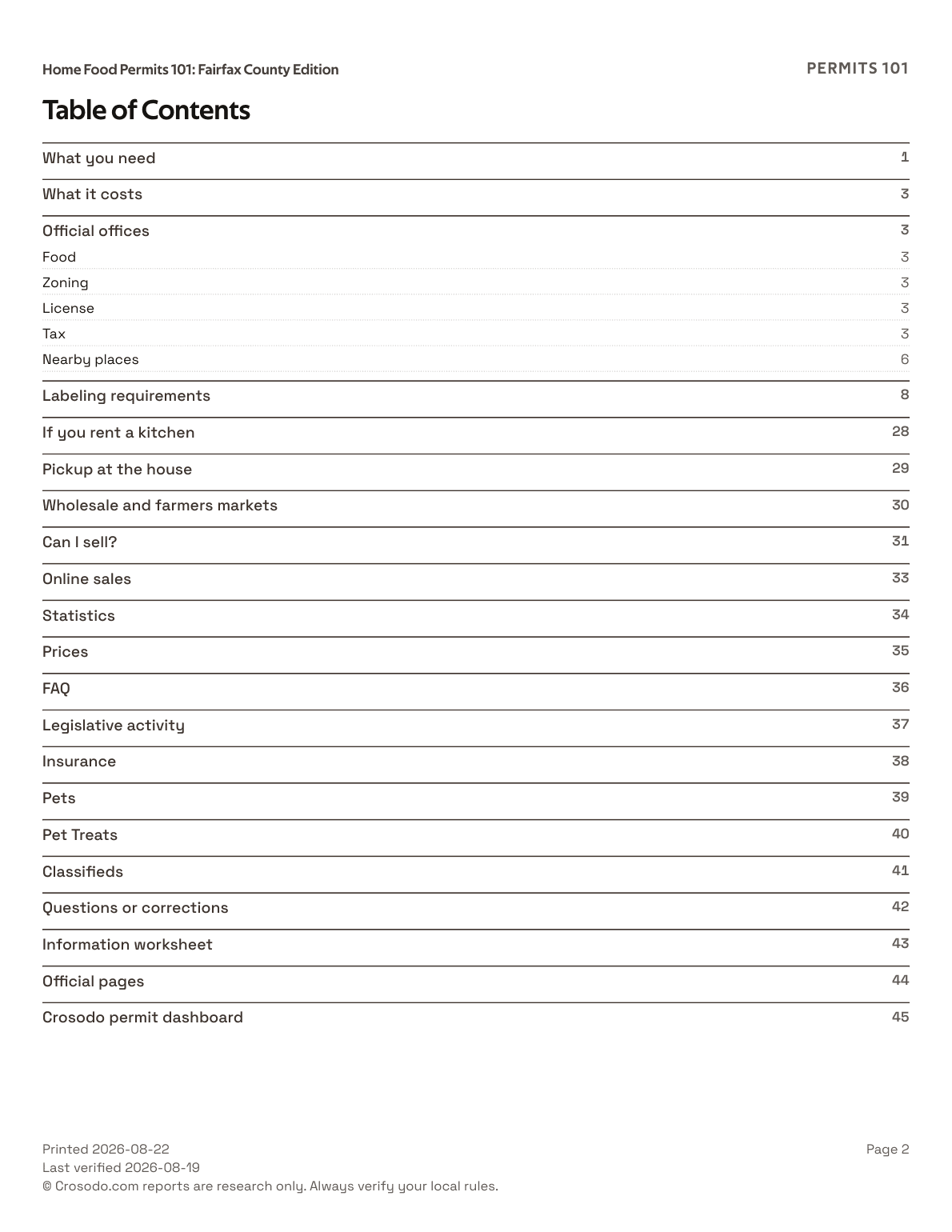
- Full South Dakota statute text with key provisions and official citation
- Allowed and prohibited foods, labeling rules, sales cap (None)
- Registration and permit steps with direct state-agency links
- All 66 South Dakota counties with zoning + health department links
- 211-page guide with every official source URL, licensed to your address
What exactly am I buying?
The complete South Dakota License & Permit Guide — not the free 2-page preview above.
How do I receive it?
Stripe checkout. We email a cover letter, paid receipt, and the guide (PDF) licensed to your address.
Is it current?
Every report lists its official sources so you can verify against the current statute. See also the research-verified South Dakota guide.
Not ready? Get free South Dakota cottage-food updates instead.
South Dakota Codified Laws, Title 34 – Public Health and Safety, Chapter 18 – Health Regulation of Lodging and Food Service Establishments and Campgrounds, Section 34-18-35 (Sale of Homemade Foods and Food Products)
Verbatim Excerpt34-18-35. Sale of homemade foods and food products. Except as otherwise provided in §34-18-38, the licensure provisions of this chapter do not apply to a person selling: (1) Non-temperature-controlled food prepared at a residence; (2) Home-processed canned goods; (3) Baked goods prepared at a residence; or (4) Any food product prepared at a residence and authorized under §34-18-36 or 34-18-36.1. Source: SL 2010, ch 172, §2; SL 2022, ch 106, §1. [Adjacent section:] 34-18-36. Canned goods––Requirements. No canned good may be sold unless the pH level is 4.6 or less or the water activity level is .85 or less. Except as otherwise provided in this section, a producer selling canned goods under this section shall, every five years, complete food safety training approved by the department. The training must be available online. The producer shall retain records verifying the timely completion of such training. A producer selling home-processed goods under this section may, in lieu of the requirement for food safety training, maintain verification of each recipe from a third-party processing authority. The third-party processing authority must have knowledge of the thermal processing required of food in hermetically-sealed containers and shall verify the method of processing and that the pH or water activity threshold levels are met. The processing authority shall provide verification in writing to the producer. Source: SL 2010, ch 172, §3; SL 2022, ch 106, §2.
Source: law.justia.com/codes/south-dakota/title-34/chapter-18/section-34-18-35/ →
Non-temperature-controlled foods prepared at a residence, home-processed canned goods, and baked goods prepared at a residence are all exempt from licensure. The 2022 amendment expanded allowed products beyond the prior baked-goods-only scope. Each individual involved in production of certain home-canned goods must complete a state-certified online training once every five years.
Temperature-controlled (refrigerated or hot-held) foods not covered by the statutory exemptions are not permitted without a license. The Department of Health must approve certain products under §34-18-36 and §34-18-36.1. Alcoholic beverages and meat/poultry subject to USDA inspection are generally excluded.
No specific labeling requirements are mandated in the core cottage food statute. However, for certain home-canned goods processed under §34-18-36, labeling may be required. Standard FDA labeling recommendations apply as best practices. Sales are subject to applicable sales tax.
None
Good (IJ Grade B)
66
South Dakota Counties (66)
Cottage food registration usually happens at the county level. Click any county for local zoning, health department, and planning department links.
Where to verify South Dakota's rules
Data compiled from primary sources. Cottage food laws change — verify with your state agency before relying on this information.
Cottage food laws are amended every year. This is a starting reference, not legal advice. Verify with South Dakota Department of Healthand your local health department before relying on this data.