
Illinois Cottage Food Law PDF 2026 — Full Legal Text + Annotations
Full statute text, allowed foods, registration, sales cap None, and all 102 Illinois counties with zoning + health department links. 289-page PDF with official sources. Free preview below — buy the complete guide for $44.
This page shows the first 2 pages + statute excerpt. One-time $44 · Yours to keep · Stripe checkout · Guide (PDF) emailed with receipt.
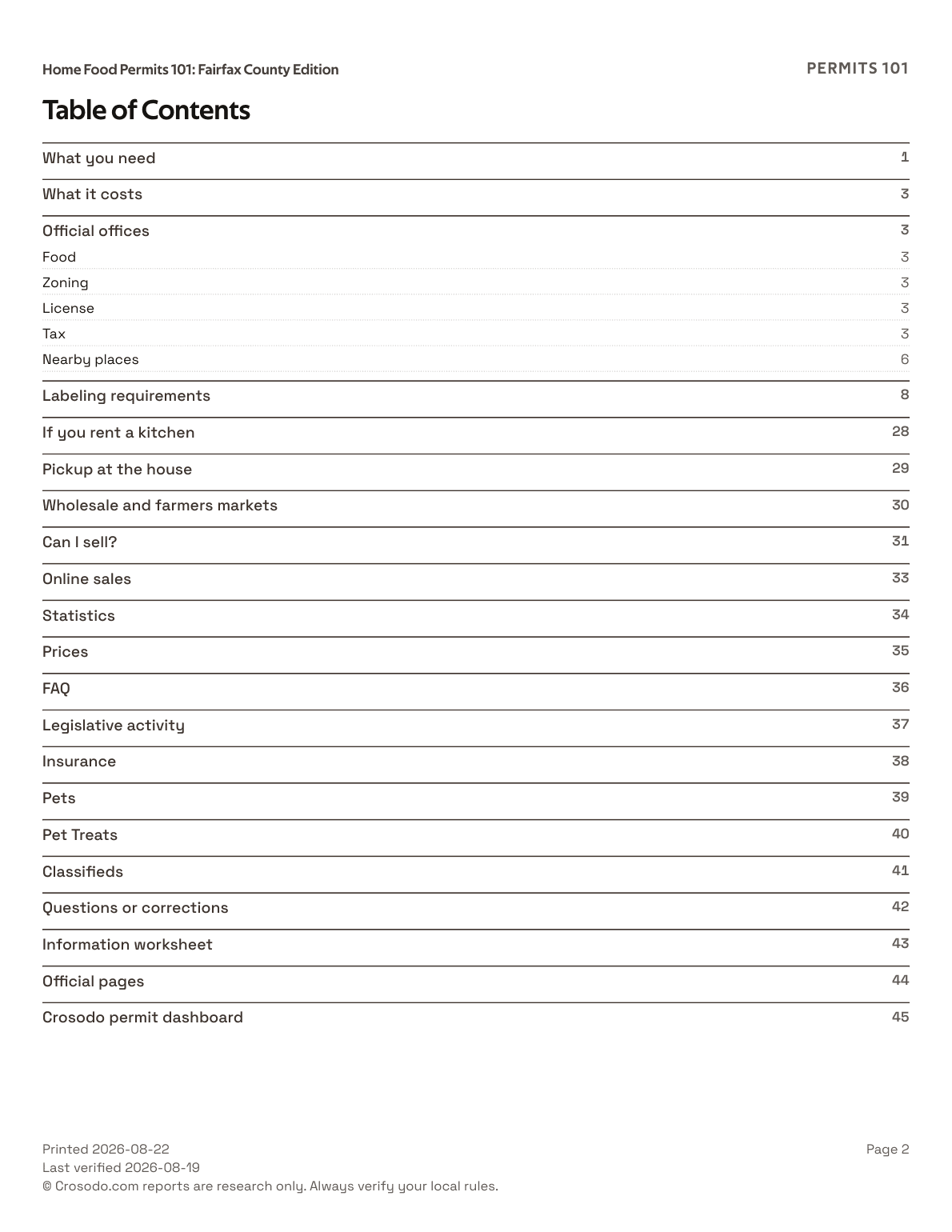
- Full Illinois statute text with key provisions and official citation
- Allowed and prohibited foods, labeling rules, sales cap (None)
- Registration and permit steps with direct state-agency links
- All 102 Illinois counties with zoning + health department links
- 289-page guide with every official source URL, licensed to your address
What exactly am I buying?
The complete Illinois License & Permit Guide — not the free 2-page preview above.
How do I receive it?
Stripe checkout. We email a cover letter, paid receipt, and the guide (PDF) licensed to your address.
Is it current?
Every report lists its official sources so you can verify against the current statute. See also the research-verified Illinois guide.
Not ready? Get free Illinois cottage-food updates instead.
Illinois Compiled Statutes 410 ILCS 625/4, Food Handling Regulation Enforcement Act, Section 4 (Cottage food operation); as amended by Public Act 102-0633 (SB 2007, eff. January 2022) and Public Act 103-0903 (SB 2617, eff. January 2025)
Verbatim Excerpt(410 ILCS 625/4) Sec. 4. Cottage food operation. (a) For the purpose of this Section: 'Cottage food operation' means an operation conducted by a person who produces or packages food or drink, other than foods and drinks listed as prohibited in paragraph (1.5) of subsection (b) of this Section, in a kitchen located in that person's primary domestic residence or another appropriately designed and equipped kitchen on a farm residential or commercial-style kitchen on that property for direct sale by the owner, a family member, or employee. (b) A cottage food operation may produce homemade food and drink provided that all of the following conditions are met: (1.3) A cottage food operation must register with the local health department for the unit of local government in which it is located, but may sell products outside of the unit of local government where the cottage food operation is located. (1.5) A cottage food operation shall not sell or offer to sell the following food items: (A) meat, poultry, fish, seafood, or shellfish; (B) dairy, except as an ingredient in a non-potentially hazardous baked good or candy; (C) eggs, except as an ingredient in a non-potentially hazardous food; (D) pumpkin pies, sweet potato pies, cheesecakes, custard pies, creme pies, and pastries with potentially hazardous fillings or toppings; (E) garlic in oil or oil infused with garlic, except if acidified; (F) low-acid canned foods; (G) sprouts; (H) cut leafy greens, except dehydrated, acidified, or blanched and frozen; (M) alcoholic beverages; or (N) kombucha.
Source: ilga.gov/Documents/Legislation/PublicActs/102/PDF/102-0633.pdf →
Illinois uses a 'prohibited list' approach — everything not prohibited is allowed, including baked goods, candies, condiments (honey, ketchup, mustards, nut butters, oils, pickles, salsas, sauces, syrups, vinegars), dry goods, pastries, preserves (including acidified foods and fermented foods with extra requirements), snacks, carbonated drinks, extracts, frozen produce, hardboiled eggs, and juices. Many perishable foods are allowed for direct in-state sales but may not be shipped.
Prohibited items include meat/poultry/fish/seafood/shellfish; dairy and eggs except as ingredients in non-PHF baked goods; custard/cream pies with hazardous fillings; garlic in oil (unless acidified); low-acid canned foods; sprouts; raw cut leafy greens; alcoholic beverages; and kombucha. Some items with special requirements (acidified foods, certain canned tomato products) are allowed with additional documentation.
Labels must include the product name, ingredients in descending order by weight, allergen information, net weight/volume, the city/unit of local government name, and the point-of-sale notice: 'This product was produced in a home kitchen not inspected by a health department that may also process common food allergens.' Products must be pre-packaged in the home kitchen; exceptions (e.g., wedding cakes) require local health department approval.
None
Great (IJ Grade B-)
102
Illinois Counties (102)
Cottage food registration usually happens at the county level. Click any county for local zoning, health department, and planning department links.
Where to verify Illinois's rules
Data compiled from primary sources. Cottage food laws change — verify with your state agency before relying on this information.
Cottage food laws are amended every year. This is a starting reference, not legal advice. Verify with Illinois Department of Public Healthand your local health department before relying on this data.