
Illinois cottage food law
Last updated: · Research verified · Full guide $44 lifetime (289 pages)
Tier: Great. No or very high sales cap, broad product list, multiple sales channels including retail and online. Most home bakers can run a meaningful operation here.
Full Illinois License & Permit Guide (289 pages). Statute, every county we have researched, and official source URLs. Stripe checkout. Cover letter, paid receipt, and the guide (PDF) licensed to your address.
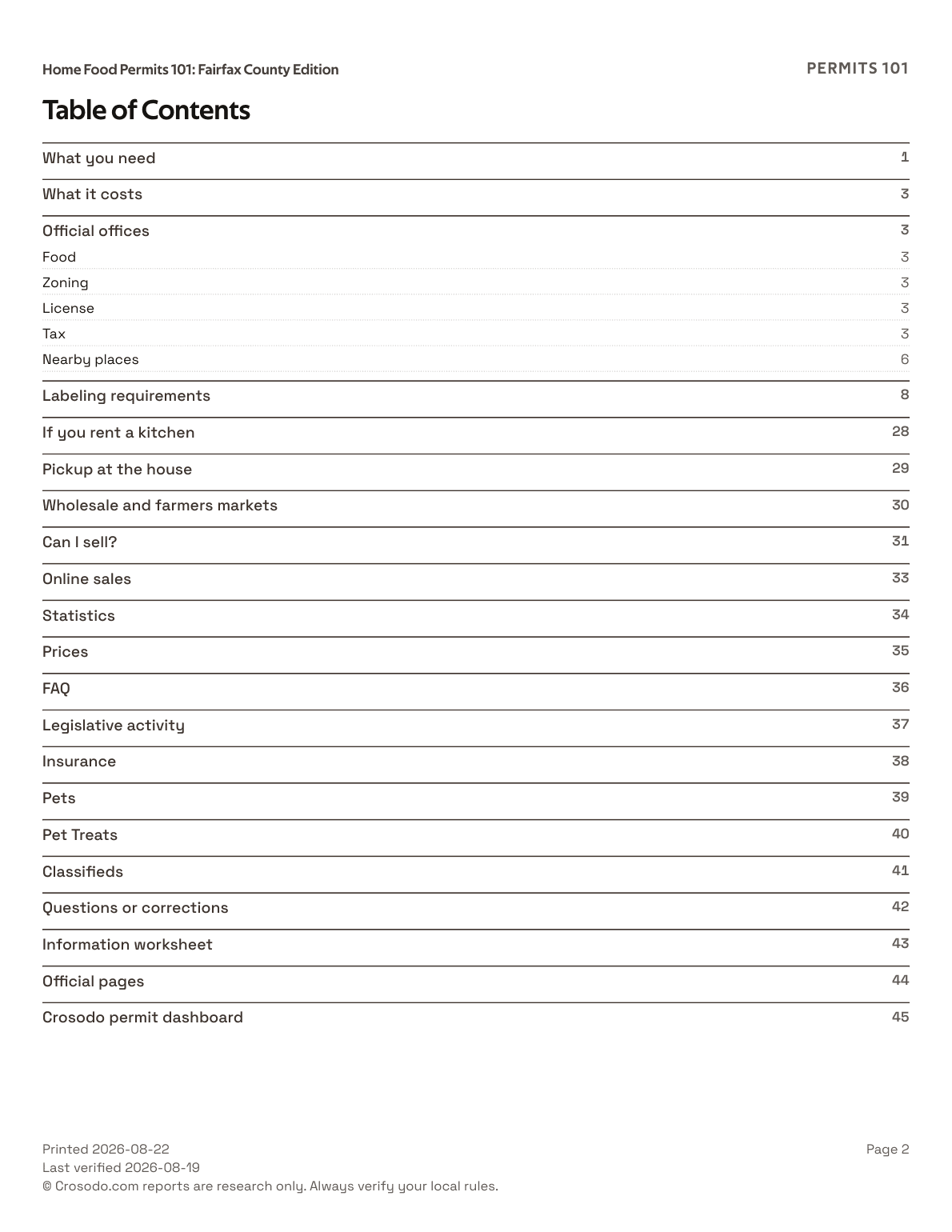
Unlimited Pass. Your journey to getting permitted for cottage food sales. Premium dashboard tools, unlimited state and county reports, and the 50-state label report. Lifetime access. Includes the full Illinois License & Permit Guide (289 pages).
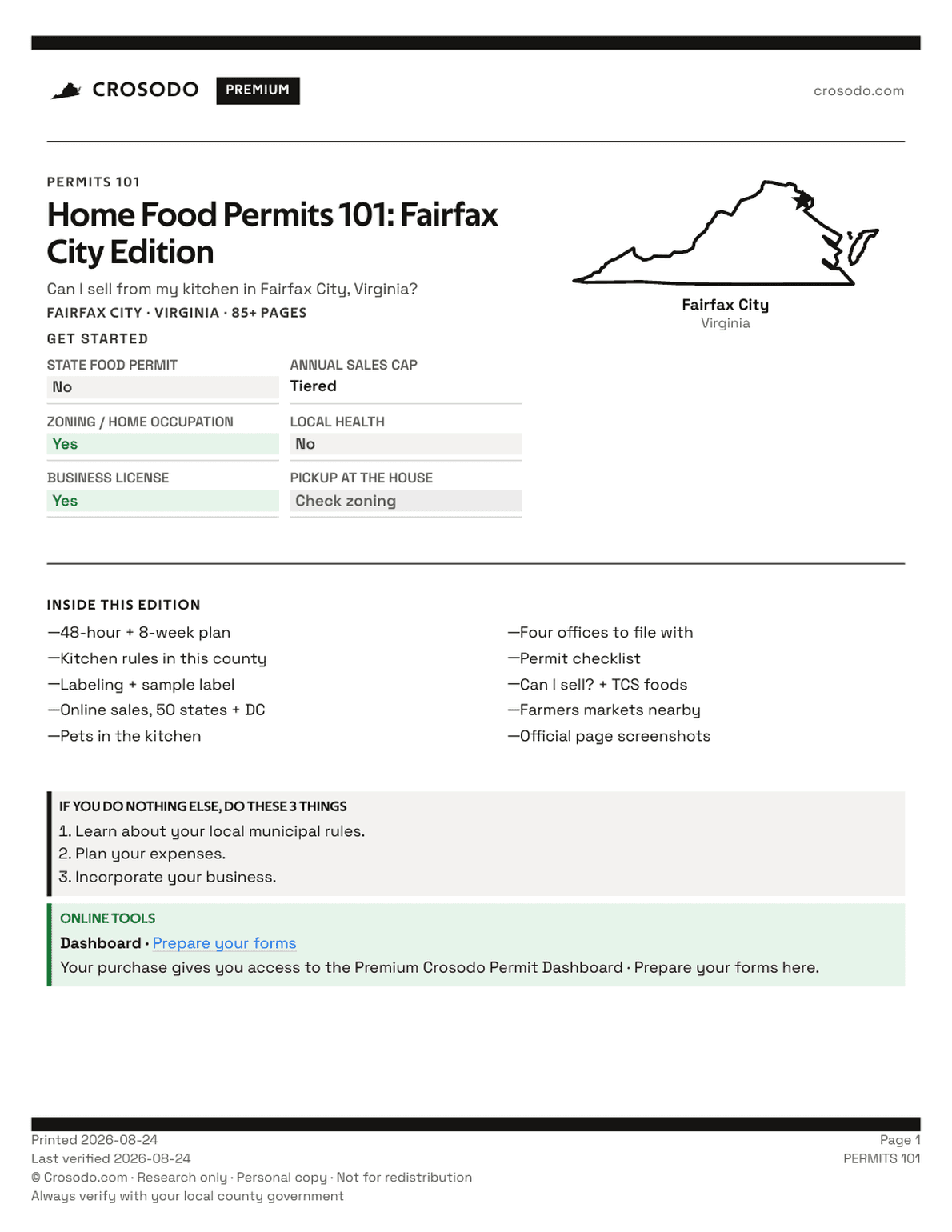
How to start in Illinois
A practical path from “am I allowed?” to first sale. Not legal advice — confirm every step with Illinois agencies and your local offices.
Confirm your products are allowed
Illinois allows Illinois uses a 'prohibited list' approach — everything not prohibited is allowed, including baked goods, candies, condiments (honey, ketchup, mustards, nut butters, oils, pickles, salsas, sauces, syrups, vinegars), dry goods, pastries, preserves (including acidified foods and fermented foods with extra requirements), snacks, carbonated drinks, extracts, frozen produce, hardboiled eggs, and juices. Many perishable foods are allowed for direct in-state sales but may not be shipped.. High-risk or refrigerated foods usually need a commercial kitchen — not a cottage exemption.
Choose sales channels you can actually use
Sales cap: No cap. Indirect / wholesale-style sales: No. Farmers markets and direct-to-consumer pickup are the usual start. Check county and city rules before advertising porch pickup.
Clear local zoning, licenses, and tax IDs
State cottage food rules are the floor. Your city or county may still require a business license, home occupation approval, HOA permission, or sales tax registration. Do this before you print an address on Instagram.
Registration, training, and kitchen rules
State registration: Yes. Food handler / training: Yes (specific course). Kitchen inspection: Upon-complaint. Complete certificates the market or agency will ask for.
Build compliant labels
Use the Illinois label requirements on this site (and the free template). Match disclaimer language to the statute or agency guide before you print a batch.
Soft-launch, then first paid sales
Keep a simple sales log from day one so you stay under any annual cap. Soft-launch with pre-orders before a full market day.
Verify with official sources
Re-check the state cottage food page and your local health / planning office before you invest in equipment or marketing. Rules change.
What usually goes on the package
- Product name (common or usual name of the food)
- Business or producer name
- Producer address (or address alternative your state allows)
- Ingredients in descending order by weight
- Major allergen disclosures (e.g. wheat, milk, eggs, soy, tree nuts, peanuts, fish, shellfish, sesame)
- Net weight or quantity
- Home-kitchen disclaimer: “This product was produced in a home kitchen not inspected by a health department that may also process common food allergens. If you have safety concerns, contact your local health department.”
This is a planning checklist compiled for home bakers. It is not legal, tax, or zoning advice.
Illinois vs neighboring cottage food laws
Tier and sales-cap snapshot for Illinois and nearby states. Click through for full rules, labeling, and county pages.
| State | Tier | Sales cap | Guide |
|---|---|---|---|
| IllinoisYou are here | Great | None | This page |
| Indiana | Great | None | Indiana law → |
| Iowa | Good | None | Iowa law → |
| Kentucky | Okay | 60000 | Kentucky law → |
| Missouri | Great | None | Missouri law → |
| Wisconsin | Freedom | Tiered | Wisconsin law → |
Need a compliant product label for Illinois? Open the Illinois label mockup.
None
Illinois uses a 'prohibited list' approach — everything not prohibited is allowed, including baked goods, candies, condiments (honey, ketchup, mustards, nut butters, oils, pickles, salsas, sauces, syrups, vinegars), dry goods, pastries, preserves (including acidified foods and fermented foods with extra requirements), snacks, carbonated drinks, extracts, frozen produce, hardboiled eggs, and juices. Many perishable foods are allowed for direct in-state sales but may not be shipped.
Registration: Yes. Food handler cert: Yes (specific course).
Illinois Compiled Statutes 410 ILCS 625/4, Food Handling Regulation Enforcement Act, Section 4 (Cottage food operation); as amended by Public Act 102-0633 (SB 2007, eff. January 2022) and Public Act 103-0903 (SB 2617, eff. January 2025)
Verbatim excerpt(410 ILCS 625/4) Sec. 4. Cottage food operation. (a) For the purpose of this Section: 'Cottage food operation' means an operation conducted by a person who produces or packages food or drink, other than foods and drinks listed as prohibited in paragraph (1.5) of subsection (b) of this Section, in a kitchen located in that person's primary domestic residence or another appropriately designed and equipped kitchen on a farm residential or commercial-style kitchen on that property for direct sale by the owner, a family member, or employee. (b) A cottage food operation may produce homemade food and drink provided that all of the following conditions are met: (1.3) A cottage food operation must register with the local health department for the unit of local government in which it is located, but may sell products outside of the unit of local government where the cottage food operation is located. (1.5) A cottage food operation shall not sell or offer to sell the following food items: (A) meat, poultry, fish, seafood, or shellfish; (B) dairy, except as an ingredient in a non-potentially hazardous baked good or candy; (C) eggs, except as an ingredient in a non-potentially hazardous food; (D) pumpkin pies, sweet potato pies, cheesecakes, custard pies, creme pies, and pastries with potentially hazardous fillings or toppings; (E) garlic in oil or oil infused with garlic, except if acidified; (F) low-acid canned foods; (G) sprouts; (H) cut leafy greens, except dehydrated, acidified, or blanched and frozen; (M) alcoholic beverages; or (N) kombucha.
Source: ilga.gov/Documents/Legislation/PublicActs/102/PDF/102-0633.pdf →
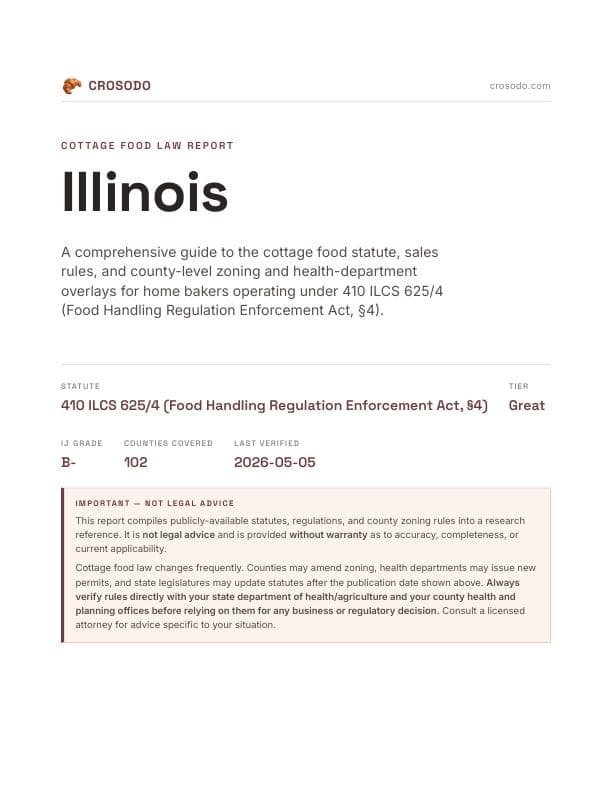
Illinois Cottage Food Law — 289 pages and 102 counties
The long report for this state (289 pages): statute, every county we've researched, and official source URLs. Stripe checkout. We email a cover letter, paid receipt, and the guide (PDF) licensed to your address.
Print Illinois labels for your first market
After the law page, this is the next thing most bakers need: a print-ready mockup with the Illinois home-kitchen disclaimer, allergen line, and net-weight fields.
This product was produced in a home kitchen not inspected by a health department that may also process common food allergens. If you have safety concerns, contact your local health department.
- Product name, producer, and address (or allowed alternative)
- Ingredients by weight and major allergens
- Net weight / quantity
- Illinois home-kitchen / “not inspected” disclaimer
Not legal advice. Verify wording with the state agency before a production print run.
Where to verify Illinois's rules
2024 Cottage Food Guide
Official agency guidance changes without notice. The text below is reproduced for reference only — always confirm current rules on the agency website before relying on it.
- Illinois Department of Public Health (IDPH)https://extension.illinois.edu/sites/default/files/2024-10/cottage_food_guide.pdf
This guide was developed by the Illinois Department of Public Health (IDPH) in partnership with cottage food advocacy groups, local health departments, University of Illinois Extension, cottage food producers, and economic development organizations. The purpose is to support cottage food businesses, grow a thriving cottage food industry in Illinois, and ensure that cottage food products are safe, healthy, and enjoyable for all.
What Is a Cottage Food Operation?
- A Cottage Food Operation means an operation conducted by a person who produces or packages food or drink, other than foods and drinks listed as prohibited in the law, in a kitchen located in that person's primary domestic residence or another appropriately designed and equipped kitchen on a farm for direct sale by the owner, a family member, or employee.
- All sales must be direct-to-customer by the owner, a family member, or an employee listed on the Cottage Food Operator Registration Form. Cottage food products may not be repacked, sold, or distributed by a third party.
- Cottage food operations must be registered as a Cottage Food Operator with their local health department in the county or municipality in which they reside.
- No.
- If you are a farmer, yes. If you are not a farmer, then no. The law is written this way in order to prevent persons from turning outbuildings into storefronts.
Registration
- The fee to register is capped at $50 by law. Your local health department may charge between $0 and $50.
- You must register annually.
- No. Unlike restaurants and retailers, your home kitchen will not be inspected by a local health department upon registration. However, a local health department may inspect your home kitchen if there is cause to believe your products are not safe or not in compliance with the law.
- Registration does not involve an inspection and generally refers to a simpler process. Licensure comes with inspections and a formal process with related costs. A commercial kitchen is a licensed operation.
Prohibited Products
- As of January 1, 2018, all food and drink are permitted, except for what is specifically prohibited in the law:
- Meat, poultry, fish, seafood, or shellfish.
- Dairy, except as an ingredient in a non-potentially hazardous baked good or candy, or as an ingredient in a baked good frosting such as buttercream.
- Eggs, except as an ingredient in a non-potentially hazardous food or as an ingredient in a baked good frosting such as buttercream, if the eggs are not raw.
- Pumpkin pies, sweet potato pies, cheesecakes, custard pies, creme pies, and pastries with potentially hazardous fillings or toppings.
- Garlic in oil or oil infused with garlic, except if the garlic oil is acidified.
- Low-acid canned foods; sprouts; cut leafy greens (except dehydrated, acidified or blanched and frozen); cut or puréed fresh tomato or melon; dehydrated tomato or melon; frozen cut melon; wild-harvested non-cultivated mushrooms; alcoholic beverages; kombucha.
FAQ: Allowed Foods
- Yes, as long as you do not sell your product as a medicine or advertise any health claims.
- No. Kombucha is directly prohibited in the law.
- Yes. Honey is a product regulated under the USDA and not considered a cottage food product.
- Yes, as long as no prohibited ingredients (such as meat, dairy, etc.) are included. For safety, aim for a water activity of 0.85 or less.
FAQ: Sales Avenues
- No. In previous versions of the bill there had been limits, but those no longer apply.
- The Illinois Cottage Food Law only regulates sales within state lines. Products crossing state lines are considered interstate commerce and subject to Federal rules and regulations.
- No. Cottage food laws specifically state "Food and drink produced by a Cottage Food Operation shall be sold directly to consumers for their own consumption and not for resale."
- No. The use of an ingredient in an item that will be sold is considered resale.
- Yes, however, sales may only happen within the state of Illinois. You are not allowed to ship or deliver out of state. You must provide clear signage on your Etsy page that your product was made in a home kitchen not inspected by a health department.
Certified Food Protection Manager (CFPM)
- All cottage food operators, and any person helping to prepare or package food products as part of the cottage food operation, must have completed the Certified Food Protection Manager certification course and passed the exam before the cottage food registration can be approved.
- Look for a course that is ANSI accredited, at least eight hours long, with a proctored exam. The cost of the training varies, but the range is usually between $100 and $300, and is valid for five years.
- NOTE: The food handler training is NOT valid for cottage food operators.
Reproduced from the official IDPH / University of Illinois Extension 2024 Cottage Food Guide. Verify current rules with your local health department.
Illinois Counties
102 counties tracked. Pick yours for the local zoning + health department links.
View all 102 counties →City zoning rules in Illinois
City zoning rules apply on top of the state cottage food law — home occupation, customer pickup, signage, and employees.
Permit Guide 101 — $26
This page is the free Illinois statute. Permit Guide 101 is the paid county packet — pick your county or independent city for the permit stack that is not on this directory page.
Pick your Illinois county
The Cottage Baker's Field Guide (PDF)
A 6-page reference covering all 51 jurisdictions with methodology and tier explainers — same data as this directory, ready to print and tape to your wall.
Download the PDFWas this page helpful?
Illinois cottage food law — FAQ
Do I need a license or permit to sell homemade food in Illinois?
Yes — Yes. Food handler certification: Yes (specific course).
What foods can I sell under the Illinois cottage food law?
Illinois uses a 'prohibited list' approach — everything not prohibited is allowed, including baked goods, candies, condiments (honey, ketchup, mustards, nut butters, oils, pickles, salsas, sauces, syrups, vinegars), dry goods, pastries, preserves (including acidified foods and fermented foods with extra requirements), snacks, carbonated drinks, extracts, frozen produce, hardboiled eggs, and juices. Many perishable foods are allowed for direct in-state sales but may not be shipped.
Is there a sales cap for cottage food in Illinois?
None
How good is Illinois's cottage food law?
Illinois is a Great-tier cottage food state by Crosodo's rating criteria. No or very high sales cap, broad product list, multiple sales channels including retail and online. Most home bakers can run a meaningful operation here.
Keep exploring Illinois
Labels, product checks, county zoning, and local discuss — so one state page becomes a full readiness plan.
Market-day tees from the Crosodo collection — for the craft, not the algorithm.
What bakers ask about Illinois
Seed threads for markets, zoning, and labels — join the channel or ask the directory.
Farmers market process in Illinois?
Which markets welcome cottage bakers, what they charge, and label checks on day one.
Good label printers in Illinois?
Local print shops or home setups that handle home-kitchen disclaimers cleanly.
Zoning experience in Illinois counties?
Home occupation, pickup traffic, signage — what did your planning office actually require?
How I got legal in Illinois
Registration portal tips, food handler cert, and the county step nobody publishes.
Illinois label wording that passed review
Share real labels (blur personal info) and any county extras beyond the state minimum.
You might like these too
While you're deep in Illinois rules — vintage-varsity tees for booth days and bake nights.

Resources for cottage food and home bakers
Supplies, courses, insurance, farmers markets, kitchen rentals, and local services. To advertise here, visit crosodo.com/advertise. Browse all classifieds.
Advertise here
Packaging, labels, baking tools, bulk ingredients, and equipment for cottage food operators. Reach home bakers across the country.
crosodo.com/advertiseAdvertise here
Baking classes, cottage food business training, workshops, and food safety education. Reach home bakers across the country.
crosodo.com/advertiseAdvertise here
Product liability, home bakery, market vendor, and small food business insurance. Reach home bakers across the country.
crosodo.com/advertiseAdvertise in Illinois
Reach home bakers in Illinois. Supply stores, farmers markets, kitchen rentals, co-packer referrals, and bakery services are welcome.
Learn about placementsYour business here
Local cottage food listings, community kitchens, farmers market dates, and non-profit events can be submitted for review.
Submit a community listingAds are paid placements. Crosodo does not endorse listed vendors. Verify all product, service, course, insurance, and legal information independently.
Cottage food laws are amended every year. This is a starting reference, not legal advice. Verify with Illinois Department of Public Health and your local health department before relying on this data.