
Kansas Cottage Food Law PDF 2026 — Full Legal Text + Annotations
Full statute text, allowed foods, registration, sales cap None, and all 105 Kansas counties with zoning + health department links. 275-page PDF with official sources. Free preview below — buy the complete guide for $44.
This page shows the first 2 pages + statute excerpt. One-time $44 · Yours to keep · Stripe checkout · Guide (PDF) emailed with receipt.
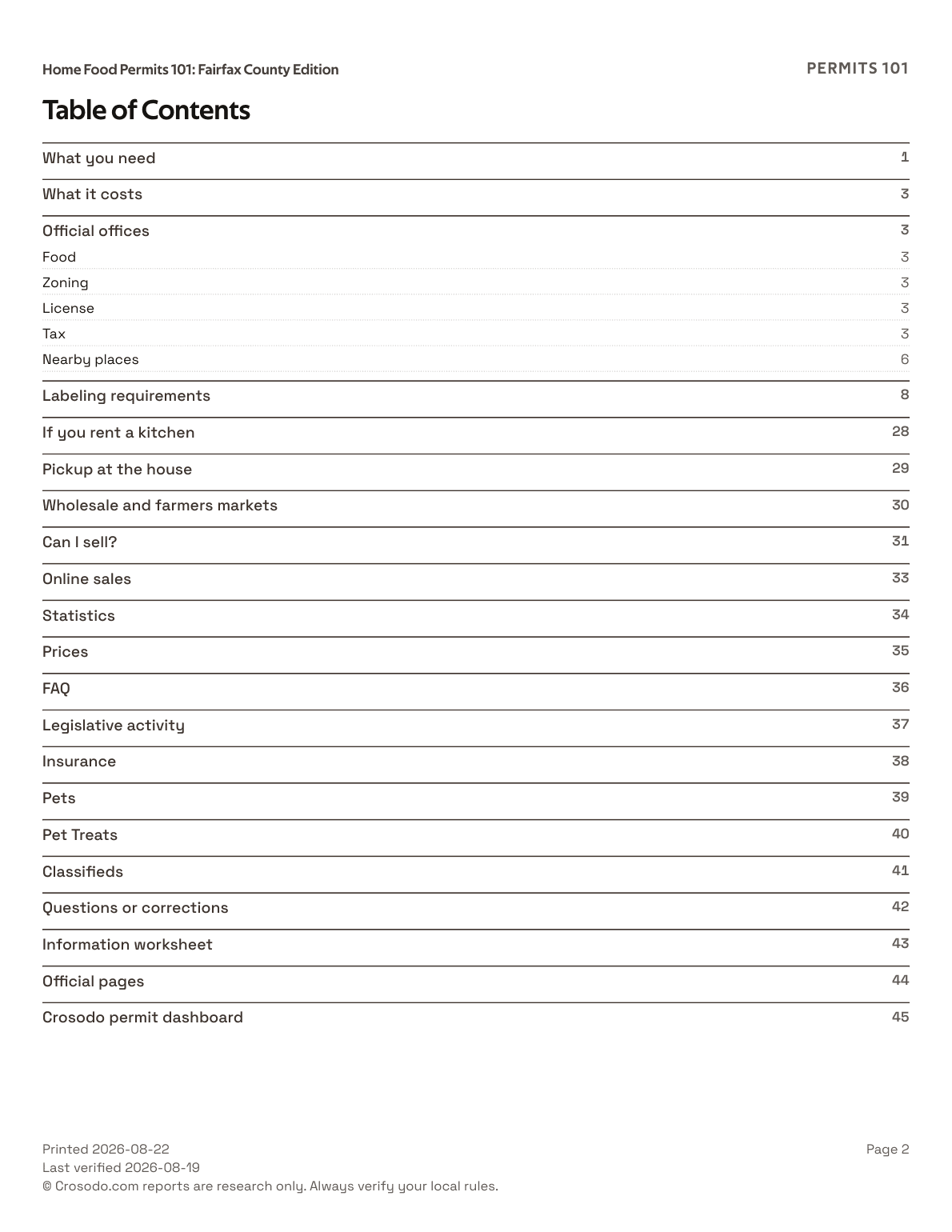
- Full Kansas statute text with key provisions and official citation
- Allowed and prohibited foods, labeling rules, sales cap (None)
- Registration and permit steps with direct state-agency links
- All 105 Kansas counties with zoning + health department links
- 275-page guide with every official source URL, licensed to your address
What exactly am I buying?
The complete Kansas License & Permit Guide — not the free 2-page preview above.
How do I receive it?
Stripe checkout. We email a cover letter, paid receipt, and the guide (PDF) licensed to your address.
Is it current?
Every report lists its official sources so you can verify against the current statute. See also the research-verified Kansas guide.
Not ready? Get free Kansas cottage-food updates instead.
Kansas Statutes Annotated §65-689(d)(4) — Food Establishment License Exceptions (Cottage Food Exemption); accompanied by Kan. Admin. Regs. §4-28-33
Verbatim ExcerptK.S.A. § 65-689. Same; license requirements, fees, inspections, denial, hearing, display; exceptions (a) It shall be unlawful for any person to engage in the business of conducting a food establishment or food processing plant unless such person shall have in effect a valid license therefor issued by the secretary. [...] (d) A license shall not be required by: (1) A plant or facility registered or licensed by the department of agriculture pursuant to article 7 of chapter 65 of the Kansas Statutes Annotated, and amendments thereto [...] (2) A registered nonprofit organization that provides food without charge solely to people who are food insecure [...] (3) A location where prepackaged individual meals are distributed to persons eligible under the federal older Americans act. (4) A person who produces food for distribution directly to the end consumer, if such food does not require time and temperature control for safety or specialized processing, as determined by the secretary. (5) A person who serves food exclusively on interstate conveyances or common carriers. (6) A person operating a food establishment for less than seven days in any calendar year. [...] Kan. Admin. Regs. § 4-28-33. Sanitation and hygiene requirements for exempt food establishments. Each food establishment exempted from licensure in K.S.A. 65-689, and amendments thereto, shall meet the following requirements: Food preparation areas shall be protected from environmental contamination, including rain, dust, and pests. Food contact surfaces, including cutting boards, utensils, and dishes, shall be cleaned, rinsed, and sanitized before food-handling activities begin and also as necessary.
Source: nationalaglawcenter.org/wp-content/uploads/assets/cottagefood/Kansas.pdf →
Almost all nonperishable (non-TCS) foods can be sold directly to consumers anywhere, including out-of-state sales (with additional requirements). Allowed products include most baked goods, candies, dried goods, condiments, jams and jellies, nuts, snacks, and certain other shelf-stable items. Some perishable foods are allowed with restrictions (ready-to-eat items at events up to 6 times/year; certain TCS products up to 6 days/year without a license).
Acidified foods (pickles, salsas, sauces, ketchup), oils, most perishable baked goods, low-acid canned foods, kombucha, and meat jerkies are prohibited under the direct-to-consumer exemption. Some lab-tested items (certain frostings, macarons, pecan pies, pepper jellies, mustards, low-acid jams, herb syrups) may be allowed with prior product testing.
Labels must include: business address, business name, ingredients, net amount/weight, and product name. No specific 'not inspected' statement is required by state law, though KDA guidance recommends it.
None
Great (IJ Grade B+)
105
Kansas Counties (105)
Cottage food registration usually happens at the county level. Click any county for local zoning, health department, and planning department links.
Where to verify Kansas's rules
Data compiled from primary sources. Cottage food laws change — verify with your state agency before relying on this information.
Cottage food laws are amended every year. This is a starting reference, not legal advice. Verify with Kansas Department of Agricultureand your local health department before relying on this data.