
Oregon Cottage Food Law PDF 2026 — Full Legal Text + Annotations
Full statute text, allowed foods, registration, sales cap 50000, and all 36 Oregon counties with zoning + health department links. 122-page PDF with official sources. Free preview below — buy the complete guide for $44.
This page shows the first 2 pages + statute excerpt. One-time $44 · Yours to keep · Stripe checkout · Guide (PDF) emailed with receipt.
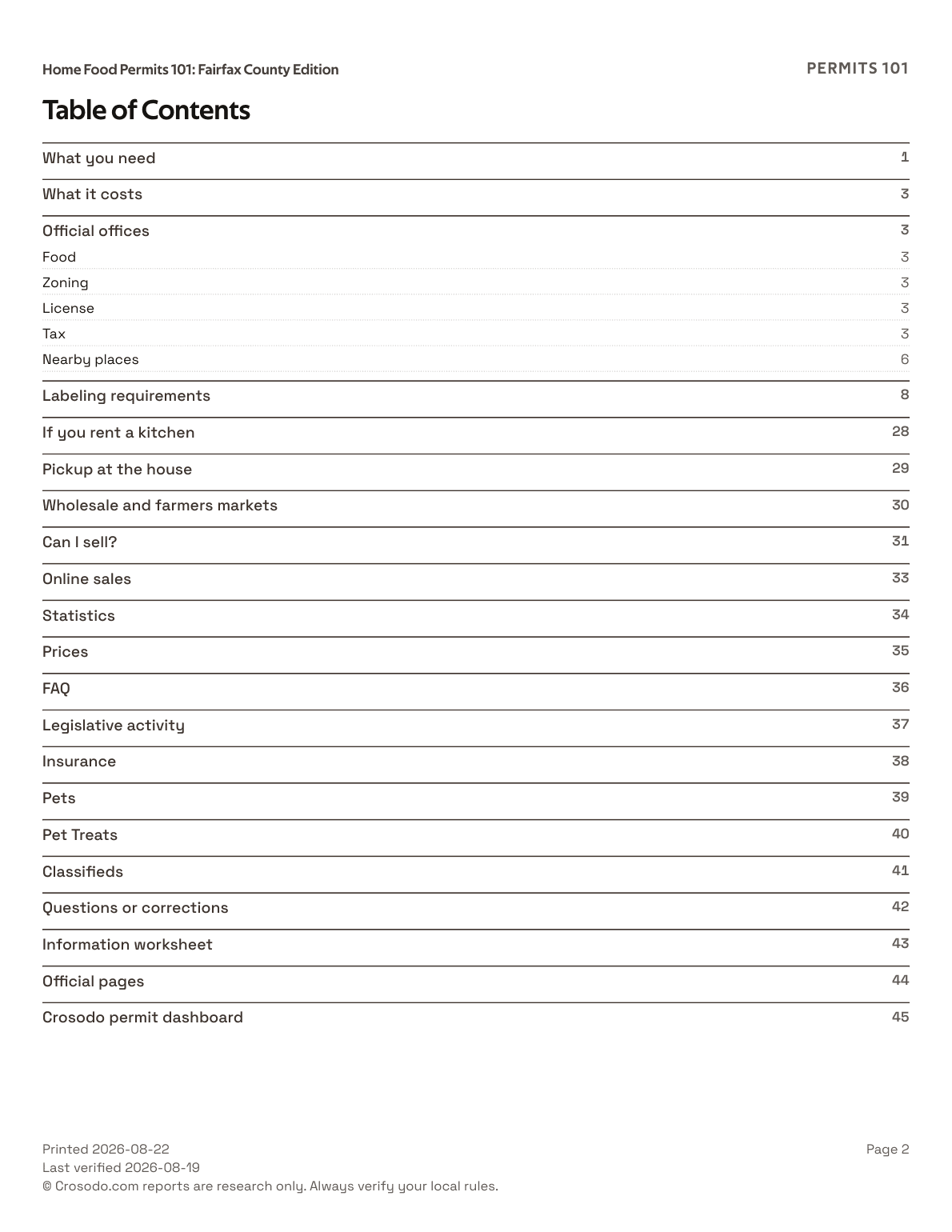
- Full Oregon statute text with key provisions and official citation
- Allowed and prohibited foods, labeling rules, sales cap (50000)
- Registration and permit steps with direct state-agency links
- All 36 Oregon counties with zoning + health department links
- 122-page guide with every official source URL, licensed to your address
What exactly am I buying?
The complete Oregon License & Permit Guide — not the free 2-page preview above.
How do I receive it?
Stripe checkout. We email a cover letter, paid receipt, and the guide (PDF) licensed to your address.
Is it current?
Every report lists its official sources so you can verify against the current statute. See also the research-verified Oregon guide.
Not ready? Get free Oregon cottage-food updates instead.
Oregon Revised Statutes §616.723, Food establishments in residential dwellings (as amended by Oregon SB 643, 2023 Regular Session)
Verbatim Excerpt616.723. (1) As used in this section: (a) "Food" and "food establishment" have the meanings given those terms in ORS 616.695. "Food" does not include any article containing cannabis. (b) "Potentially hazardous" means requiring temperature control due to the capacity to support the rapid and progressive growth of infectious microorganisms or the growth of toxic microorganisms. (c) "Retailer" means a person who engages in the business of selling consumer goods to retail buyers. "Retailer" includes coffee shops and excludes restaurants. (2) ORS 616.695 to 616.755 do not apply to a food establishment if: (a) The food establishment is located in a residential dwelling; (b) The foods prepared at the food establishment for public distribution are packaged and not potentially hazardous, including but not limited to baked goods, confectionary items, coffee beans, teas, popcorn, jams, jellies, honey, syrups, fruit butters, nut mixes, repackaged freeze-dried foods, repackaged dried and dehydrated foods and powdered drink mixes; (c) The food bears on its label a statement and product information as described in subsection (6) of this section informing consumers that the product is not prepared in an inspected food establishment; (d) The annual gross sales of foods prepared at the food establishment do not exceed $50,000, adjusted annually for inflation pursuant to the Consumer Price Index for All Urban Consumers, West Region (All Items); and (e) Each individual involved in the preparation of food at the food establishment for public distribution has successfully completed a food handler training program and holds a certificate issued under ORS 624.570.
Source: olis.oregonlegislature.gov/liz/2023R1/Downloads/MeasureDocument/SB643 →
Packaged, non-potentially-hazardous foods made in a residential dwelling are permitted, including baked goods, confectionery items, coffee beans, teas, popcorn, jams, jellies, honey, syrups, fruit butters, nut mixes, repackaged freeze-dried foods, repackaged dried and dehydrated foods, and powdered drink mixes. Cannabis-containing foods are excluded. Direct sales to end users are permitted in any manner — from home, online, through the mail, and at events.
Potentially hazardous foods (requiring temperature control) are prohibited. Cannabis-containing foods are expressly excluded. Residential-dwelling establishments may not sell to institutions (caterers, schools, day care centers, hospitals, nursing homes, correctional facilities, or restaurants). Sales to retailers are permitted under specific conditions.
Each product label must include: the statement 'This product is homemade, is not prepared in an inspected food establishment' (or equivalent), product name, ingredients in descending order by weight, net volume, name and phone number of the establishment, address or unique identification number, applicable allergen warnings, and presence of pets in the dwelling. If nutrient content or health claims are made, nutritional information is also required.
50000
Good (IJ Grade D+)
36
Oregon Counties (36)
Cottage food registration usually happens at the county level. Click any county for local zoning, health department, and planning department links.
Where to verify Oregon's rules
Data compiled from primary sources. Cottage food laws change — verify with your state agency before relying on this information.
Cottage food laws are amended every year. This is a starting reference, not legal advice. Verify with Oregon Department of Agricultureand your local health department before relying on this data.