Wyoming Cottage Food Law PDF 2026 — Full Legal Text + Annotations
Full statute text, allowed foods, registration, sales cap None, and all 23 Wyoming counties with zoning + health department links. 81-page PDF with official sources. Free preview below — buy the complete guide for $44.
This page shows the first 2 pages + statute excerpt. One-time $44 · Yours to keep · Stripe checkout · Guide (PDF) emailed with receipt.
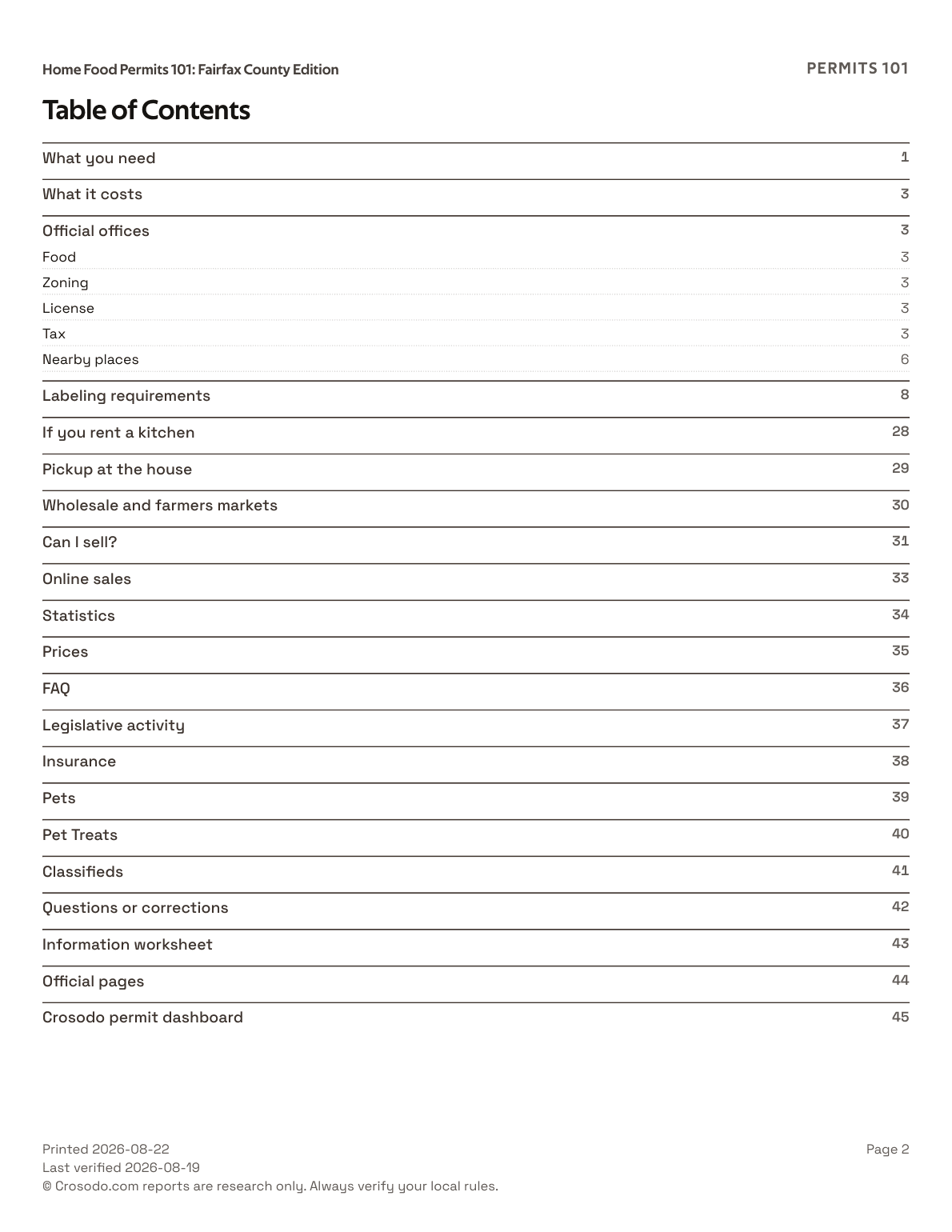
- Full Wyoming statute text with key provisions and official citation
- Allowed and prohibited foods, labeling rules, sales cap (None)
- Registration and permit steps with direct state-agency links
- All 23 Wyoming counties with zoning + health department links
- 81-page guide with every official source URL, licensed to your address
What exactly am I buying?
The complete Wyoming License & Permit Guide — not the free 2-page preview above.
How do I receive it?
Stripe checkout. We email a cover letter, paid receipt, and the guide (PDF) licensed to your address.
Is it current?
Every report lists its official sources so you can verify against the current statute. See also the research-verified Wyoming guide.
Not ready? Get free Wyoming cottage-food updates instead.
Wyoming Statutes Title 11 Agriculture, Livestock and Horticulture, Chapter 49 Marketing Homemade Foods, §§11-49-101 through 11-49-104 (Wyoming Food Freedom Act)
Verbatim Excerpt11-49-101. Short title. This act is known and may be cited as the "Wyoming Food Freedom Act." 11-49-102. Definitions. (iv) "Homemade" means food that is prepared or processed in a private home kitchen, that is not licensed, inspected or regulated; (v) "Informed end consumer" means a person who is the last person to purchase any product, who does not resell the product and who has been informed that the product is not licensed, regulated or inspected; (vi) "Producer" means any person who grows, harvests, prepares or processes any food or drink products on the person's owned or leased property, does not produce more than two hundred fifty thousand (250,000) individual food or drink products annually and does not exceed two hundred fifty thousand dollars ($250,000.00) in gross revenue annually from the food and drink products; (x) "Non-potentially hazardous food" means food that does not require time or temperature control for safety including limiting pathogenic microorganism growth or toxin formation. "Non-potentially hazardous food" includes, but is not limited to, jams, uncut fruits and vegetables, pickled vegetables, hard candies, fudge, nut mixes, granola, dry soup mixes excluding meat based soup mixes, coffee beans, popcorn and baked goods that do not include dairy or meat frosting or filling or other potentially hazardous frosting or filling; (xi) "Potentially hazardous food" means food that requires time or temperature control for safety including limiting pathogenic microorganism growth or toxin formation. "Potentially hazardous food" includes, but is not limited to, foods requiring refrigeration, dairy products, quiches, pizzas, frozen doughs, meat and cooked vegetables and beans. 11-49-103(b). Unless otherwise provided in this section, homemade food products produced, sold and consumed in compliance with the Wyoming Food Freedom Act shall be exempt from state licensure, permitting, inspection, packaging and labeling requirements. 11-49-103(c)(i). Transactions shall be directly between the producer and the informed end consumer, except as otherwise provided by this act. A producer may utilize a designated agent to facilitate a transaction. The seller of eggs, dairy products or a homemade food product consisting of non-potentially hazardous food may be the producer of the item, a designated agent of the producer or a third party vendor including a retail shop or grocery store as long as the sale is made in compliance with this act.
Source: tetoncountywy.gov/DocumentCenter/View/37981/Wyoming-Food-Freedom-Act-2025 →
Extraordinarily broad: all homemade foods including TCS (potentially hazardous) foods such as dairy, eggs, quiches, pizzas, cooked vegetables, and baked goods with dairy/meat fillings — as long as transactions comply with the Act. Non-potentially hazardous foods (jams, pickled vegetables, baked goods without hazardous fillings, candies, granola, etc.) may even be sold through third-party vendors and retail shops. Potentially hazardous homemade foods (except eggs and dairy) must be sold by the producer or designated agent directly to the informed end consumer.
Meat products are generally excluded with specific exceptions (poultry up to 1,000 birds/year, live animals, rabbit meat, farm-raised non-catfish fish, animal shares under §11-49-104). Homemade or uninspected food cannot be served or used as an ingredient in a commercial food establishment. Interstate commerce is prohibited. Producers must not exceed 250,000 individual products or $250,000 gross revenue annually.
Homemade foods are broadly exempt from labeling requirements (§11-49-103(b)). However, the producer must inform the end consumer (verbally or by sign) that the food is not certified, labeled, licensed, packaged, regulated, or inspected. For retail/grocery store sales: non-potentially hazardous foods must be labeled 'this food was made in a home kitchen, is not regulated or inspected and may contain allergens.' Retail spaces selling homemade food must display a sign indicating it has not been inspected. Potentially hazardous homemade foods at retail locations adjacent to commercial food establishments require physical separation per §11-49-103(d).
None
Freedom (IJ Grade A)
23
Wyoming Counties (23)
Cottage food registration usually happens at the county level. Click any county for local zoning, health department, and planning department links.
Where to verify Wyoming's rules
Data compiled from primary sources. Cottage food laws change — verify with your state agency before relying on this information.
Cottage food laws are amended every year. This is a starting reference, not legal advice. Verify with Wyoming Department of Agricultureand your local health department before relying on this data.