
Utah Cottage Food Law PDF 2026 — Full Legal Text + Annotations
Full statute text, allowed foods, registration, sales cap None, and all 29 Utah counties with zoning + health department links. 98-page PDF with official sources. Free preview below — buy the complete guide for $44.
This page shows the first 2 pages + statute excerpt. One-time $44 · Yours to keep · Stripe checkout · Guide (PDF) emailed with receipt.
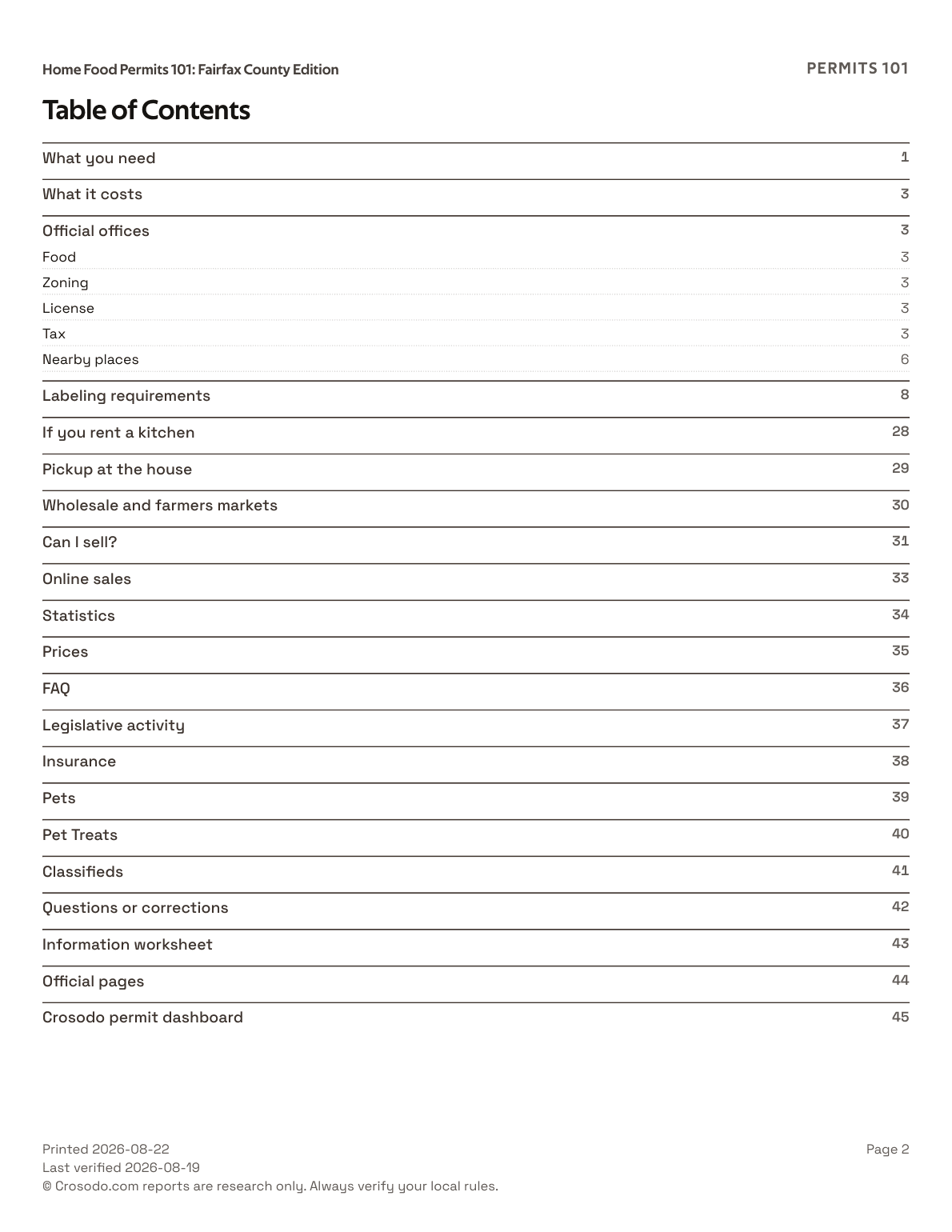
- Full Utah statute text with key provisions and official citation
- Allowed and prohibited foods, labeling rules, sales cap (None)
- Registration and permit steps with direct state-agency links
- All 29 Utah counties with zoning + health department links
- 98-page guide with every official source URL, licensed to your address
What exactly am I buying?
The complete Utah License & Permit Guide — not the free 2-page preview above.
How do I receive it?
Stripe checkout. We email a cover letter, paid receipt, and the guide (PDF) licensed to your address.
Is it current?
Every report lists its official sources so you can verify against the current statute. See also the research-verified Utah guide.
Not ready? Get free Utah cottage-food updates instead.
Utah Code, Title 4 – Utah Agricultural Code, Chapter 5 – Utah Wholesome Food Act, Part 5 – Special Programs, Section 4-5-501 (Cottage Food Operations)
Verbatim Excerpt4-5-501. Cottage food operations. (1) For purposes of this chapter: (a) "Cottage food operation" means a person who produces a cottage food product in a home kitchen. (b) "Cottage food product" means a nonpotentially hazardous baked good, jam, jelly, or other nonpotentially hazardous food produced in a home kitchen. (c) "Home kitchen" means a kitchen: (i) designed and intended for use by the residents of a home; and (ii) used by a resident of the home for the production of a cottage food product. (d) "Potentially hazardous food" means: (i) a food of animal origin; (ii) raw seed sprouts; or (iii) a food that requires time or temperature control, or both, for safety to limit pathogenic microorganism growth or toxin formation, as identified by the department in rule. (3) Rules adopted pursuant to Subsection (2) may not require: (a) the use of a commercial surface such as a stainless steel counter or cabinet; (b) the use of a commercial grade: (i) sink; (ii) dishwasher; or (iii) oven; (c) a separate kitchen for the cottage food operation; or (d) the submission of plans and specifications before construction of, or remodel of, a cottage food production operation. (4) The operator of a cottage food operation shall: (a) register with the department as a cottage food operation before operating as a cottage food operation; (b) hold a valid food handler's permit; and (c) package a cottage food product with a label, as specified by the department in rule.
Source: law.justia.com/codes/utah/title-4/chapter-5/part-5/section-501/ →
All non-potentially hazardous foods (non-TCS) produced in a home kitchen are allowed under the cottage food registration. This includes baked goods, jams, jellies, candy, granola, dried herbs, non-TCS beverages, and other shelf-stable foods. A separate Home Consumption and Homemade Food Act (Title 4, Chapter 5A) provides an alternative pathway with fewer registration requirements but more sales restrictions.
Potentially hazardous foods (foods of animal origin, raw seed sprouts, and any food requiring time/temperature control for safety) are prohibited under the cottage food framework. Meat, raw dairy, and TCS prepared foods require commercial food establishment licensing.
Labels must be applied as specified by the UDAF in administrative rules. Typical requirements include product name, ingredients, net weight, producer name and address, and a statement that the product was made in a home kitchen not inspected by the state. The statute explicitly prohibits rules requiring commercial-grade equipment or a separate kitchen, making the registration pathway accessible.
None
Freedom (IJ Grade A-)
29
Utah Counties (29)
Cottage food registration usually happens at the county level. Click any county for local zoning, health department, and planning department links.
Where to verify Utah's rules
Data compiled from primary sources. Cottage food laws change — verify with your state agency before relying on this information.
Cottage food laws are amended every year. This is a starting reference, not legal advice. Verify with Utah Department of Agriculture and Foodand your local health department before relying on this data.