Cottage food law & license in Contra Costa County, CA
What's in the Contra Costa County permit report
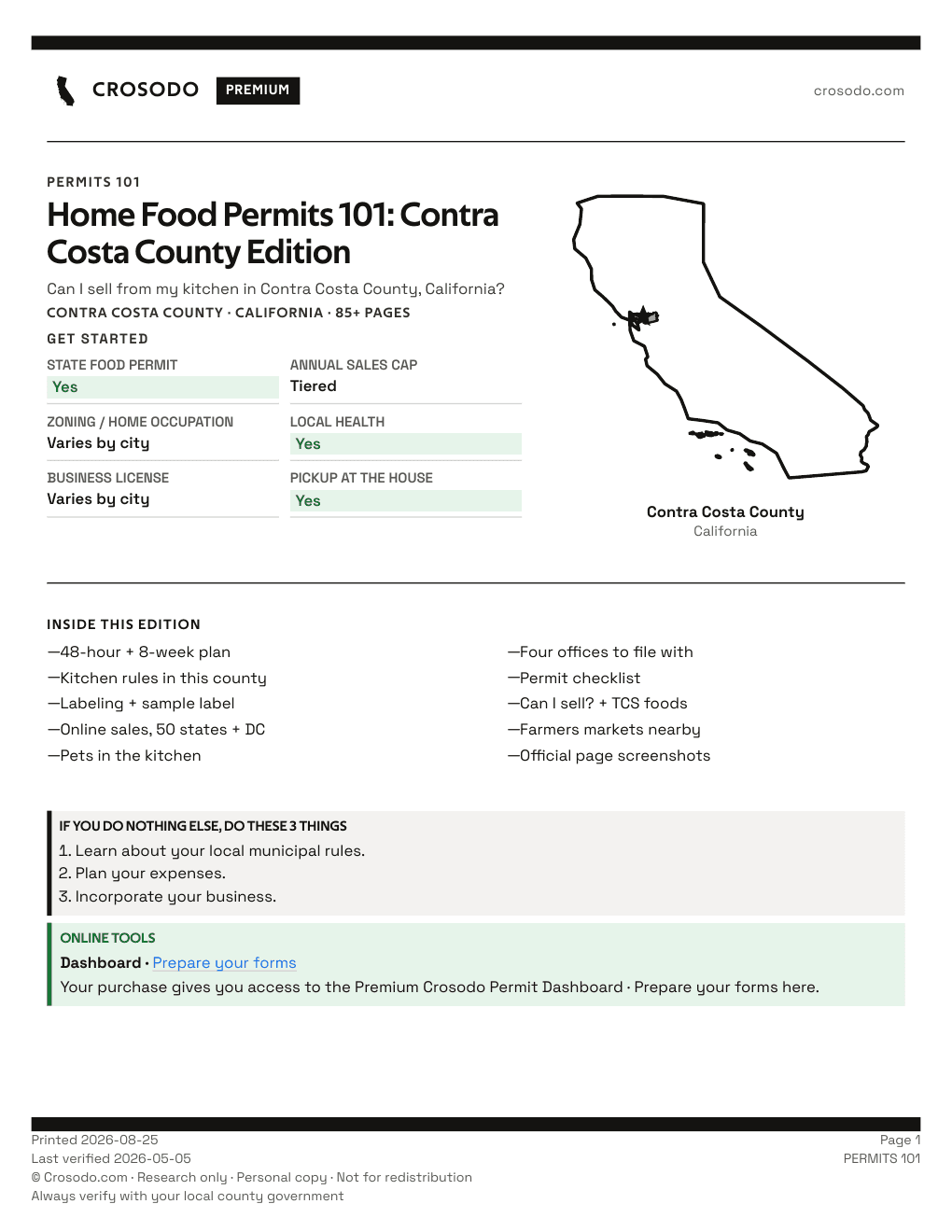
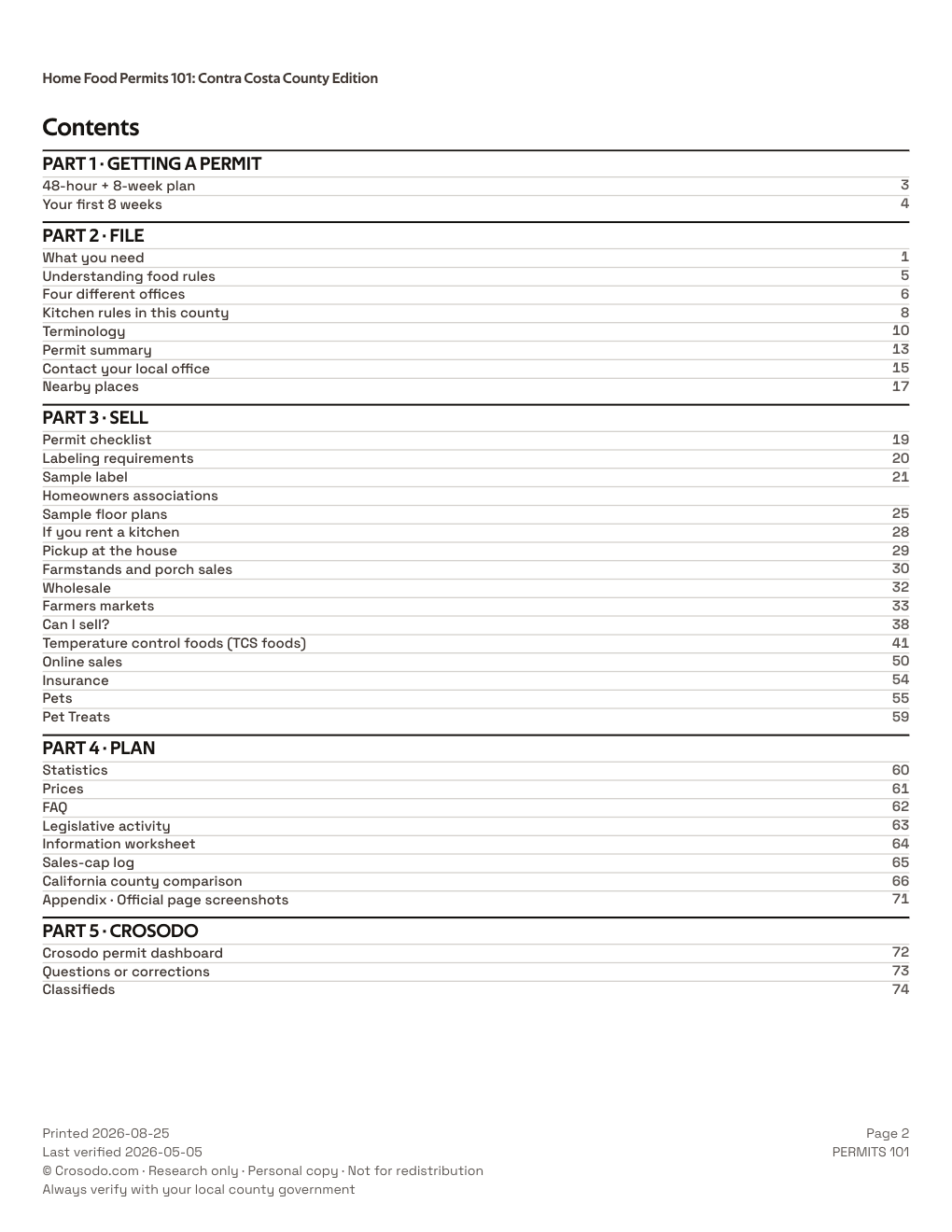
Free page = the law. Permit Guide = the apply checklist and workspace.
Cottage Pro included: every other county guide and state report, plus the label packet, are the bonus — this county's packet is the reason to buy.
One payment. No subscription, nothing to cancel.
Reviewed · This page stays free · Cottage Pro unlocks the apply checklist
Can I sell this in Contra Costa County?
More Contra Costa County resources
What's new for California cottage bakers?
How do I start a cottage food business in Contra Costa County?
How to start in Contra Costa County
Permit, label, and local steps for selling under California cottage food rules in Contra Costa County. Not legal advice.
CDPH does not register CFOs
CDPH does not permit or register Cottage Food Operations. Class A registration and Class B permits go through the county Environmental Health agency. CDPH only maintains the approved cottage foods list. Class A is direct sales only (up to $75,000 gross a year). Class B is direct plus indirect (up to $150,000). 2026 CPI-adjusted gross annual sales limits (effective January 1, 2026): Class A $88,878, Class B $177,756. Statutory bases: $75,000 / $150,000, adjusted annually for inflation (Cal. Health & Safety Code §113758).
Confirm your menu under state law
California cottage food rules control what you may make at home (Only foods on the official state-approved foods list may be sold; this includes most non-perishable foods such as baked goods, jams and preserves, candies, chocolates, dried goods, and spices. Class A operations are limited to direct sales (including online and shipping within California); Class B operations may additionally sell through retail stores and restaurants.). Contra Costa County cannot expand a food the state bans.
Map channels and local sales rules
State sales cap: Tiered (see notes). On-site / porch pickup in Contra Costa County: Yes. Prefer markets or off-site pickup if residential customer traffic is restricted.
Local permits, tax, and home occupation
Home occupation permit: Varies by city. Many places still need a general business license or tax certificate even when the state has no cottage food “permit.” Check planning, the clerk, and any HOA or lease before advertising your address.
Training, registration, inspection
State registration: Not with CDPH. County Environmental Health registers Class A (direct) and permits Class B (direct plus indirect).. Local inspection in Contra Costa County: Yes. Finish food handler training early — markets often ask for a copy.
Labels that match the state
Print labels with California disclaimer and allergen rules before market day. Use the free California label page for the one-pager checklist and mockup.
Insurance and first sales
Farmers markets often require a certificate of insurance. Soft-launch with pre-orders, keep a sales log, and re-verify rules if you change products or venues.
What usually goes on the package
- Product name (common or usual name of the food)
- Business or producer name
- Producer address (or address alternative your state allows)
- Ingredients in descending order by weight
- Major allergen disclosures (e.g. wheat, milk, eggs, soy, tree nuts, peanuts, fish, shellfish, sesame)
- Net weight or quantity
- Home-kitchen disclaimer: “Made in a Home Kitchen”
Planning checklist only. Confirm with state and local agencies before you sell.
Can I test myself on Contra Costa County rules? (Crosodo Verified quiz)
Test yourself on Contra Costa County rules
A free 10-question quiz generated from verified Contra Costa County and California data. Pass at 80% for a Crosodo Verified badge.
Crosodo Verified means this person passed Crosodo's county rules quiz. It is not a government license, permit, or food-handler certification.
Take the Crosodo Verified quizHow do I verify Contra Costa County cottage food rules with California agencies?
Contra Costa County is a top-50 county by population in California (pop. 1,162,648). Under California's Good-tier cottage food law (sales cap: Tiered (see notes)), home bakers must still clear local zoning and health rules in this county. Registration path: County EH — not CDPH. Start with California Department of Public Health (state cottage food page linked below), then confirm Contra Costa County health and planning requirements via the health department links on this page. Local notes for Contra Costa County: home kitchen allowed; inspection required; home occupation permit not required. Contra Costa County is a MEHKO opt-in county — the ordinance applies countywide (both incorporated and unincorporated areas), making it broader than some other CA MEHKO adoptions. The MEHKO is capped at 30 meals/day, 90 meals/week, and $100,000 gross annual sales. MEHKO permit year runs March 1 through February 28/29; renewable annually; not transferable. All persons at the MEHKO must get Contra Costa County Food Handler Certification within 30 days of joining the operation. CCH annual inspection required. Download the free reports below for a portable summary, and always re-check official sources before you sell.
What practical tips help me start selling in Contra Costa County?
Tier: Good
California has a Good-tier cottage food law — solid baseline with moderate restrictions, typically a high sales cap (often $50K+) and standard direct-to-consumer rules. Workable for most home bakers with reasonable scale plans.
California cottage food law →Health department
Many states delegate cottage food registration and inspection to the county health department. Contact theirs for the local process.
Home occupation rules
The county or city zoning code governs whether you can run a home-based food business — customer visits, signage, employees, floor area.
What are the Contra Costa County zoning rules for a home bakery?
Home kitchen, inspection, and zoning rules for Contra Costa County
State baseline: Cal. Health & Safety Code §113758
- Home kitchen allowed
- Yes
- Restrictions
- Contra Costa County adopted a MEHKO ordinance (Ordinance 2024-05) approved by the Board of Supervisors on June 20, 2024, effective July 1, 2024 — initially as a two-year pilot, subsequently codified as Article 413-3.20 of the County Ordinance Code. Contra Costa Health (CCH) Environmental Health Division is the permitting authority for both CFOs and MEHKOs throughout the county (both incorporated and unincorporated areas). Only one MEHKO may operate per residence.
- Separate dedicated kitchen
- No
- Pet restrictions
- State baseline applies
- Water supply
- State baseline applies
- Handwashing
- State baseline applies
- Food storage
- State baseline applies
- Inspection required
- Yes
- Inspection trigger
- MEHKO: initial inspection before permit issuance; annual inspections (or more frequently for cause). CFO Class B: initial inspection; annual inspection. CFO Class A: no routine inspection; upon-complaint only.
- Home occupation permit
- Varies by city
- Permit details
- State preemption (Gov. Code §51035) bars local zoning restrictions on CFOs. Cities within Contra Costa County may require home occupation permits for other aspects of the business. MEHKO operators must comply with all operational requirements in Ordinance 2024-05 and CCH regulations.
- Local business license
- Varies by city
- On-site customer pickup
- Yes
- On-site signage
- Conditional
- Delivery / pickup
- MEHKO: meals for dine-in, take-out, and delivery; MEHKO may also serve as a commissary for permitted food carts. CFO: direct/indirect sales within California only. Delivery must comply with Cal. Health & Safety Code §114367.5. MEHKO permit must not be used as outdoor advertising.
- Max employees in home
- MEHKO: all participating persons must obtain Contra Costa County Food Handler Certification within 30 days of joining. State baseline (1 FTE) for CFO.
- Relevant code section
- Contra Costa County Ordinance Code Article 413-3.20 (MEHKO, eff. July 1, 2024); Cal. Health & Safety Code §§114367–114367.6
Contra Costa County is a MEHKO opt-in county — the ordinance applies countywide (both incorporated and unincorporated areas), making it broader than some other CA MEHKO adoptions. The MEHKO is capped at 30 meals/day, 90 meals/week, and $100,000 gross annual sales. MEHKO permit year runs March 1 through February 28/29; renewable annually; not transferable. All persons at the MEHKO must get Contra Costa County Food Handler Certification within 30 days of joining the operation. CCH annual inspection required.
What does the California cottage food statute say?
California Homemade Food Act (AB 1616, amended AB 1144/AB 831)
Full California License & Permit Guide →Verbatim excerpt(a) "Cottage food operation" means an enterprise that has no more than the amount in gross annual sales that is specified in this subdivision, is operated by a cottage food operator, and has no more than one full-time equivalent cottage food employee, not including a family member or household member of the cottage food operator, within the registered or permitted area of a private home where the cottage food operator resides and where cottage food products are prepared or packaged for direct, indirect, or direct and indirect sale to consumers pursuant to this part. A "Class A" cottage food operation shall not have more than seventy-five thousand dollars ($75,000) in verifiable gross annual sales. A "Class B" cottage food operation shall not have more than one hundred fifty thousand dollars ($150,000) in verifiable gross annual sales. The gross annual sales for a "Class A" or "Class B" cottage food operation shall be annually adjusted for inflation based on the California Consumer Price Index. (1) A "Class A" cottage food operation, which is a cottage food operation that may engage only in direct sales of cottage food products from the cottage food operation or other direct sales venues. (2) A "Class B" cottage food operation, which is a cottage food operation that may engage in both direct sales and indirect sales of cottage food products from the cottage food operation, from direct sales venues, from offsite events, or from a third-party retail food facility. (3) "Cottage food products" means nonpotentially hazardous foods, including foods that are described in Section 114365.5 and that are prepared for sale in the kitchen of a cottage food operation. (4) "Direct sale" means a transaction within the state between a cottage food operation and a consumer, in which the consumer purchases the cottage food product directly from the cottage food operation. Direct sales include, but are not limited to, transactions at holiday bazaars or other temporary events, such as bake sales or food swaps, transactions at farm stands, certified farmers' markets, or through community-supported agriculture subscriptions.
Source: leginfo.legislature.ca.gov/faces/codes_displaySection.xhtml?lawCode=HSC§ionNum=113758 →
Cottage Pro — $15 one time
This page stays free. Contra Costa County’s apply checklist, every county guide, and the Verified badge are in Cottage Pro.
Buy the Report — $15 one timeContra Costa County cottage food — FAQ
Do I need a permit to sell cottage food in Contra Costa County, California?
County Environmental Health registers Class A / permits Class B — not CDPH. Local home-occupation permit: Varies by city. Home kitchen: Yes. Confirm with Contra Costa County EHS before you sell.
Class A vs Class B cottage food in Contra Costa County?
Class B permit holders may sell indirectly through retail stores and restaurants statewide; Class A registrants are limited to direct sales only and may not sell through any retail or wholesale venue.
What is the cottage food permit fee in Contra Costa County?
Crosodo has not verified a published cottage-food fee for Contra Costa County. Ask Contra Costa County EHS for the current Class A / Class B charge.
What is the sales cap for cottage food in California?
Caps 2026: Class A $88,878 / Class B $177,756. There is typically no separate county sales cap, but local permits can still limit operations.
Where do I apply for a cottage food permit in Contra Costa County?
Apply via Contra Costa County EHS (cchealth.org). Official link: https://www.cchealth.org. Crosodo is the checklist beside that filing site.
What foods can I sell under California cottage food law in Contra Costa County?
Only foods on the official state-approved foods list may be sold; this includes most non-perishable foods such as baked goods, jams and preserves, candies, chocolates, dried goods, and spices. Class A operations are limited to direct sales (including online and shipping within California); Class B operations may additionally sell through retail stores and restaurants. County zoning does not expand the state product list — if a food is banned by California, it stays banned. Verify with the state agency before selling.
Is a health inspection required for home bakers in Contra Costa County?
Inspection: Yes. Trigger: MEHKO: initial inspection before permit issuance; annual inspections (or more frequently for cause). CFO Class B: initial inspection; annual inspection. CFO Class A: no routine inspection; upon-complaint only.. Non-TCS baked goods are often exempt from kitchen inspection under state cottage food law, but local rules can differ.
Cottage Pro · $15 one time
Every California report, every county Permit Guide, the label packet, and the dashboard — one subscription.
Buy the Report — $15 one timeContra Costa County cottage food reports
Home cottage-food permit stack — zoning, health, license, and what the state does not require.

Zoning, permits, health department rules, and local sources for Contra Costa County.
Download county report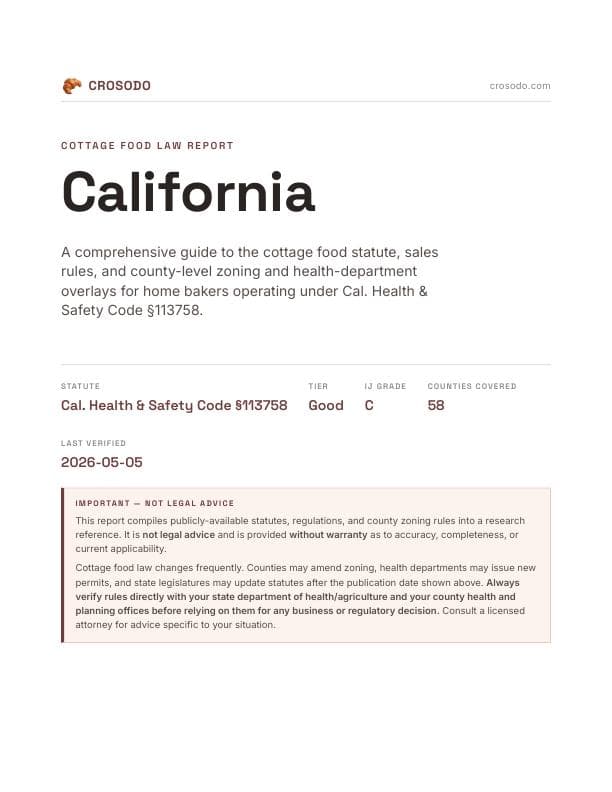
Full California License & Permit Guide (189 pages). Statute and every county. Buy it further down only if you sell outside Contra Costa County.
California law pageFree email alerts
Contra Costa County Cottage Food Updates
Local rule changes and news for home bakers in Contra Costa County, with California statewide updates below the county news in every email. Every story links to its source.
What sources is this Contra Costa County page based on?
Where to verify Contra Costa County rules
Contra Costa County vs. bordering counties
| Regulation | Contra Costa County This county | San Francisco County | San Joaquin County |
|---|---|---|---|
| Home kitchen allowed | Yes | Yes | Yes |
| Separate dedicated kitchen | No | No | No |
| Pets allowed | State baseline applies | Standard sanitation; not specifically addressed | Standard sanitation; no specific county guidance found |
| Inspection required | Yes | Conditional | Conditional |
| On-site customer pickup | Yes | Yes | Yes |
| On-site signage | Conditional | Conditional | Conditional |
| Delivery / pickup | MEHKO: meals for dine-in, take-out, and delivery; MEHKO may also serve as a commissary for permitted food carts. CFO: direct/indirect sales… | Class A: direct sales only (in person, phone, internet; mail/third-party delivery permitted within California). Class B: direct plus indire… | Class A: direct sales only (in person, phone, internet; mail/third-party delivery permitted within California). Class B: direct and indirec… |
| Home occupation permit | Varies by city | Yes | Conditional |
| Local business license | Varies by city | Yes | Varies |
| Restrictions | Contra Costa County adopted a MEHKO ordinance (Ordinance 2024-05) approved by the Board of Supervisors on June 20, 2024, effective July 1, … | San Francisco is a consolidated city-county. CFO permits are administered by the SF Department of Public Health (SFDPH). Class A (direct sa… | San Joaquin County Environmental Health Department administers CFO permits. Class A: $186 fee, direct sales only, up to current state cap (… |
| Food storage | State baseline applies | Standard food storage per state approved foods list | Standard food storage per state approved foods list |
| Population | 1,162,648 | 851,036 | 779,445 |
What other California counties can I compare?
Other California counties
Can I list my bakes in the Crosodo classifieds?
Resources for cottage food and home bakers
Supplies, courses, insurance, farmers markets, kitchen rentals, and local services. To advertise here, visit crosodo.com/advertise. Browse all classifieds.
Ads are paid placements. Crosodo does not endorse listed vendors. Verify all product, service, course, insurance, and legal information independently.
Is this Contra Costa County page legal advice?
Cottage food law and municipal zoning interact in non-obvious ways. Before investing in equipment or marketing, talk to California's department of agriculture, your local health department, and your county or city's planning office. Crosodo is a clothing brand for cottage bakers, not a law firm.
Where can I talk with other Contra Costa County bakers?
Contra Costa County baker discussion
53 public threads from bakers talking about Contra Costa County — permits, zoning, markets, and what's selling. Read along or sign in to post.
Local bakers discuss zoning, permits, top sellers, sourdough, farmers markets, and more in the Crosodo forum.
Can I sell cottage food from home in Contra Costa County? (short answer)
What are the steps to my first legal sale in Contra Costa County?
Steps to your first legal sale
- Which permit you need — local names like HBB, MHO, CFO Class A
- Zoning / home occupation: where you file
- Local health Class A/B path when the county runs itIn Cottage Pro
- Fee schedule — published amount only, blank if noneIn Cottage Pro
- House pickup vs off-site — what zoning already saysIn Cottage Pro
Steps 1–2 are free on this page. Cottage Pro is the full apply checklist, every county report, and the dashboard workspace.
What should I know about Contra Costa County at a glance?
File with Contra Costa County — Crosodo is the checklist beside this site.
Apply via Contra Costa County EHS(cchealth.org)How does the Crosodo ladder work in Contra Costa County? State vs county rules and pets
Crosodo ladder · not a license · How the ladder works
- 0Bake for friends
Give it away: gifts, potlucks, the office tray.
California
Contra Costa County
- Nothing to file
$0
Taking money? → Step 1
- 1Sell from home
Sell shelf-stable bakes straight to the person who eats them.
California
Contra Costa County
- Check with Contra Costa County business license office
Want store shelves? → Step 2
CDPH Cottage Food Operations · Contra Costa Health — Home Kitchens
- 2Sell to stores
Sell to shops, cafés and resellers from an inspected kitchen.
California
- Selling to stores: check with California Department of Public Health
Contra Costa County
- Check with Contra Costa County zoning office about an inspected home kitchen
Want a storefront? → Step 3
- 3Commercial bakery
Bake in a commercial kitchen. Sell from your own shop.
California
- Commercial kitchen permit: check with California Department of Public Health
Contra Costa County
- Check with Contra Costa County zoning and building offices
Renew permits every year
- Pets: do I need a door?
California · Step 1
Not verified yet
Check with California Department of Public Health.
California · Step 2 (home)
Not verified yet
Check with California Department of Public Health.
Save your county and take the 2-minute Crosodo Verified quiz. Crosodo is a research guide, not a government agency. Not legal advice.