Do I need a permit to start a lemonade stand?
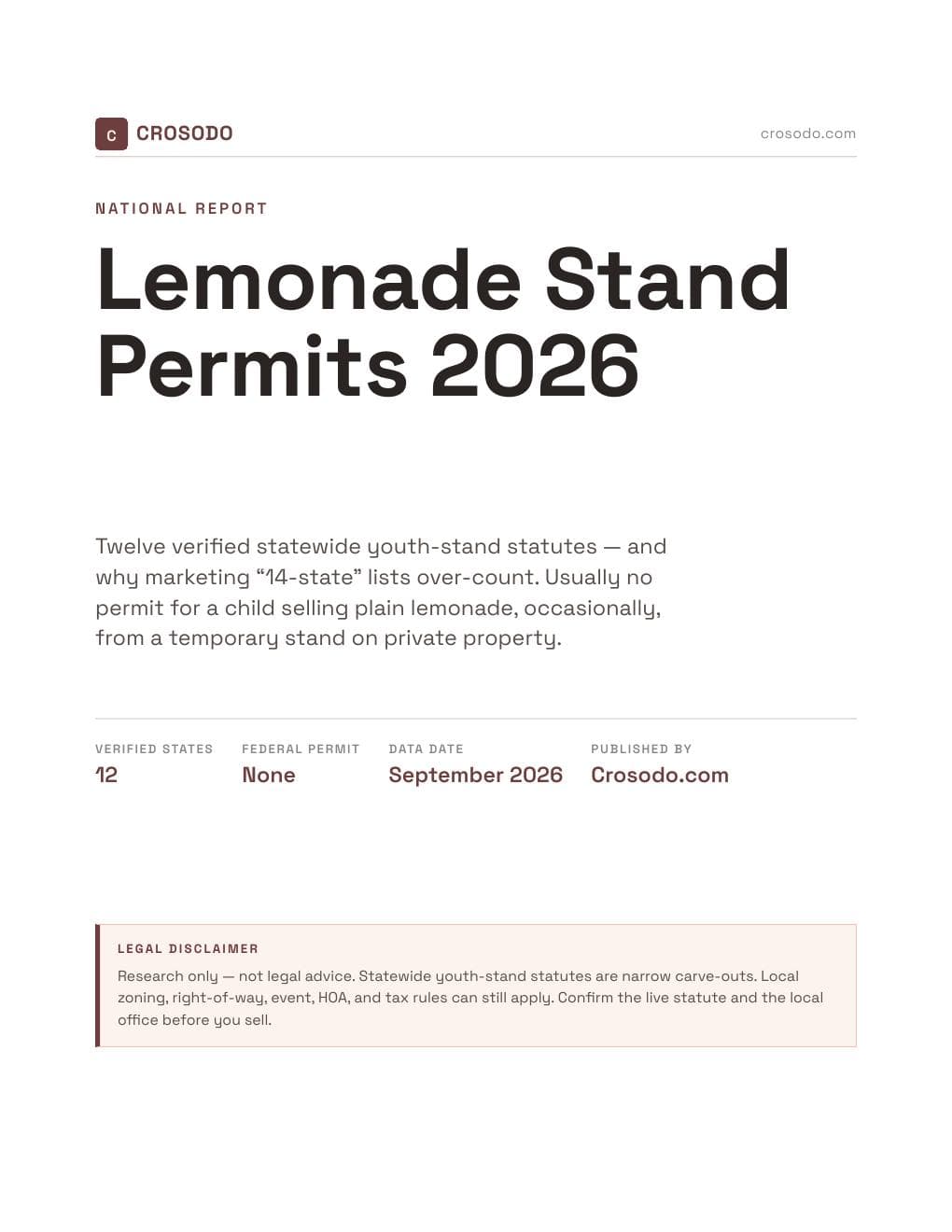
Usually no — if a child occasionally sells plain lemonade from a temporary stand on private property. Twelve verified statewide youth-stand statutes; marketing “14-state” lists over-count. Free Crosodo PDF.
Parents get two stories. One is the cardboard-stand myth: *nobody can stop a kid from selling lemonade.* The other is the viral ticket story: *you need a health permit, a business license, and a seller’s permit to pour a cup.* Both over-claim. Most occasional private-property stands are left alone. Twelve states wrote that into statewide statute. Marketing lists that say “14 states” usually counted a pending bill or a tax FAQ.
Do I need a permit?
Start with the common case: a child, a folding table, a pitcher of lemonade (lemon, water, sugar, ice), a Saturday on the family’s driveway or a neighbor’s yard with permission. In most of the country that stand does not need a food-establishment permit. The Food Code’s “food establishment” definition was written for restaurants, not a weekend kids’ table — and states that adopt the Code still leave most of these stands unlicensed as a practical matter.
The answer flips when any of these is true: an adult is running it as a business; the stand is on a sidewalk, street, or park without an event slot; it is open most of the summer like a shop; the cup holds dairy, meat, or other time/temperature control for safety (TCS) food (the modern name for potentially hazardous food); or a city is treating the corner as a vending location. Then you are in ordinary local food, right-of-way, or event rules — not the kids’-stand carve-out.
- Who
- Child vs. adult. Statutes use under 16 (Illinois), under 18 (most), or under 19 (Arizona, Utah).
- Where
- Private property with owner permission vs. public right-of-way, sidewalk, or ticketed event.
- How often
- Occasional / temporary. Colorado and Pennsylvania cap at 84 days/year.
- What
- Plain lemonade and other nonalcoholic, non-TCS drinks — not dairy, meat, or TCS sides.
- Revenue
- Some statutes cap receipts (GA generally $5,000 gross; PA generally $5,000 net; AZ TPT relief at $10,000; LA tax relief under $500).
- Local overlays
- Zoning, HOA, special event, and sales-tax accounts can still exist even where a youth-stand statute is on the books.
Is there a federal lemonade-stand permit?
No. The FDA Food Code is a model code. It does not issue kids a lemonade license, and there is no federal “lemonade-stand permit” to apply for. Federal food law sits in the background for manufacturing and interstate commerce. A neighborhood stand is a state-and-local question.
Which states protect kids’ lemonade stands?
As of September 2026, Crosodo has twelve verified statewide statutes. That is the list we will stand behind. We do not add a thirteenth from a brand campaign.
50 states + DC, county zoning, and free PDF reports.
| State | Citation | Who | Notes |
|---|---|---|---|
| Arizona | A.R.S. §§ 9-500.50, 11-269.29, 42-5045 (SB 1370 / Ch. 237, 2024) | Under 19 | Occasional; TPT relief if gross ≤ $10,000/yr |
| Colorado | C.R.S. art. 29-11.3 (SB19-103, 2019) | Under 18 | ≤ 84 days/year; distance from commercial competitors |
| Georgia | O.C.G.A. § 36-80-30 (Georgia Lemonade Stand Act; SB 55, 2023) | Under 18 (+ school / diploma conditions) | Private property; gross ≤ $5,000; lemonade / non-PH drinks or prepackaged / nonconsumables |
| Illinois | 410 ILCS 625/3.9 (Hayli’s Law, 2021) | Under 16 | Bars health departments only — other local rules may still apply |
| Iowa | Iowa Code §§ 137F.1(15), 137F.8A (2020) | Under 18 | Non-TCS, non-alcohol; temporary / occasional; private property |
| Louisiana | R.S. 47:301(1)(c), 47:360(H) (2016) | Minors | Sales < $500/yr — tax / occupational-license framing, not full health preemption |
| Missouri | RSMo §§ 71.610, 92.045 (SB 145, 2025) | Owner ≤ 18 | Municipal licensing / tax framing |
| New Jersey | N.J.S.A. 40:52-19 (2021) | Under 18 | Only occasionally |
| Pennsylvania | 53 Pa.C.S. § 306 (Act 34 / HB 664, 2021) | Under 18 | ≤ 84 days; net ≤ $5,000 generally; distance from competitors |
| Texas | Tex. Loc. Gov’t Code § 250.009; Prop. Code § 202.020 (HB 234, 2019) | Under 18 | Lemonade / other nonalcoholic drinks; private property or public park; HOA limits |
| Utah | Utah Code § 10-1-203(7)(b) (+ county analog) | Under 19 | Occasional; municipalities may still impose event requirements |
| Wisconsin | Wis. Stat. § 66.0416 (2019 Wis. Act 60) | Under 18 solely | Goods other than potentially hazardous food; private property; occasional sales |
The PDF prints the same twelve rows with a sixth column: what may still need a permit in that state. Read Illinois, Louisiana, Missouri, and Utah slowly. A health-department bar is not a city-license bar. A tax exemption under $500 is not a food-code exemption. An “occasional” carve-out can still leave a festival booth in the event-permit line.
What still needs a permit — even in those twelve states?
- Public right-of-way and sidewalk vending. A driveway stand and a curb stand are different legal facts. Texas names private property or a public *park*; it does not turn every street corner into a free vending zone.
- Special events and festivals. Utah’s municipal carve-out still lets a city impose event requirements. A booth inside a permitted fair is usually on the event’s food list, not the kids’-stand statute.
- TCS / potentially hazardous food. Dairy drinks, meat, cut melon, and other foods that need temperature control are outside these carve-outs. Iowa and Wisconsin say so in the product line.
- Over the day-count or dollar cap. Colorado and Pennsylvania: 84 days. Georgia: generally $5,000 gross. Pennsylvania: generally $5,000 net. Arizona’s TPT relief stops at $10,000. Louisiana’s tax / license relief stops under $500.
- Adult-run or commercial-frequency stands. New Jersey’s “only occasionally” sentence is the clearest version of a rule every one of these statutes is aiming at.
- HOA and private-community rules. Texas Property Code § 202.020 limits what an HOA can do; other states leave private covenants alone. Owner permission still matters.
- Local police-power leftovers. Illinois Hayli’s Law stops *health departments*. A zoning, business-license, or right-of-way office can still have a form.
What about California — and those Country Time “14-state” lists?
Do not list California as a lemonade-law state. CDTFA seller’s-permit guidance for temporary cold lemonade to-go is a *sales-tax* note. It is not statewide health or business-license preemption. County environmental health, city licenses, and park/event permits still exist.
The extra names on “14-state” (or longer) graphics are usually pending bills counted as enacted, a tax FAQ counted as a food law, a cottage-food statute counted as a kids’-stand statute, or one city’s ordinance treated as statewide law. If a source cannot point to a numbered statewide section, it is not in our matrix. Empty is a researched answer.
Is a lemonade stand the same as cottage food?
No. Cottage food is a home-kitchen exemption (or registration) for selling listed non-TCS foods — cookies, bread, jam — under a homemade-food statute. A lemonade stand is a temporary youth sale, usually outdoors. Different instrument. Mixing them is how “14-state lemonade law” lists pick up cottage-food states that never mentioned a kids’ stand.
If you are a home baker asking whether *you* need a permit, start with the food businesses that don’t need a permit table and Cottage Food Fees 2026. If you need the county stack — cottage path, home occupation, event booth — use What permits. The field guide is the 50-state cottage-baker overview, not a kids’-stand license.
Which bills are still pending?
- Michigan HB 6007 — House passed around June 2026; Senate pending. Not law.
- Indiana 2024 HB 1019 — not enacted.
- New York Lemon-Aid bills — not enacted statewide.
We will move a row into the verified matrix when the enrolled text is on the books. Until then, those states stay in the “not law” box — even if a press release already printed the map.
How to cite
Suggested citation: Crosodo Research, *Lemonade Stand Permits 2026* (September 2026), available at crosodo.com/reports/lemonade-stand-permits-2026.pdf. Rebuild with `python3 data/research/reports/build_lemonade_stand_permits_report.py`. Always verify the live statute before relying on a carve-out.
Crosodo Journal entries are recipe, craft, and cottage-food notes for home bakers. Recipes assume an active starter and basic equipment. Cottage food sales are governed by your state's law — start with the free state directory, check a product with Can I sell this?, or grab a label template. Not legal advice.