
California Cottage Food Law PDF 2026 — Full Legal Text + Annotations
Full statute text, allowed foods, registration, sales cap Tiered (see notes), and all 58 California counties with zoning + health department links. 189-page PDF with official sources. Free preview below — buy the complete guide for $44.
This page shows the first 2 pages + statute excerpt. One-time $44 · Yours to keep · Stripe checkout · Guide (PDF) emailed with receipt.
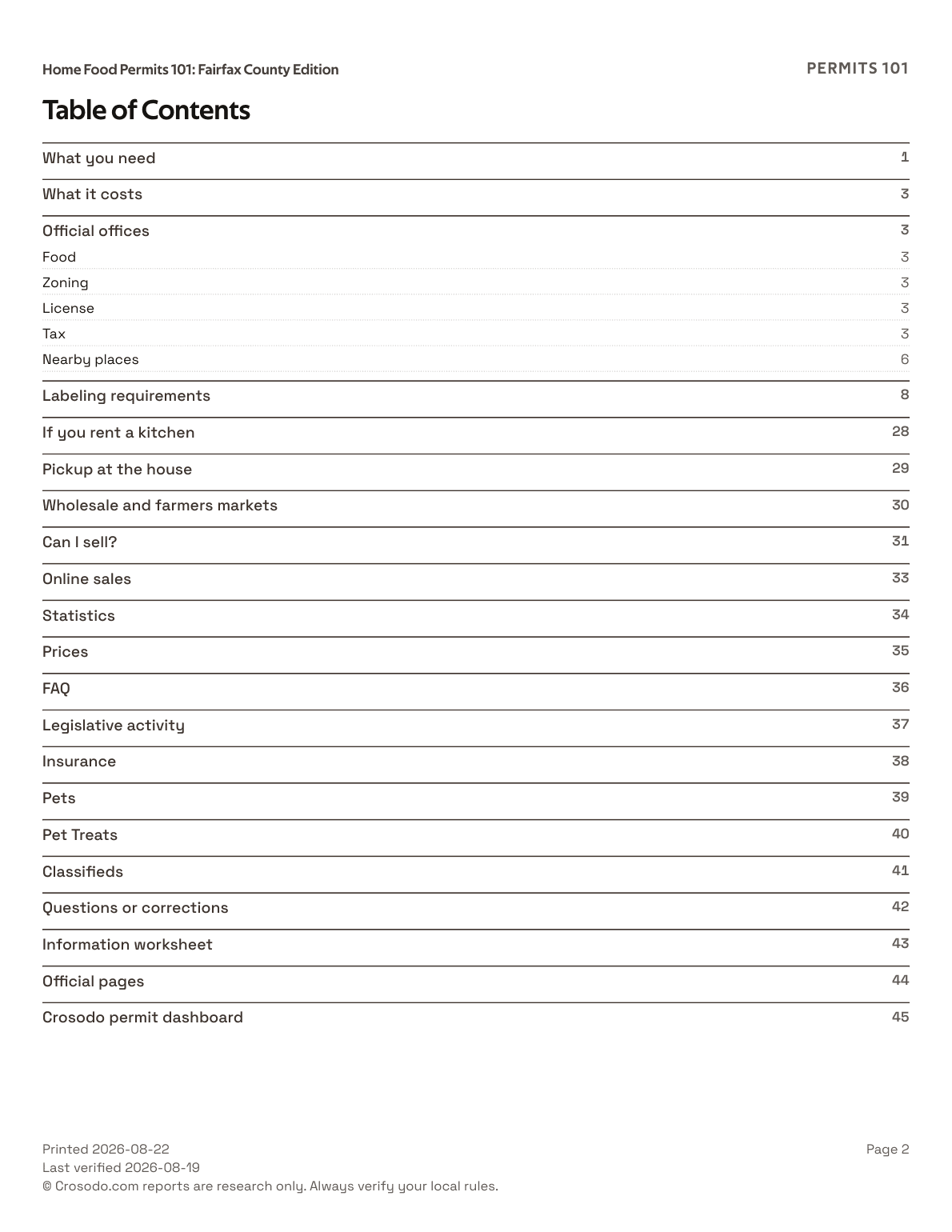
- Full California statute text with key provisions and official citation
- Allowed and prohibited foods, labeling rules, sales cap (Tiered (see notes))
- Registration and permit steps with direct state-agency links
- All 58 California counties with zoning + health department links
- 189-page guide with every official source URL, licensed to your address
What exactly am I buying?
The complete California License & Permit Guide — not the free 2-page preview above.
How do I receive it?
Stripe checkout. We email a cover letter, paid receipt, and the guide (PDF) licensed to your address.
Is it current?
Every report lists its official sources so you can verify against the current statute. See also the research-verified California guide.
Not ready? Get free California cottage-food updates instead.
California Homemade Food Act (AB 1616, amended AB 1144/AB 831)
Verbatim Excerpt(a) "Cottage food operation" means an enterprise that has no more than the amount in gross annual sales that is specified in this subdivision, is operated by a cottage food operator, and has no more than one full-time equivalent cottage food employee, not including a family member or household member of the cottage food operator, within the registered or permitted area of a private home where the cottage food operator resides and where cottage food products are prepared or packaged for direct, indirect, or direct and indirect sale to consumers pursuant to this part. A "Class A" cottage food operation shall not have more than seventy-five thousand dollars ($75,000) in verifiable gross annual sales. A "Class B" cottage food operation shall not have more than one hundred fifty thousand dollars ($150,000) in verifiable gross annual sales. The gross annual sales for a "Class A" or "Class B" cottage food operation shall be annually adjusted for inflation based on the California Consumer Price Index. (1) A "Class A" cottage food operation, which is a cottage food operation that may engage only in direct sales of cottage food products from the cottage food operation or other direct sales venues. (2) A "Class B" cottage food operation, which is a cottage food operation that may engage in both direct sales and indirect sales of cottage food products from the cottage food operation, from direct sales venues, from offsite events, or from a third-party retail food facility. (3) "Cottage food products" means nonpotentially hazardous foods, including foods that are described in Section 114365.5 and that are prepared for sale in the kitchen of a cottage food operation. (4) "Direct sale" means a transaction within the state between a cottage food operation and a consumer, in which the consumer purchases the cottage food product directly from the cottage food operation. Direct sales include, but are not limited to, transactions at holiday bazaars or other temporary events, such as bake sales or food swaps, transactions at farm stands, certified farmers' markets, or through community-supported agriculture subscriptions.
Source: leginfo.legislature.ca.gov/faces/codes_displaySection.xhtml?lawCode=HSC§ionNum=113758 →
Only foods on the official state-approved foods list may be sold; this includes most non-perishable foods such as baked goods, jams and preserves, candies, chocolates, dried goods, and spices. Class A operations are limited to direct sales (including online and shipping within California); Class B operations may additionally sell through retail stores and restaurants.
Temperature-controlled and perishable foods are prohibited. Products must be nonpotentially hazardous. Interstate sales are not permitted. All sales and deliveries must remain within California.
Labels must include the county name, permit or registration number, and the statement 'Made in a Home Kitchen' or 'Repackaged in a Home Kitchen.' Wherever the CFO advertises to the public (including websites and social media), all three of these items must be included.
Tiered (see notes)
Good (IJ Grade C)
58
California Counties (58)
Cottage food registration usually happens at the county level. Click any county for local zoning, health department, and planning department links.
Where to verify California's rules
Data compiled from primary sources. Cottage food laws change — verify with your state agency before relying on this information.
Cottage food laws are amended every year. This is a starting reference, not legal advice. Verify with California Department of Public Healthand your local health department before relying on this data.