
Maine Cottage Food Law PDF 2026 — Full Legal Text + Annotations
Full statute text, allowed foods, registration, sales cap None, and all 16 Maine counties with zoning + health department links. 65-page PDF with official sources. Free preview below — buy the complete guide for $44.
This page shows the first 2 pages + statute excerpt. One-time $44 · Yours to keep · Stripe checkout · Guide (PDF) emailed with receipt.
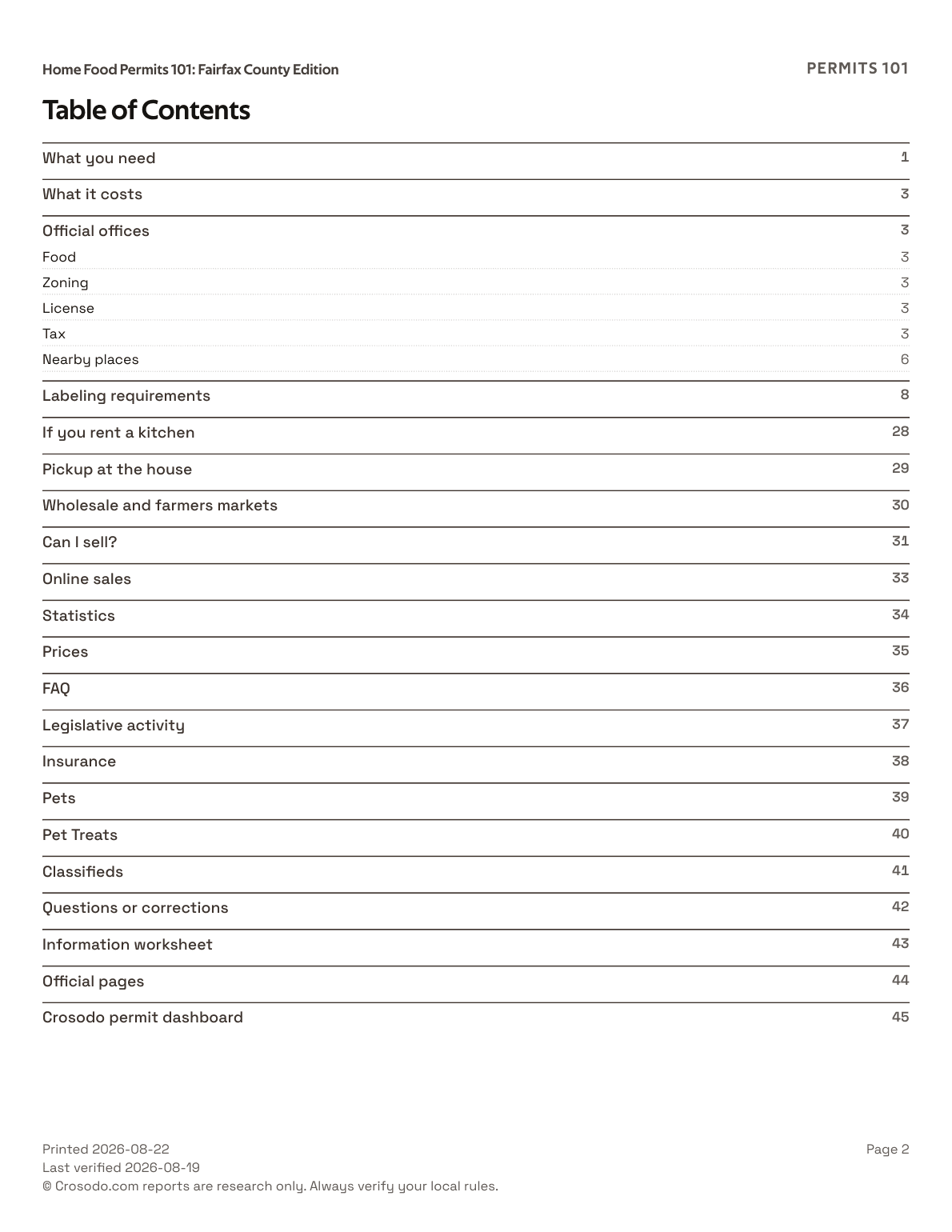
- Full Maine statute text with key provisions and official citation
- Allowed and prohibited foods, labeling rules, sales cap (None)
- Registration and permit steps with direct state-agency links
- All 16 Maine counties with zoning + health department links
- 65-page guide with every official source URL, licensed to your address
What exactly am I buying?
The complete Maine License & Permit Guide — not the free 2-page preview above.
How do I receive it?
Stripe checkout. We email a cover letter, paid receipt, and the guide (PDF) licensed to your address.
Is it current?
Every report lists its official sources so you can verify against the current statute. See also the research-verified Maine guide.
Not ready? Get free Maine cottage-food updates instead.
Maine Revised Statutes Title 7, Chapter 8-F — Direct Producer-to-Consumer Transactions (Food Sovereignty Act), Sections 282–285; originally enacted PL 2017, c. 314, last amended PL 2025, c. 309
Verbatim Excerpt§282. Definitions As used in this chapter, unless the context otherwise indicates, the following terms have the following meanings. [PL 2017, c. 314, §1 (NEW).] 1. Direct producer-to-consumer transaction. "Direct producer-to-consumer transaction" means an exchange of food or food products directly between a food producer and a consumer by barter, trade or purchase on the property or premises owned, leased or rented by the food producer; at roadside stands, fundraisers, farmers' markets and community social events; or through buying clubs, deliveries or community-supported agriculture programs, herd-share agreements and other private arrangements. [PL 2023, c. 420, §1 (AMD).] 2. Food or food products. "Food or food products" means food or food products that are grown, produced, processed or prepared for human consumption, including, but not limited to, vegetables, fruit, eggs, grain or grain products, herbs, seasonings or spices, milk or milk products, meat or meat products, poultry or poultry products, fish or fish products, seafood or seafood products, cider or juice, acidified foods, canned fruits or vegetables, honey, nuts, maple products or condiments or any combination of those items, such as baked goods, sandwiches or other meals, and that are provided in a direct producer-to-consumer transaction. [PL 2025, c. 309, §5 (AMD).] 2-B. Food sovereignty. "Food sovereignty" means the right of persons to healthy and culturally appropriate food produced through ecologically sound and sustainable methods and the right of persons to define their own food and agriculture systems. §284. Authority Notwithstanding any provision of law regulating food in this Title or Title 22 to the contrary, except as contained in section 285, a municipality or plantation may adopt ordinances regarding traditional foodways and direct producer-to-consumer transactions, and the State shall recognize such ordinances by not enforcing those laws or implementing rules with respect to those traditional foodways or direct producer-to-consumer transactions that are governed by the ordinance.
Source: legislature.maine.gov/statutes/7/title7sec282.html →
Under the Food Sovereignty Act, in municipalities with local food sovereignty ordinances, almost any food produced and sold in a direct producer-to-consumer transaction is allowed, including vegetables, fruits, eggs, dairy, meat, poultry, fish, seafood, cider, juice, acidified foods, canned fruits/vegetables, honey, nuts, maple products, baked goods, sandwiches, and other meals. Under the statewide home food processor license (separate from the Food Sovereignty Act), most shelf-stable non-TCS foods are allowed after kitchen inspection.
Under the statewide home food processor license pathway, perishable baked goods are prohibited and low-acid pressure-canned foods made at home may not be sold. Acidified foods (salsas, pickles, certain dressings, chocolate sauces) require prior approval from the University of Maine's School of Food and Agriculture. The Food Sovereignty Act's municipal ordinance pathway has fewer prohibitions but is limited to participating municipalities.
Under the statewide license, label requirements apply for packaged products sold away from the home; however, no label is required for products sold directly from the producer's home. Labels for retail/market sales must include standard food labeling information. The Food Sovereignty Act municipal ordinance pathway may have different local requirements.
None
Freedom (IJ Grade B+)
16
Maine Counties (16)
Cottage food registration usually happens at the county level. Click any county for local zoning, health department, and planning department links.
Where to verify Maine's rules
Data compiled from primary sources. Cottage food laws change — verify with your state agency before relying on this information.
Cottage food laws are amended every year. This is a starting reference, not legal advice. Verify with Maine Department of Agriculture, Conservation and Forestryand your local health department before relying on this data.