
South Carolina Cottage Food Law PDF 2026 — Full Legal Text + Annotations
Full statute text, allowed foods, registration, sales cap None, and all 46 South Carolina counties with zoning + health department links. 140-page PDF with official sources. Free preview below — buy the complete guide for $44.
This page shows the first 2 pages + statute excerpt. One-time $44 · Yours to keep · Stripe checkout · Guide (PDF) emailed with receipt.
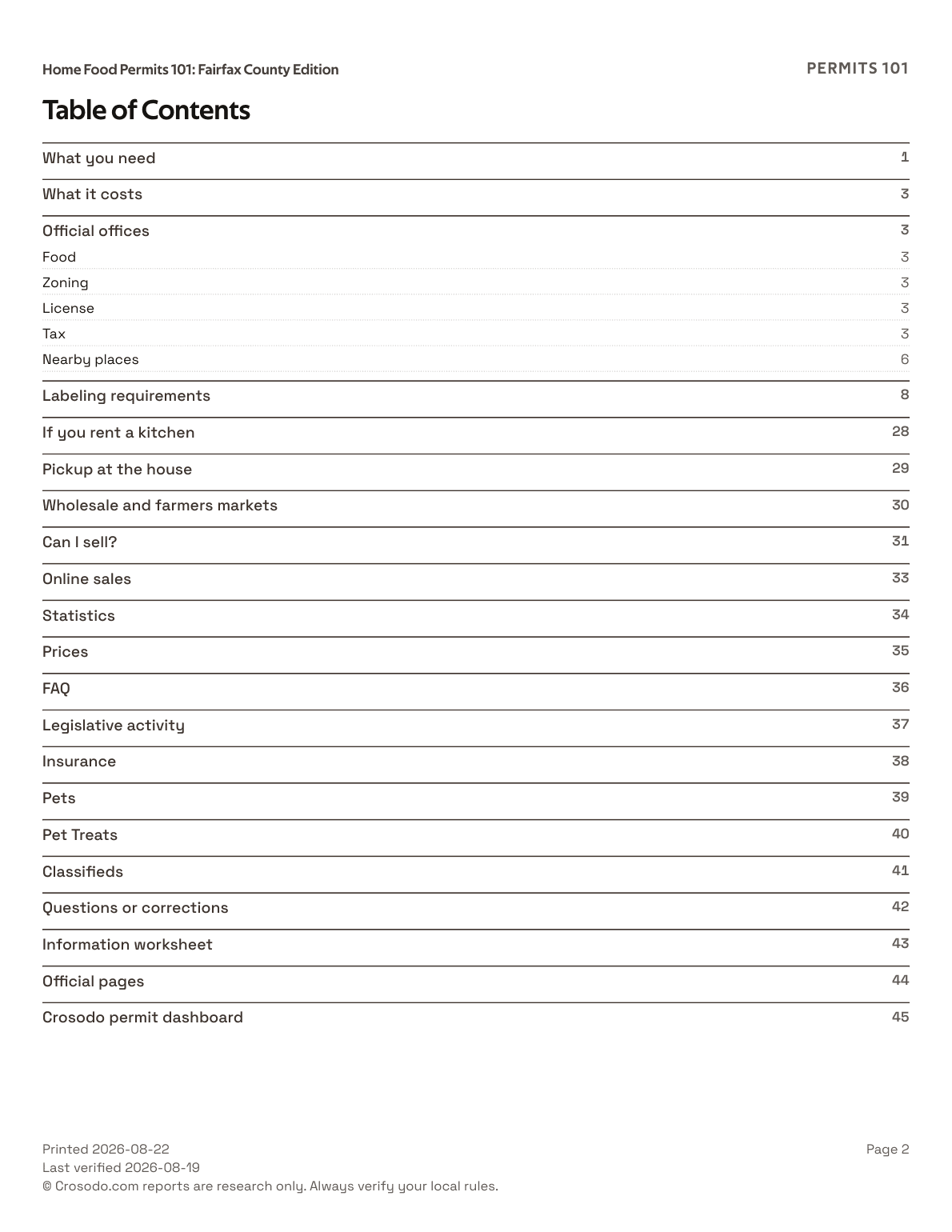
- Full South Carolina statute text with key provisions and official citation
- Allowed and prohibited foods, labeling rules, sales cap (None)
- Registration and permit steps with direct state-agency links
- All 46 South Carolina counties with zoning + health department links
- 140-page guide with every official source URL, licensed to your address
What exactly am I buying?
The complete South Carolina License & Permit Guide — not the free 2-page preview above.
How do I receive it?
Stripe checkout. We email a cover letter, paid receipt, and the guide (PDF) licensed to your address.
Is it current?
Every report lists its official sources so you can verify against the current statute. See also the research-verified South Carolina guide.
Not ready? Get free South Carolina cottage-food updates instead.
South Carolina Code of Laws, Title 44 – Health, Chapter 1 – Department of Public Health, Section 44-1-145 (Home-Based Food Production Operations)
Verbatim Excerpt(A) As used in this section: (1) "Home-based food production operation" means a person who produces food items in the kitchen of their primary domestic residence for direct sale to consumers, including online and by mail order, or to retail stores, including grocery stores. The person must not produce foods that are potentially hazardous. Foods in item (2) with a pH value greater than 5.6 and foods in item (3) with a pH value greater than 4.6 are considered potentially hazardous unless a product assessment is conducted pursuant to the 2009 Federal Drug Administration Food Code. (D) All food items packaged at the operation for sale must be properly labeled. The label must comply with federal laws and regulations and must include: (1) the name and address of the home-based food production operation. If a home-based food production operator does not want to include his address on the label, then the department shall provide an identification number to the operator, upon the operator's request, that can be used on the label instead; (2) the name of the product being sold; (3) the ingredients used to make the product in descending order of predominance by weight; and (4) a conspicuous statement printed in all capital letters and in a color that provides a clear contrast to the background that reads: "PROCESSED AND PREPARED BY A HOME-BASED FOOD PRODUCTION OPERATION THAT IS NOT SUBJECT TO SOUTH CAROLINA'S FOOD SAFETY REGULATIONS." (E) Home-based food operations only may sell, or offer to sell, food items directly to a person, including online and by mail order, or to retail stores, including grocery stores. (F) A home-based food production operation is not a retail food establishment and is not subject to regulation by the department pursuant to Regulation 61.25. (G) The provisions of this section do not apply to an operation with net earnings of less than fifteen hundred dollars annually.
Source: scstatehouse.gov/code/t44c001.php →
Non-potentially hazardous foods produced in the kitchen of a primary domestic residence are allowed, including baked goods, candy, jams, jellies, and other shelf-stable foods not requiring refrigeration. The 2022 amendment expanded allowed distribution to retail stores and grocery stores.
Potentially hazardous foods (those requiring refrigeration for safety) are prohibited unless a product assessment is conducted pursuant to the 2009 FDA Food Code; foods with pH above 5.6 (non-acid foods) or pH above 4.6 (acidified foods) are presumed potentially hazardous.
Labels must include: name and address of the home-based food production operation (or department-issued ID number if operator prefers not to disclose address); name of product; ingredients in descending order of predominance by weight; and the conspicuous all-caps disclaimer 'PROCESSED AND PREPARED BY A HOME-BASED FOOD PRODUCTION OPERATION THAT IS NOT SUBJECT TO SOUTH CAROLINA'S FOOD SAFETY REGULATIONS.'
None
Good (IJ Grade B-)
46
South Carolina Counties (46)
Cottage food registration usually happens at the county level. Click any county for local zoning, health department, and planning department links.
Where to verify South Carolina's rules
Data compiled from primary sources. Cottage food laws change — verify with your state agency before relying on this information.
Cottage food laws are amended every year. This is a starting reference, not legal advice. Verify with South Carolina Department of Agricultureand your local health department before relying on this data.