
Cottage food law & license in York County, SC
Reviewed · Guide (PDF) emailed after checkout · Yours to keep
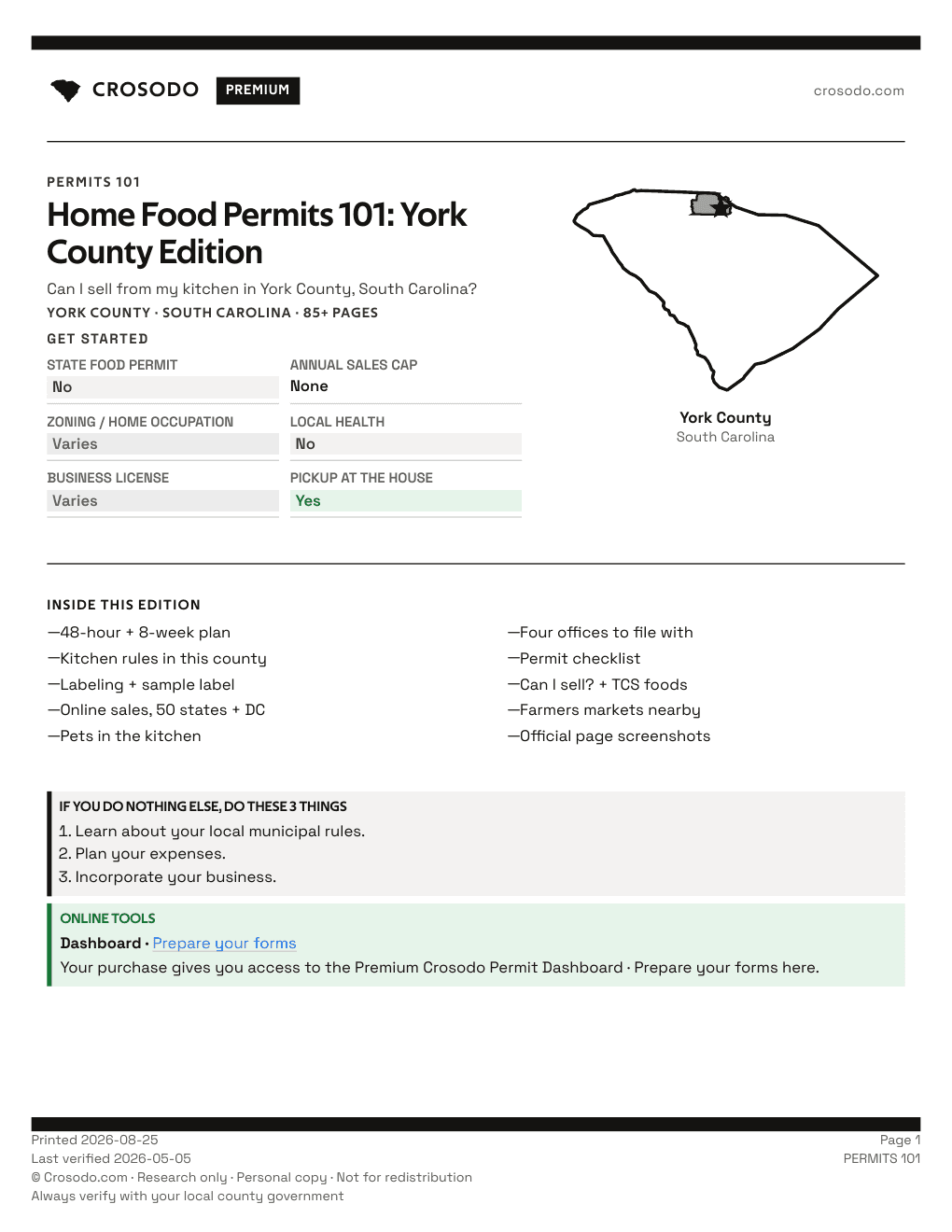
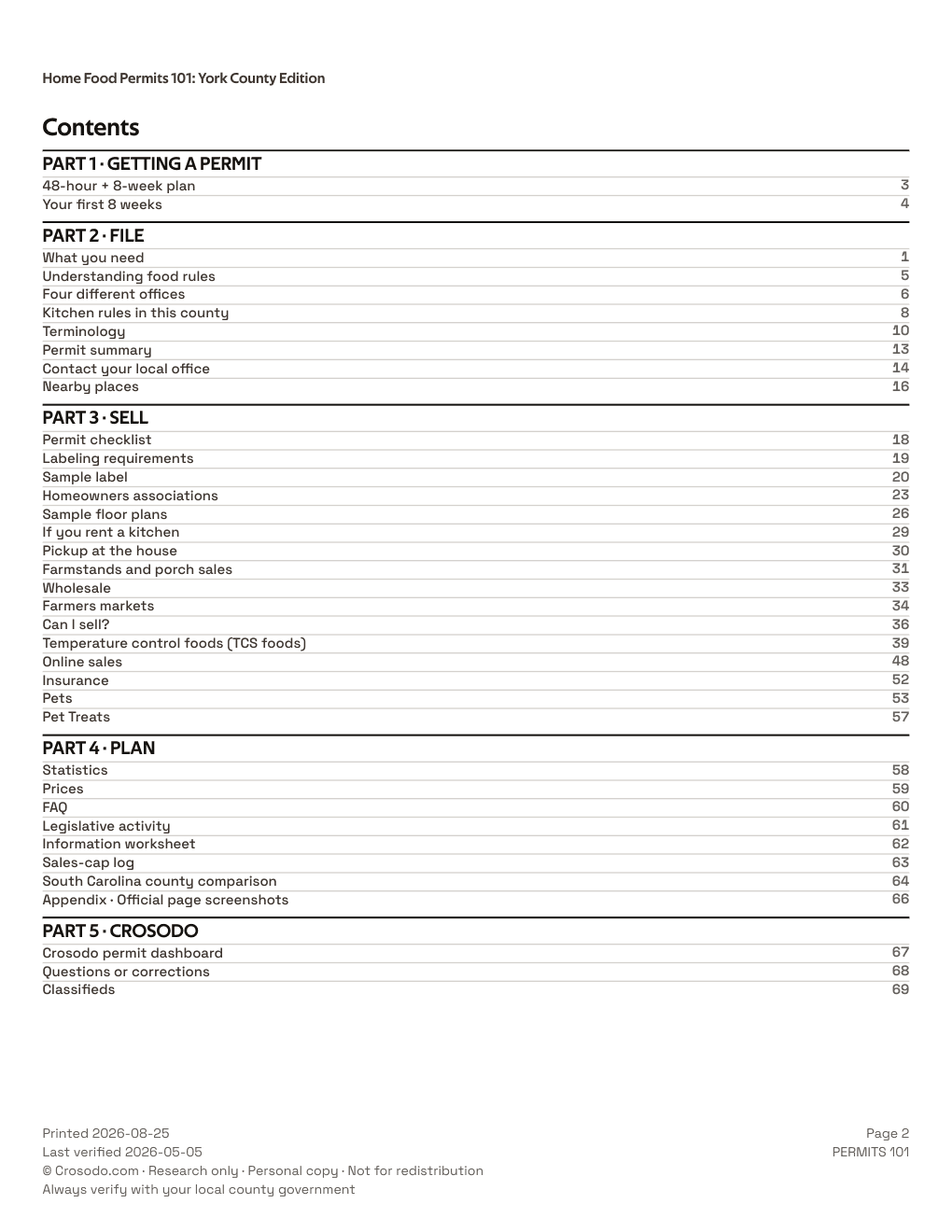
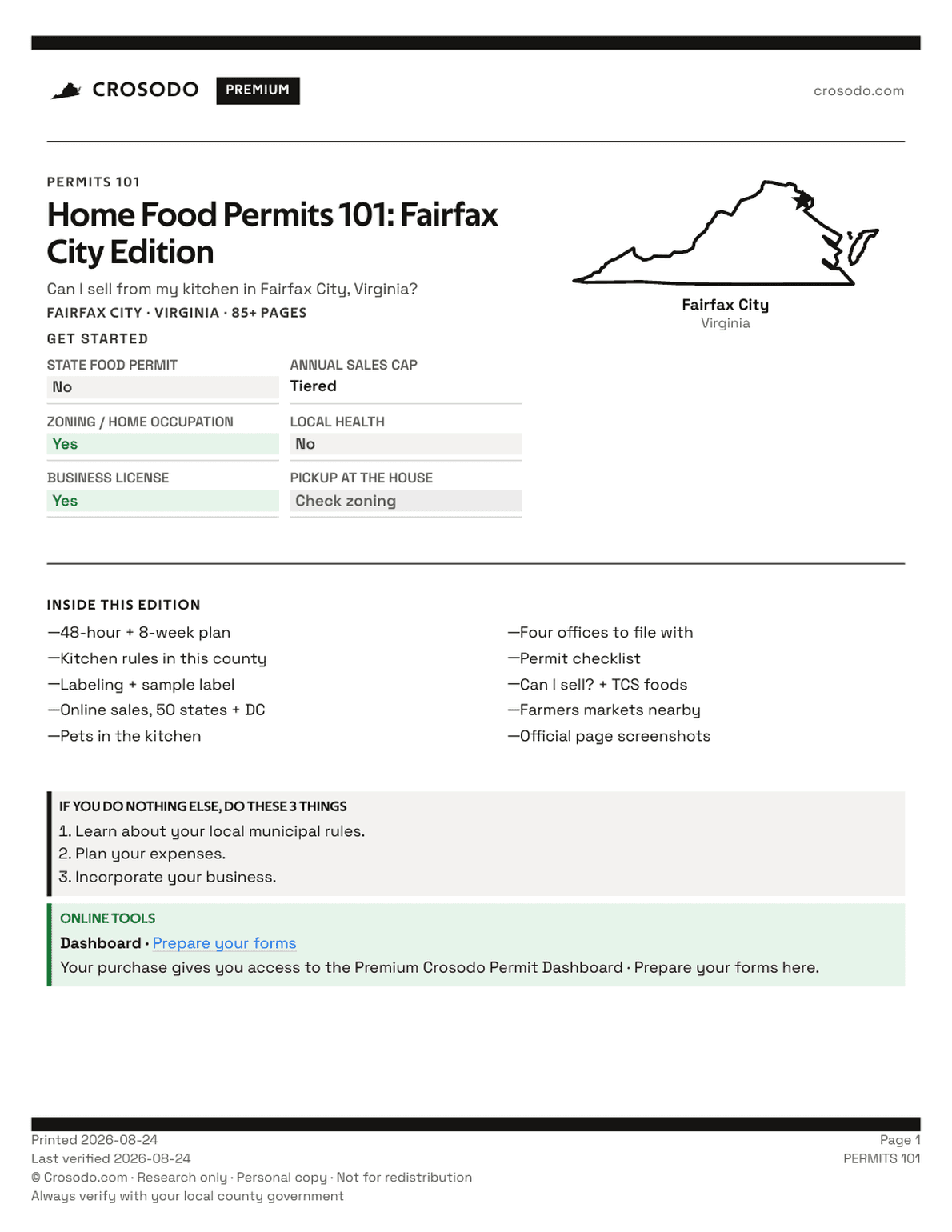
York County Permits 101 for York County, South Carolina (69 pages). After you pay, you get lifetime access to premium dashboard features. Unlock the permit planning workspace on your dashboard.
South Carolina cottage food — common first products
County zoning cannot expand a state ban. Check the product, then the local rules on this page.
What's in the York County permit report
How to start in York County
Permit, label, and local steps for selling under South Carolina cottage food rules in York County. Not legal advice.
Confirm your menu under state law
South Carolina cottage food rules control what you may make at home (Non-potentially hazardous foods produced in the kitchen of a primary domestic residence are allowed, including baked goods, candy, jams, jellies, and other shelf-stable foods not requiring refrigeration. The 2022 amendment expanded allowed distribution to retail stores and grocery stores.). York County cannot expand a food the state bans.
Map channels and local sales rules
State sales cap: No cap. On-site / porch pickup in York County: Yes. Prefer markets or off-site pickup if residential customer traffic is restricted.
Local permits, tax, and home occupation
Home occupation permit: Varies. Many places still need a general business license or tax certificate even when the state has no cottage food “permit.” Check planning, the clerk, and any HOA or lease before advertising your address.
Training, registration, inspection
State registration: No. Local inspection in York County: No. Finish food handler training early — markets often ask for a copy.
Labels that match the state
Print labels with South Carolina disclaimer and allergen rules before market day. Use the free South Carolina label page for the one-pager checklist and mockup.
Insurance and first sales
Farmers markets often require a certificate of insurance. Soft-launch with pre-orders, keep a sales log, and re-verify rules if you change products or venues.
What usually goes on the package
- Product name (common or usual name of the food)
- Business or producer name
- Producer address (or address alternative your state allows)
- Ingredients in descending order by weight
- Major allergen disclosures (e.g. wheat, milk, eggs, soy, tree nuts, peanuts, fish, shellfish, sesame)
- Net weight or quantity
- Home-kitchen disclaimer: “PROCESSED AND PREPARED BY A HOME-BASED FOOD PRODUCTION OPERATION THAT IS NOT SUBJECT TO SOUTH CAROLINA'S FOOD SAFETY REGULATIONS.”
Planning checklist only. Confirm with state and local agencies before you sell.
York County is a county in South Carolina (pop. 282,987). Under South Carolina's Good-tier cottage food law (sales cap: None), home bakers must still clear local zoning and health rules in this county. Registration path: No. Start with South Carolina Department of Agriculture (state cottage food page linked below), then confirm York County health and planning requirements via the planning / zoning links on this page. Local notes for York County: home kitchen allowed; inspection not required; home occupation permit not required. York County is Charlotte, NC metro suburb (Rock Hill area). Same SC state baseline. No county-specific cottage food overlay found. Download the free reports below for a portable summary, and always re-check official sources before you sell.
York County cottage food reports
Home cottage-food permit stack — zoning, health, license, and what the state does not require.
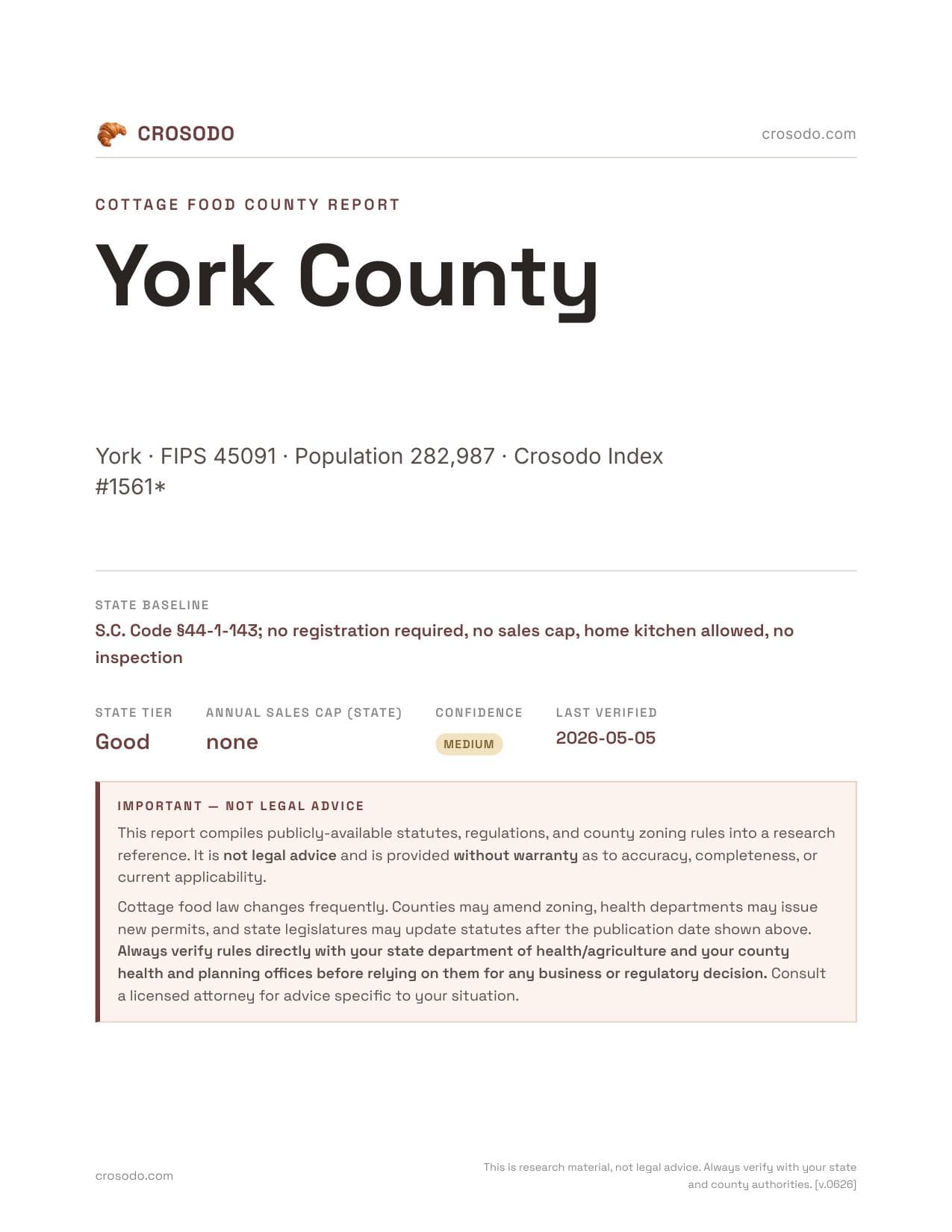
Zoning, permits, health department rules, and local sources for York County.
Download county report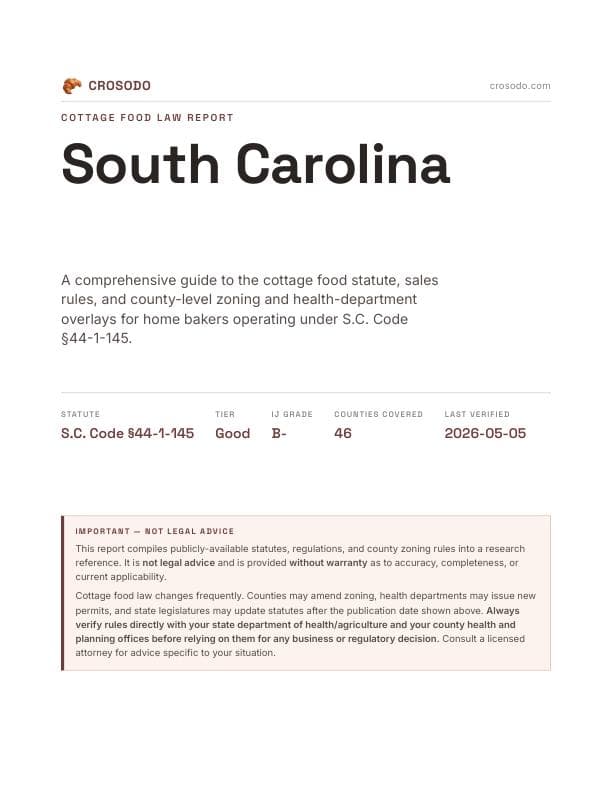
Full South Carolina License & Permit Guide (140 pages). Statute, all counties, and official source links.
Tier: Good
South Carolina has a Good-tier cottage food law — solid baseline with moderate restrictions, typically a high sales cap (often $50K+) and standard direct-to-consumer rules. Workable for most home bakers with reasonable scale plans.
South Carolina cottage food law →Health department
Many states delegate cottage food registration and inspection to the county health department. Contact theirs for the local process.
Home occupation rules
The county or city zoning code governs whether you can run a home-based food business — customer visits, signage, employees, floor area.
Home kitchen, inspection, and zoning rules for York County
State baseline: S.C. Code §44-1-143; no registration required, no sales cap, home kitchen allowed, no inspection
- Home kitchen allowed
- Yes
- Restrictions
- No domestic activities in kitchen during production; pets excluded from production area; water/sewage must meet state standards; non-TCS foods only
- Separate dedicated kitchen
- No
- Pet restrictions
- All animals including pets excluded from production area during food production
- Water supply
- Water and sewage disposal systems must meet state standards
- Handwashing
- Standard food safety handwashing
- Food storage
- Stored in sanitary conditions
- Inspection required
- No
- Inspection trigger
- No state inspection required
- Home occupation permit
- Varies
- Permit details
- No state food permit required. York County Planning Department (yorkcounty.gov/planning) may have home occupation zoning requirements; operator should verify with York County Planning
- Local business license
- Varies
- On-site customer pickup
- Yes
- On-site signage
- Conditional
- Delivery / pickup
- Direct to consumer including online and mail within SC; also to retail stores for resale
- Max employees in home
- Not specified
- Relevant code section
- Not identified
York County is Charlotte, NC metro suburb (Rock Hill area). Same SC state baseline. No county-specific cottage food overlay found.
South Carolina Code of Laws, Title 44 – Health, Chapter 1 – Department of Public Health, Section 44-1-145 (Home-Based Food Production Operations)
Full South Carolina License & Permit Guide →Verbatim excerpt(A) As used in this section: (1) "Home-based food production operation" means a person who produces food items in the kitchen of their primary domestic residence for direct sale to consumers, including online and by mail order, or to retail stores, including grocery stores. The person must not produce foods that are potentially hazardous. Foods in item (2) with a pH value greater than 5.6 and foods in item (3) with a pH value greater than 4.6 are considered potentially hazardous unless a product assessment is conducted pursuant to the 2009 Federal Drug Administration Food Code. (D) All food items packaged at the operation for sale must be properly labeled. The label must comply with federal laws and regulations and must include: (1) the name and address of the home-based food production operation. If a home-based food production operator does not want to include his address on the label, then the department shall provide an identification number to the operator, upon the operator's request, that can be used on the label instead; (2) the name of the product being sold; (3) the ingredients used to make the product in descending order of predominance by weight; and (4) a conspicuous statement printed in all capital letters and in a color that provides a clear contrast to the background that reads: "PROCESSED AND PREPARED BY A HOME-BASED FOOD PRODUCTION OPERATION THAT IS NOT SUBJECT TO SOUTH CAROLINA'S FOOD SAFETY REGULATIONS." (E) Home-based food operations only may sell, or offer to sell, food items directly to a person, including online and by mail order, or to retail stores, including grocery stores. (F) A home-based food production operation is not a retail food establishment and is not subject to regulation by the department pursuant to Regulation 61.25. (G) The provisions of this section do not apply to an operation with net earnings of less than fifteen hundred dollars annually.
Source: scstatehouse.gov/code/t44c001.php →
York County Permit Guide $26
This page stays free — the York County statute, zoning notes, and official links. Permit Guide 101 is the paid packet (69 pages): the home cottage-food permit stack (zoning, health, and business license), the checklist, and the dashboard workspace. That packet is not on this free page.
York County cottage food — FAQ
Do I need a permit to sell cottage food in York County, South Carolina?
Home occupation permit: Varies. No state food permit required. York County Planning Department (yorkcounty.gov/planning) may have home occupation zoning requirements; operator should verify with York County Planning State cottage food registration may also apply — check the South Carolina guide at https://crosodo.com/states/south-carolina.
Is a health inspection required for home bakers in York County?
Inspection: No. Trigger: No state inspection required. Non-TCS baked goods are often exempt from kitchen inspection under state cottage food law, but local rules can differ.
What foods can I sell under South Carolina cottage food law in York County?
Non-potentially hazardous foods produced in the kitchen of a primary domestic residence are allowed, including baked goods, candy, jams, jellies, and other shelf-stable foods not requiring refrigeration. The 2022 amendment expanded allowed distribution to retail stores and grocery stores. County zoning does not expand the state product list — if a food is banned by South Carolina, it stays banned. Verify with the state agency before selling.
What is the sales cap for cottage food in South Carolina?
South Carolina state law lists cottage food sales at None. There is typically no separate county sales cap, but local permits or zoning can still limit operations.
Do I need a home occupation permit in York County?
Home occupation permit: Varies. No state food permit required. York County Planning Department (yorkcounty.gov/planning) may have home occupation zoning requirements; operator should verify with York County Planning
The free county page is the short version. This is the full South Carolina License & Permit Guide (140 pages) — statute, every county we have researched, and official source URLs. Stripe checkout. Cover letter, paid receipt, and the guide (PDF) licensed to your address.
Unlimited Pass. Your journey to getting permitted for cottage food sales. Premium dashboard tools, unlimited state and county reports, and the 50-state label report. Lifetime access. Includes the full South Carolina License & Permit Guide (140 pages).
Where to verify York County rules
York County vs. bordering counties
| Regulation | York County This county | Lancaster County | Cherokee County |
|---|---|---|---|
| Home kitchen allowed | Yes | Yes | Yes |
| Separate dedicated kitchen | No | No | No |
| Pets allowed | All animals including pets excluded from production area during food production | No specific restriction under South Carolina cottage food law. | No specific SC state or Cherokee County restriction found. |
| Inspection required | No | No | No |
| On-site customer pickup | Yes | Yes | Yes |
| On-site signage | Conditional | Conditional | Conditional |
| Delivery / pickup | Direct to consumer including online and mail within SC; also to retail stores for resale | Direct and indirect sales allowed. Retail stores, grocery stores, online, mail order, farmers markets, home pickup all permitted as of 2022… | Direct and indirect sales (retail stores) permitted since 2022. Online and mail order allowed. Department-issued ID number may be used in l… |
| Home occupation permit | Varies | Varies | Varies |
| Local business license | Varies | Varies | Varies |
| Restrictions | No domestic activities in kitchen during production; pets excluded from production area; water/sewage must meet state standards; non-TCS fo… | South Carolina cottage food law (§44-1-145, 2022 amendment): no registration, no inspection, no sales cap. Allowed: non-PHF foods from prim… | Non-potentially hazardous foods from primary domestic residence kitchen. No registration, permit, or inspection required. No sales cap. Ret… |
| Food storage | Stored in sanitary conditions | Non-PHF shelf-stable foods only; pH or water activity assessment may be needed for borderline products. | Products must be non-potentially hazardous and shelf-stable. Cannot have pH above 5.6 (non-acid foods) or above 4.6 (acidified foods) witho… |
| Population | 282,987 | 97,611 | 56,200 |
York County baker discussion
53 public threads from bakers talking about York County — permits, zoning, markets, and what's selling. Read along or sign in to post.
Other South Carolina counties
Resources for cottage food and home bakers
Supplies, courses, insurance, farmers markets, kitchen rentals, and local services. To advertise here, visit crosodo.com/advertise. Browse all classifieds.
Advertise here
Packaging, labels, baking tools, bulk ingredients, and equipment for cottage food operators. Reach home bakers across the country.
crosodo.com/advertiseAdvertise here
Baking classes, cottage food business training, workshops, and food safety education. Reach home bakers across the country.
crosodo.com/advertiseAdvertise here
Product liability, home bakery, market vendor, and small food business insurance. Reach home bakers across the country.
crosodo.com/advertiseAdvertise in York County, South Carolina
Reach home bakers in York County, South Carolina. Supply stores, farmers markets, kitchen rentals, co-packer referrals, and bakery services are welcome.
Learn about placementsYour business here
Local cottage food listings, community kitchens, farmers market dates, and non-profit events can be submitted for review.
Post in the local discussionAds are paid placements. Crosodo does not endorse listed vendors. Verify all product, service, course, insurance, and legal information independently.
Cottage food law and municipal zoning interact in non-obvious ways. Before investing in equipment or marketing, talk to South Carolina's department of agriculture, your local health department, and your county or city's planning office. Crosodo is a clothing brand for cottage bakers, not a law firm.
Local bakers discuss zoning, permits, top sellers, sourdough, farmers markets, and more in the Crosodo forum.