
Wisconsin Cottage Food Law PDF 2026 — Full Legal Text + Annotations
Full statute text, allowed foods, registration, sales cap Tiered, and all 72 Wisconsin counties with zoning + health department links. 229-page PDF with official sources. Free preview below — buy the complete guide for $44.
This page shows the first 2 pages + statute excerpt. One-time $44 · Yours to keep · Stripe checkout · Guide (PDF) emailed with receipt.
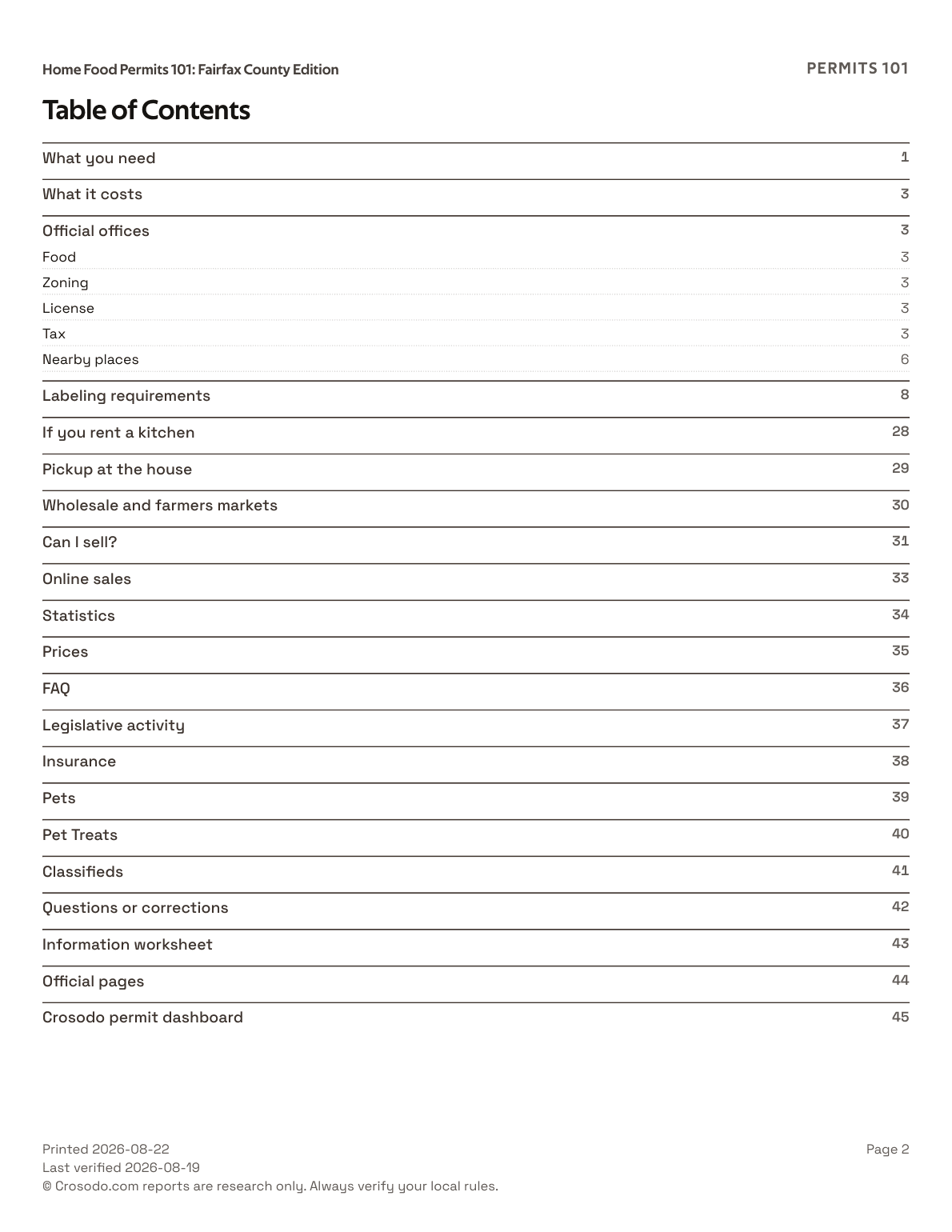
- Full Wisconsin statute text with key provisions and official citation
- Allowed and prohibited foods, labeling rules, sales cap (Tiered)
- Registration and permit steps with direct state-agency links
- All 72 Wisconsin counties with zoning + health department links
- 229-page guide with every official source URL, licensed to your address
What exactly am I buying?
The complete Wisconsin License & Permit Guide — not the free 2-page preview above.
How do I receive it?
Stripe checkout. We email a cover letter, paid receipt, and the guide (PDF) licensed to your address.
Is it current?
Every report lists its official sources so you can verify against the current statute. See also the research-verified Wisconsin guide.
Not ready? Get free Wisconsin cottage-food updates instead.
Wisconsin Statutes Chapter 97 Food, §97.29 Food processing plants (cottage food exemption at §97.29(2)(b)2); supplemented by Kivirist v. DATCP court order (2017) for home bakers
Verbatim Excerpt97.29(2)(b)2. A person is not required to obtain a license under this section to sell at retail food products that the person prepares and cans at home in this state if all of the following apply: a. The food products are pickles or other processed vegetables or fruits with an equilibrium pH value of 4.6 or lower. b. The person sells the food products at a community or social event or a farmers' market in this state. c. The person receives less than $5,000 per year from the sale of the food products. d. The person displays a sign at the place of sale stating: "These canned goods are homemade and not subject to state inspection." e. Each container of food product that is sold is labeled with the name and address of the person who prepared and canned the food product, the date on which the food product was canned, the statement "This product was made in a private home not subject to state licensing or inspection.", and a list of ingredients in descending order of prominence. If any ingredient originates from milk, eggs, fish, crustacean shellfish, tree nuts, wheat, peanuts, or soybeans, the list of ingredients shall include the common name of the ingredient. [The Kivirist v. DATCP circuit court order (2017) additionally enjoined enforcement of food processing and retail food establishment licensure against home bakers of good character who sell nonhazardous, shelf-stable baked goods direct to consumer at low volume, without a stated dollar cap. This court order was not appealed by DATCP and remains good law. A subsequent Court of Appeals decision (2024) held that this exception does NOT extend to unbaked nonpotentially hazardous homemade goods (chocolates, fudges, candies, etc.).]
Source: docs.legis.wisconsin.gov/document/statutes/97.29 →
Two distinct pathways: (1) Statute §97.29(2)(b)2 allows unlicensed home-canned pickles and acidified vegetables/fruits (pH 4.6 or lower) sold at community events or farmers' markets, capped at $5,000/year; (2) The Kivirist court order (2017) allows home bakers of good character to sell nonhazardous, shelf-stable baked goods direct to consumer at low volume without a license, with no stated dollar cap. DATCP may not enforce licensure against such bakers.
TCS (potentially hazardous) foods require a food processing plant license. The Kivirist exception applies only to baked goods — not to unbaked nonpotentially hazardous items (chocolates, fudge, candies, rice crispy treats, etc.), which remain subject to licensure per the 2024 Court of Appeals ruling. Home-canned goods above $5,000/year require licensure.
For home-canned goods (§97.29(2)(b)2): label must include the name and address of the preparer, the date canned, the statement 'This product was made in a private home not subject to state licensing or inspection,' and ingredients in descending order of prominence with major allergen common names listed. A sign at the point of sale must state: 'These canned goods are homemade and not subject to state inspection.' For home bakers under the Kivirist exemption, labeling requirements are not separately codified.
Tiered
Freedom (IJ Grade B)
72
Wisconsin Counties (72)
Cottage food registration usually happens at the county level. Click any county for local zoning, health department, and planning department links.
Where to verify Wisconsin's rules
Data compiled from primary sources. Cottage food laws change — verify with your state agency before relying on this information.
Cottage food laws are amended every year. This is a starting reference, not legal advice. Verify with Wisconsin Department of Agriculture, Trade and Consumer Protectionand your local health department before relying on this data.