
Colorado Cottage Food Law PDF 2026 — Full Legal Text + Annotations
Full statute text, allowed foods, registration, sales cap Tiered (see notes), and all 64 Colorado counties with zoning + health department links. 188-page PDF with official sources. Free preview below — buy the complete guide for $44.
This page shows the first 2 pages + statute excerpt. One-time $44 · Yours to keep · Stripe checkout · Guide (PDF) emailed with receipt.
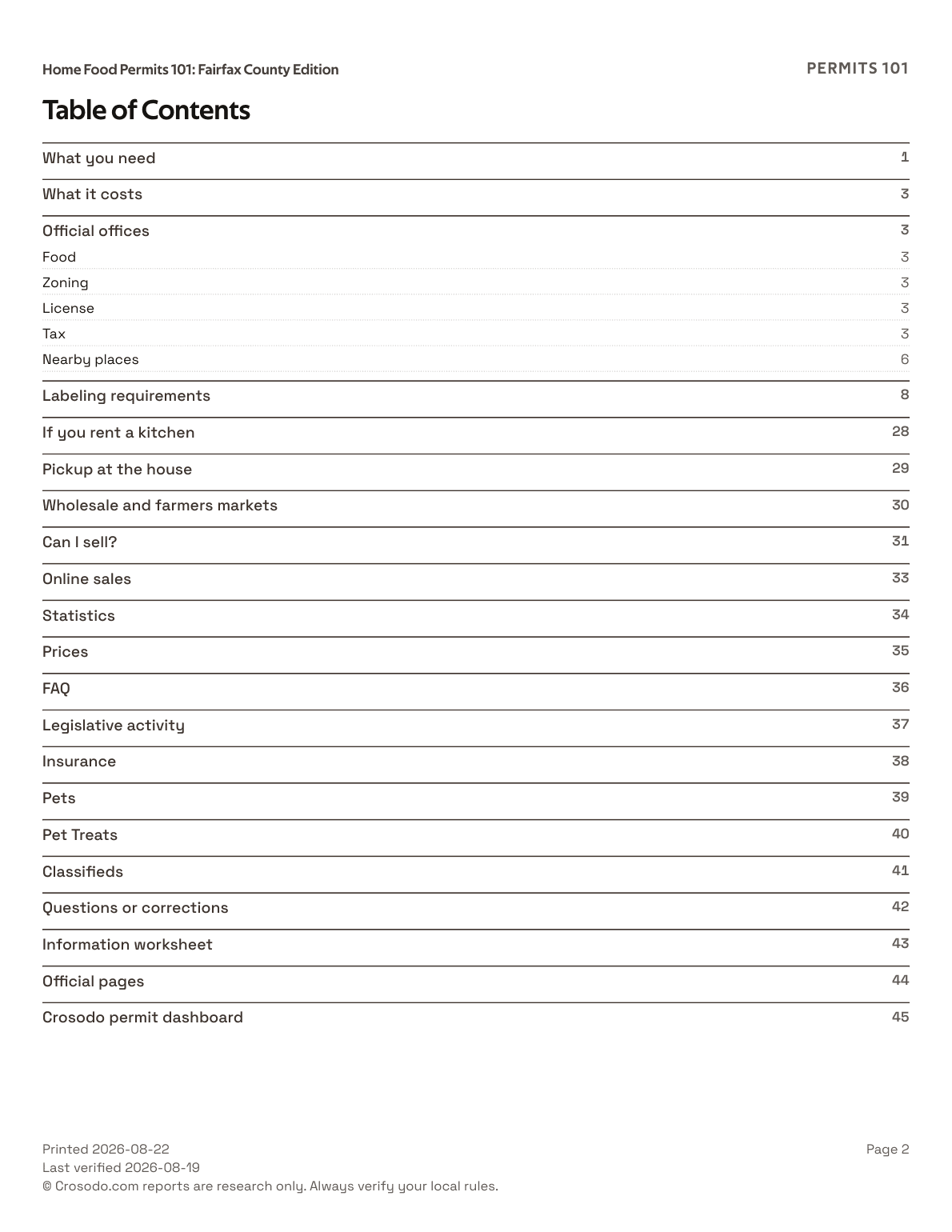
- Full Colorado statute text with key provisions and official citation
- Allowed and prohibited foods, labeling rules, sales cap (Tiered (see notes))
- Registration and permit steps with direct state-agency links
- All 64 Colorado counties with zoning + health department links
- 188-page guide with every official source URL, licensed to your address
What exactly am I buying?
The complete Colorado License & Permit Guide — not the free 2-page preview above.
How do I receive it?
Stripe checkout. We email a cover letter, paid receipt, and the guide (PDF) licensed to your address.
Is it current?
Every report lists its official sources so you can verify against the current statute. See also the research-verified Colorado guide.
Not ready? Get free Colorado cottage-food updates instead.
Colorado Cottage Foods Act
Verbatim Excerpt25-4-1614. Home kitchens - exemption - food inspection - short title - definitions - rules. (2)(b)(I) A producer is permitted under this section to sell only a limited range of foods that have been produced, processed, or packaged that are nonpotentially hazardous and do not require refrigeration. These foods include pickled fruits and vegetables, spices, teas, dehydrated produce, nuts, seeds, honey, jams, jellies, preserves, fruit butter, flour, and baked goods, including candies, fruit empanadas, and tortillas and other nonpotentially hazardous foods. (2)(c) A producer must take a food safety course that includes basic food handling training and is comparable to, or is, a course given by the Colorado state university extension service or a state, county, or district public health agency and must maintain a status of good standing in accordance with the course requirements. (2)(e) This section applies only to producers who earn net revenues of ten thousand dollars or less per calendar year from the sale of each eligible food product produced in the producer's home kitchen. (3)(a) A food product sold under this section must have an affixed label that includes at least: the name of the food product; the producer's name, the address at which the food was prepared, and the producer's current telephone number or electronic mail address; and a statement that reads: "This product was produced in a home kitchen that is not subject to state licensure or inspection. This product is not intended for resale."
Source: leg.colorado.gov/bill_files/40283/download →
Allowed non-refrigerated nonpotentially hazardous foods include baked goods (including candies, tortillas, empanadas), pickled fruits and vegetables (pH 4.6 or below), jams, jellies, preserves, fruit butter, spices, teas, dehydrated produce, nuts, seeds, honey, flour, and fermented foods. Whole eggs may be sold under a 250-dozen-per-month limit.
Prohibited foods include perishable baked goods, salsas, sauces, ketchup, mustards, meat jerkies, juices, and kombucha. Foods requiring refrigeration are not permitted under the current law (pending HB 26-1033 which would expand this if enacted).
Labels must include the product name, producer's name and address, phone number or email, and the statement: 'This product was produced in a home kitchen that is not subject to state licensure or inspection. This product is not intended for resale.' A sign with this same statement must be displayed at the point of sale.
Tiered (see notes)
Great (IJ Grade B-)
64
Colorado Counties (64)
Cottage food registration usually happens at the county level. Click any county for local zoning, health department, and planning department links.
Where to verify Colorado's rules
Data compiled from primary sources. Cottage food laws change — verify with your state agency before relying on this information.
Cottage food laws are amended every year. This is a starting reference, not legal advice. Verify with Colorado Department of Public Health and Environmentand your local health department before relying on this data.