
Indiana Cottage Food Law PDF 2026 — Full Legal Text + Annotations
Full statute text, allowed foods, registration, sales cap None, and all 92 Indiana counties with zoning + health department links. 262-page PDF with official sources. Free preview below — buy the complete guide for $44.
This page shows the first 2 pages + statute excerpt. One-time $44 · Yours to keep · Stripe checkout · Guide (PDF) emailed with receipt.
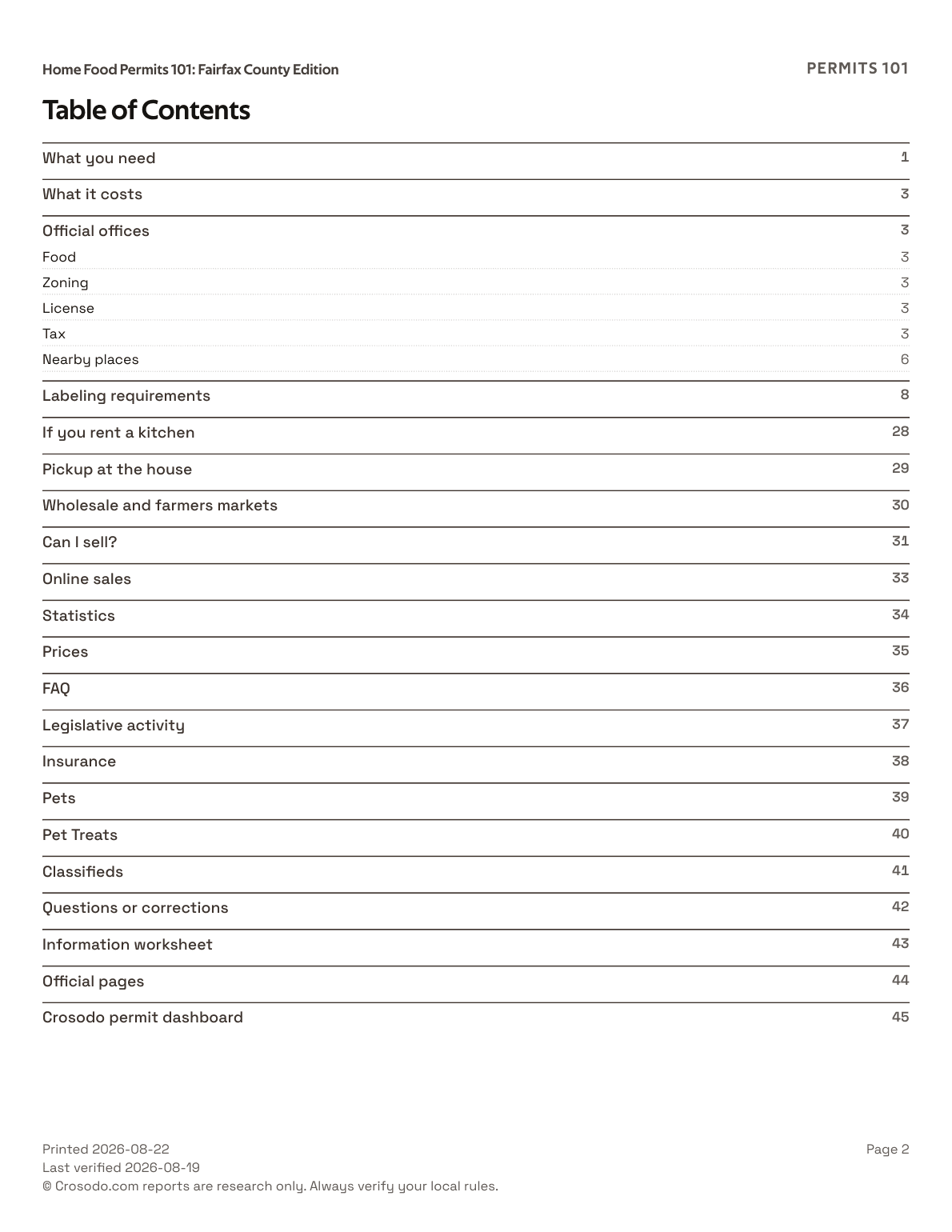
- Full Indiana statute text with key provisions and official citation
- Allowed and prohibited foods, labeling rules, sales cap (None)
- Registration and permit steps with direct state-agency links
- All 92 Indiana counties with zoning + health department links
- 262-page guide with every official source URL, licensed to your address
What exactly am I buying?
The complete Indiana License & Permit Guide — not the free 2-page preview above.
How do I receive it?
Stripe checkout. We email a cover letter, paid receipt, and the guide (PDF) licensed to your address.
Is it current?
Every report lists its official sources so you can verify against the current statute. See also the research-verified Indiana guide.
Not ready? Get free Indiana cottage-food updates instead.
Indiana Code Title 16, Article 42, Chapter 5.3 — Home Based Food Products (enacted as HEA 1149, 2022; prior law under Chapter 5.2)
Verbatim ExcerptSECTION 4. IC 16-42-5.3 IS ADDED TO THE INDIANA CODE AS A NEW CHAPTER Chapter 5.3. Home Based Food Products Sec. 1. (a) As used in this chapter, "end consumer" [means a] person who is the last person to purchase any food product and who does not resell the food product. Sec. 2. A person may prepare and sell food products as a home based vendor if the person complies with the requirements of this chapter. Sec. 3. The production and sale of food products by a home based vendor in accordance with this chapter are exempt from the requirements of this title that apply to food establishments. Sec. 4. A home based vendor shall prepare and sell only a food product that is [a non-potentially hazardous food]. Sec. 5. (a) A home based vendor shall include a label for packaged food or a sign for unpackaged food that contains the following information: [business name, address, product name, date produced, ingredients, net weight, and statement that product is home produced and not inspected by state department of health]. Sec. 6. (a) A home based vendor may not ship or deliver a food product to an end consumer who is located outside Indiana. Sec. 7. (a) A home based vendor shall obtain a food handler certificate from a certificate issuer that is accredited by the [American National Standards Institute]. Sec. 8. (a) A home based vendor is subject to food sampling and inspection if [there is a complaint or reason to believe a violation exists].
Source: in.gov/localhealth/unioncounty/files/2022-10-05-House-Enrolled-Act-1149-Home-Based-Vendors.pdf →
Home-based vendors may sell most nonperishable (non-potentially hazardous) foods, including baked goods, candies, jams and jellies, fermented products (not oxygen-sealed), nut butters, syrups, dried goods, coffee, tea, snacks, and similar shelf-stable items. Whole eggs, traditional pickles not stored in oxygen-sealed containers, and whole chickens or rabbits raised by the vendor (with restrictions) are also allowed.
Perishable baked goods requiring refrigeration, acidified foods (pickles in oxygen-sealed containers, salsas, sauces, ketchup, juices), low-acid canned foods, and meat jerkies are prohibited. Interstate sales and wholesale/catering are not permitted under this law.
Labels or point-of-sale signs must include: business name, home address, product name, date produced, ingredients, and the statement 'This product is home produced and processed and the production area has not been inspected by the state department of health. NOT FOR RESALE.' Net weight/count is also required.
None
Great (IJ Grade B)
92
Indiana Counties (92)
Cottage food registration usually happens at the county level. Click any county for local zoning, health department, and planning department links.
Where to verify Indiana's rules
Data compiled from primary sources. Cottage food laws change — verify with your state agency before relying on this information.
Cottage food laws are amended every year. This is a starting reference, not legal advice. Verify with Indiana State Department of Healthand your local health department before relying on this data.