Cottage food law & license in Hamilton County, IN
What's in the Hamilton County permit report
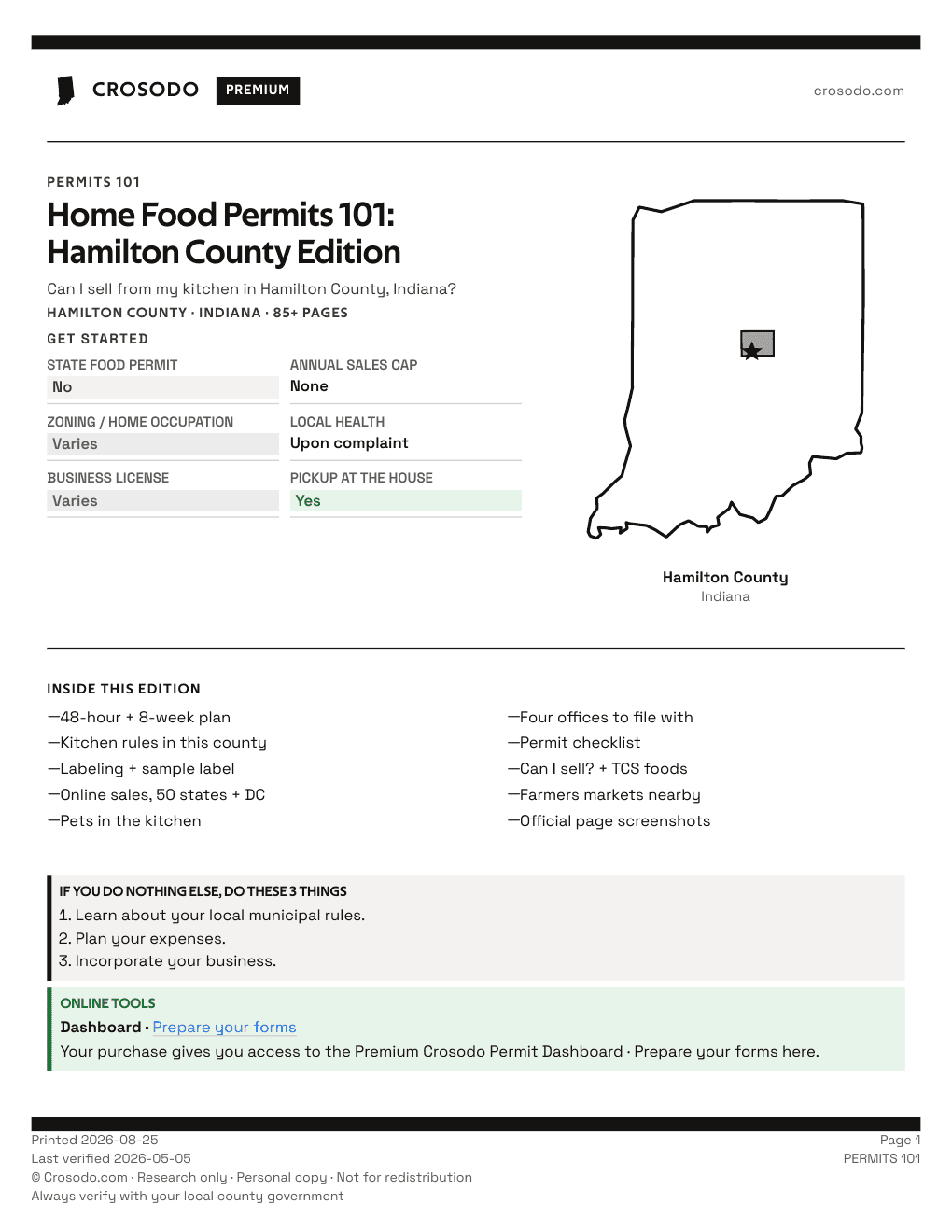
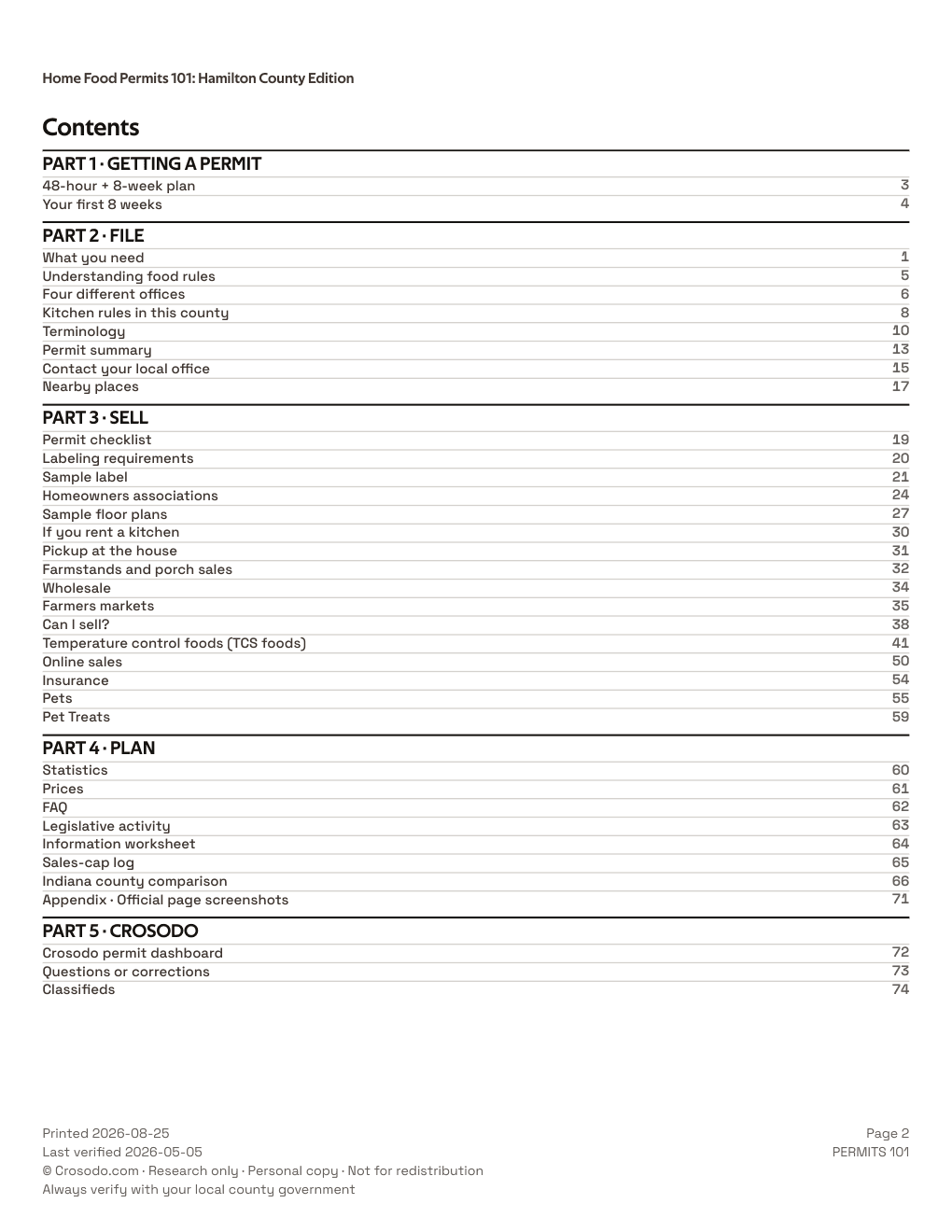
Free page = the law. Permit Guide = the apply checklist and workspace.
Cottage Pro included: every other county guide and state report, plus the label packet, are the bonus — this county's packet is the reason to buy.
One payment. No subscription, nothing to cancel.
Reviewed · This page stays free · Cottage Pro unlocks the apply checklist
Can I sell this in Hamilton County?
More Hamilton County resources
What's new for Indiana cottage bakers?
How do I start a cottage food business in Hamilton County?
How to start in Hamilton County
Permit, label, and local steps for selling under Indiana cottage food rules in Hamilton County. Not legal advice.
Confirm your menu under state law
Indiana cottage food rules control what you may make at home (Home-based vendors may sell most nonperishable (non-potentially hazardous) foods, including baked goods, candies, jams and jellies, fermented products (not oxygen-sealed), nut butters, syrups, dried goods, coffee, tea, snacks, and similar shelf-stable items. Whole eggs, traditional pickles not stored in oxygen-sealed containers, and whole chickens or rabbits raised by the vendor (with restrictions) are also allowed.). Hamilton County cannot expand a food the state bans.
Map channels and local sales rules
State sales cap: No cap. On-site / porch pickup in Hamilton County: Yes. Prefer markets or off-site pickup if residential customer traffic is restricted.
Local permits, tax, and home occupation
Home occupation permit: Varies. Many places still need a general business license or tax certificate even when the state has no cottage food “permit.” Check planning, the clerk, and any HOA or lease before advertising your address.
Training, registration, inspection
State registration: No. Local inspection in Hamilton County: Upon-complaint. Finish food handler training early — markets often ask for a copy.
Labels that match the state
Print labels with Indiana disclaimer and allergen rules before market day. Use the free Indiana label page for the one-pager checklist and mockup.
Insurance and first sales
Farmers markets often require a certificate of insurance. Soft-launch with pre-orders, keep a sales log, and re-verify rules if you change products or venues.
What usually goes on the package
- Product name (common or usual name of the food)
- Business or producer name
- Producer address (or address alternative your state allows)
- Ingredients in descending order by weight
- Major allergen disclosures (e.g. wheat, milk, eggs, soy, tree nuts, peanuts, fish, shellfish, sesame)
- Net weight or quantity
- Home-kitchen disclaimer: “This product is home produced and processed, and the production area has not been inspected by the State Department of Health. NOT FOR RESALE.”
Planning checklist only. Confirm with state and local agencies before you sell.
Can I test myself on Indiana county rules? (Crosodo Verified quiz)
Indiana county rules quiz
Hamilton County does not yet have enough verified local data for its own quiz. You can still take the Indiana statewide quiz — clearly labeled as state rules, not a Hamilton County quiz.
Crosodo Verified means this person passed Crosodo's county rules quiz. It is not a government license, permit, or food-handler certification.
Take the Crosodo Verified quizHow do I verify Hamilton County cottage food rules with Indiana agencies?
Hamilton County is a county in Indiana (pop. 349,527). Under Indiana's Great-tier cottage food law (sales cap: None), home bakers must still clear local zoning and health rules in this county. Registration path: No. Start with Indiana State Department of Health (state cottage food page linked below), then confirm Hamilton County health and planning requirements. Local notes for Hamilton County: home kitchen allowed; inspection not required; home occupation permit not required. Hamilton County Health Dept has a dedicated HBV page confirming state rules apply. County is one of fastest-growing in Indiana; multiple incorporated cities each with own zoning. No county-specific cottage food overlay beyond state rules found. Download the free reports below for a portable summary, and always re-check official sources before you sell.
What practical tips help me start selling in Hamilton County?
Tier: Great
Indiana's cottage food law is permissive (Great tier) — high or no sales cap, broad product list, and multiple sales channels allowed. The state baseline is workable for full-time operations; the county still controls zoning and inspection.
Indiana cottage food law →Health department
Many states delegate cottage food registration and inspection to the county health department. Contact theirs for the local process.
Home occupation rules
The county or city zoning code governs whether you can run a home-based food business — customer visits, signage, employees, floor area.
What are the Hamilton County zoning rules for a home bakery?
Home kitchen, inspection, and zoning rules for Hamilton County
State baseline: Ind. Code §16-42-5.2 (HBV); food handler certificate required (ANAB-accredited); no license; direct sales only; no annual sales cap
- Home kitchen allowed
- Yes
- Restrictions
- Food prepared at producer's primary residence only; non-TCS foods only; ANAB-accredited food handler certificate required; label must state product not for resale and not inspected
- Separate dedicated kitchen
- No
- Pet restrictions
- Good sanitation practices required; no specific state pet rule but kitchen cleanliness standards apply
- Water supply
- Potable water at residence
- Handwashing
- Standard handwashing required
- Food storage
- Stored in sanitary conditions at residence
- Inspection required
- Upon-complaint
- Inspection trigger
- IDOH may investigate complaints of unsafe food or foodborne illness; no routine inspections
- Home occupation permit
- Varies
- Permit details
- Hamilton County Health Dept page (hamiltoncounty.in.gov/268/Home-Based-Vendors) addresses HBV state rules. Local municipalities (Noblesville, Carmel, Fishers, Westfield) may require home occupation permits under their zoning ordinances; operator should verify with local city planning
- Local business license
- Varies
- On-site customer pickup
- Yes
- On-site signage
- Conditional
- Delivery / pickup
- In-person, telephone, internet sales allowed; delivery in-person, by mail, or third-party carrier within Indiana only; not for resale
- Max employees in home
- Not specified at state level
- Relevant code section
- Not identified
Hamilton County Health Dept has a dedicated HBV page confirming state rules apply. County is one of fastest-growing in Indiana; multiple incorporated cities each with own zoning. No county-specific cottage food overlay beyond state rules found.
What does the Indiana cottage food statute say?
Indiana Code Title 16, Article 42, Chapter 5.3 — Home Based Food Products (enacted as HEA 1149, 2022; prior law under Chapter 5.2) Additional homestead vendor / small farm vendor path added by HEA 1424 / Public Law 163 (2026).
Full Indiana License & Permit Guide →Verbatim excerptSECTION 4. IC 16-42-5.3 IS ADDED TO THE INDIANA CODE AS A NEW CHAPTER Chapter 5.3. Home Based Food Products Sec. 1. (a) As used in this chapter, "end consumer" [means a] person who is the last person to purchase any food product and who does not resell the food product. Sec. 2. A person may prepare and sell food products as a home based vendor if the person complies with the requirements of this chapter. Sec. 3. The production and sale of food products by a home based vendor in accordance with this chapter are exempt from the requirements of this title that apply to food establishments. Sec. 4. A home based vendor shall prepare and sell only a food product that is [a non-potentially hazardous food]. Sec. 5. (a) A home based vendor shall include a label for packaged food or a sign for unpackaged food that contains the following information: [business name, address, product name, date produced, ingredients, net weight, and statement that product is home produced and not inspected by state department of health]. Sec. 6. (a) A home based vendor may not ship or deliver a food product to an end consumer who is located outside Indiana. Sec. 7. (a) A home based vendor shall obtain a food handler certificate from a certificate issuer that is accredited by the [American National Standards Institute]. Sec. 8. (a) A home based vendor is subject to food sampling and inspection if [there is a complaint or reason to believe a violation exists].
Source: in.gov/localhealth/unioncounty/files/2022-10-05-House-Enrolled-Act-1149-Home-Based-Vendors.pdf →
Cottage Pro — $15 one time
This page stays free. Hamilton County’s apply checklist, every county guide, and the Verified badge are in Cottage Pro.
Buy the Report — $15 one timeHamilton County cottage food — FAQ
Do I need a permit to sell cottage food in Hamilton County, Indiana?
No state permit. Local home-occupation permit: Varies. Home kitchen: Yes. Confirm with Hamilton County environmental health before you sell.
What cottage food path applies in Hamilton County?
No state permit. Follow the registration path listed on this page.
What is the cottage food permit fee in Hamilton County?
Crosodo has not verified a published cottage-food fee for Hamilton County. Ask Hamilton County environmental health for the current cottage-food fee.
What is the sales cap for cottage food in Indiana?
No annual sales cap. There is typically no separate county sales cap, but local permits can still limit operations.
Where do I apply for a cottage food permit in Hamilton County?
Apply through Hamilton County environmental health. Crosodo does not have a verified application URL for Hamilton County, Indiana — use the county environmental health / planning contacts on this page.
What foods can I sell under Indiana cottage food law in Hamilton County?
Home-based vendors may sell most nonperishable (non-potentially hazardous) foods, including baked goods, candies, jams and jellies, fermented products (not oxygen-sealed), nut butters, syrups, dried goods, coffee, tea, snacks, and similar shelf-stable items. Whole eggs, traditional pickles not stored in oxygen-sealed containers, and whole chickens or rabbits raised by the vendor (with restrictions) are also allowed. County zoning does not expand the state product list — if a food is banned by Indiana, it stays banned. Verify with the state agency before selling.
Is a health inspection required for home bakers in Hamilton County?
Inspection: Upon-complaint. Trigger: IDOH may investigate complaints of unsafe food or foodborne illness; no routine inspections. Non-TCS baked goods are often exempt from kitchen inspection under state cottage food law, but local rules can differ.
Cottage Pro · $15 one time
Every Indiana report, every county Permit Guide, the label packet, and the dashboard — one subscription.
Buy the Report — $15 one timeHamilton County cottage food reports
Home cottage-food permit stack — zoning, health, license, and what the state does not require.
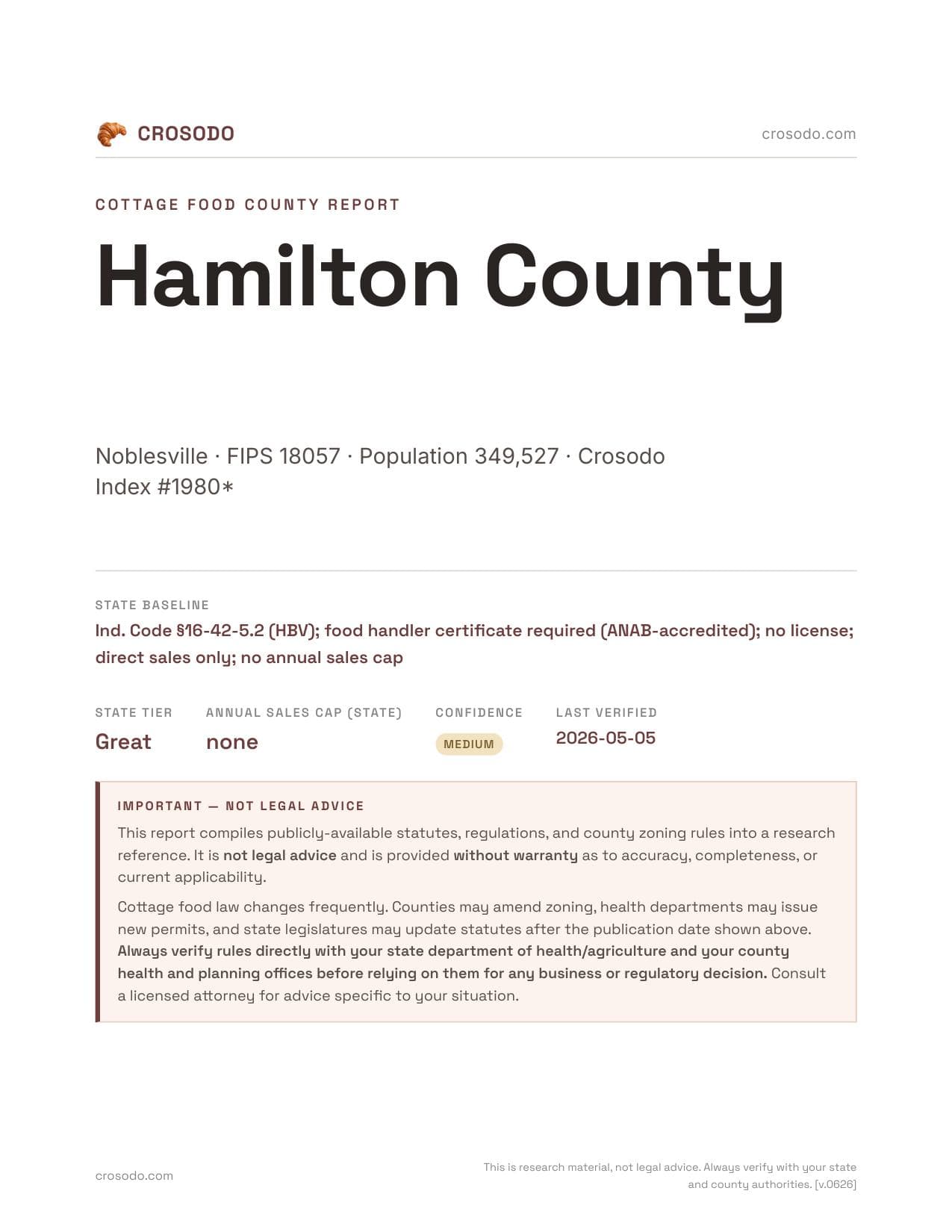
Zoning, permits, health department rules, and local sources for Hamilton County.
Download county report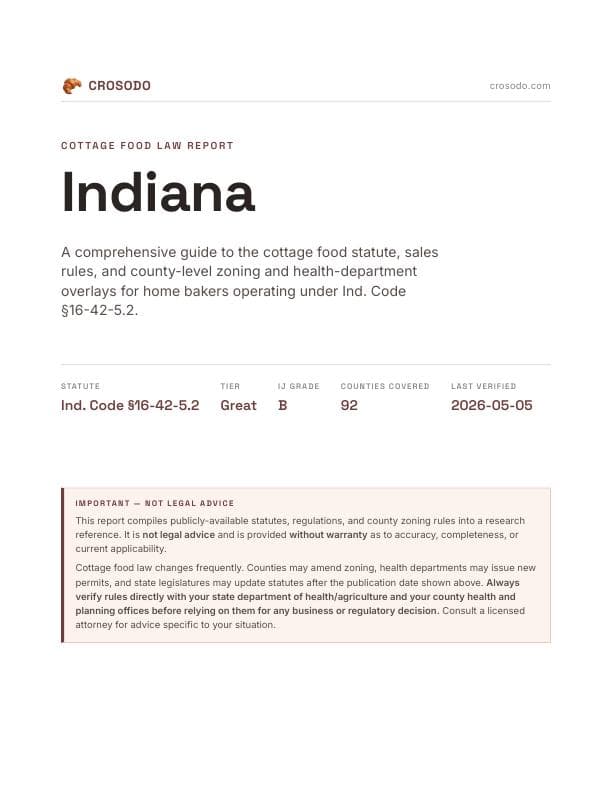
Full Indiana License & Permit Guide (262 pages). Statute and every county. Buy it further down only if you sell outside Hamilton County.
Indiana law pageFree email alerts
Hamilton County Cottage Food Updates
Local rule changes and news for home bakers in Hamilton County, with Indiana statewide updates below the county news in every email. Every story links to its source.
What sources is this Hamilton County page based on?
Where to verify Hamilton County rules
Hamilton County vs. bordering counties
| Regulation | Hamilton County This county | Madison County | Hancock County |
|---|---|---|---|
| Home kitchen allowed | Yes | Yes | Yes |
| Separate dedicated kitchen | No | No | No |
| Pets allowed | Good sanitation practices required; no specific state pet rule but kitchen cleanliness standards apply | Not explicitly prohibited; kitchen sanitation required. | Not specified in state statute; good hygienic practices required. |
| Inspection required | Upon-complaint | Upon-complaint | Upon-complaint |
| On-site customer pickup | Yes | Yes | Yes |
| On-site signage | Conditional | Conditional | Conditional |
| Delivery / pickup | In-person, telephone, internet sales allowed; delivery in-person, by mail, or third-party carrier within Indiana only; not for resale | Sales permitted from home, farmers markets, roadside stands, online, and other venues per 2022 expanded state law. | Products may be sold in-person, online, shipped within Indiana, and delivered to the end consumer. No sales to warehouses, retail food esta… |
| Home occupation permit | Varies | Varies | Conditional |
| Local business license | Varies | Varies | Varies |
| Restrictions | Food prepared at producer's primary residence only; non-TCS foods only; ANAB-accredited food handler certificate required; label must state… | Non-potentially hazardous foods produced at the individual's primary residence. Food handler certificate (ANSI-accredited) must be provided… | Must prepare food in the individual's primary residential home kitchen. Only non-TCS (non-time/temperature control for safety) foods allowe… |
| Food storage | Stored in sanitary conditions at residence | Non-potentially hazardous foods only. Stored in food-safe containers. | Must use proper sanitary procedures; containers and packaging must be sanitized. |
| Population | 349,527 | 130,545 | 80,170 |
What other Indiana counties can I compare?
Other Indiana counties
Can I list my bakes in the Crosodo classifieds?
Resources for cottage food and home bakers
Supplies, courses, insurance, farmers markets, kitchen rentals, and local services. To advertise here, visit crosodo.com/advertise. Browse all classifieds.
Ads are paid placements. Crosodo does not endorse listed vendors. Verify all product, service, course, insurance, and legal information independently.
Is this Hamilton County page legal advice?
Cottage food law and municipal zoning interact in non-obvious ways. Before investing in equipment or marketing, talk to Indiana's department of agriculture, your local health department, and your county or city's planning office. Crosodo is a clothing brand for cottage bakers, not a law firm.
Where can I talk with other Hamilton County bakers?
Hamilton County baker discussion
53 public threads from bakers talking about Hamilton County — permits, zoning, markets, and what's selling. Read along or sign in to post.
Local bakers discuss zoning, permits, top sellers, sourdough, farmers markets, and more in the Crosodo forum.
Can I sell cottage food from home in Hamilton County? (short answer)
What are the steps to my first legal sale in Hamilton County?
Steps to your first legal sale
- Which permit you need — local names like HBB, MHO, CFO Class A
- Zoning / home occupation: where you file
- Local health Class A/B path when the county runs itIn Cottage Pro
- Fee schedule — published amount only, blank if noneIn Cottage Pro
- House pickup vs off-site — what zoning already saysIn Cottage Pro
Steps 1–2 are free on this page. Cottage Pro is the full apply checklist, every county report, and the dashboard workspace.
What should I know about Hamilton County at a glance?
How does the Crosodo ladder work in Hamilton County? State vs county rules and pets
Crosodo ladder · not a license · How the ladder works
- 0Bake for friends
Give it away: gifts, potlucks, the office tray.
Hamilton County
- Nothing to file
$0
Taking money? → Step 1
- 1Sell from home
Sell shelf-stable bakes straight to the person who eats them.
Hamilton County
- Check with Hamilton County business license office
- Check with Hamilton County zoning office about home pickup
Want store shelves? → Step 2
- 2Sell to stores
Sell to shops, cafés and resellers from an inspected kitchen.
Indiana
- Selling to stores: check with Indiana State Department of Health
Hamilton County
- Check with Hamilton County zoning office about an inspected home kitchen
Want a storefront? → Step 3
- 3Commercial bakery
Bake in a commercial kitchen. Sell from your own shop.
Indiana
- Commercial kitchen permit: check with Indiana State Department of Health
Hamilton County
- Check with Hamilton County zoning and building offices
Renew permits every year
- Pets: do I need a door?
Indiana · Step 1
Not verified yet
Check with Indiana State Department of Health.
Indiana · Step 2 (home)
Not verified yet
Check with Indiana State Department of Health.
Save your county and take the 2-minute Crosodo Verified quiz. Crosodo is a research guide, not a government agency. Not legal advice.