
Minnesota Cottage Food Law PDF 2026 — Full Legal Text + Annotations
Full statute text, allowed foods, registration, sales cap 78000, and all 87 Minnesota counties with zoning + health department links. 265-page PDF with official sources. Free preview below — buy the complete guide for $44.
This page shows the first 2 pages + statute excerpt. One-time $44 · Yours to keep · Stripe checkout · Guide (PDF) emailed with receipt.
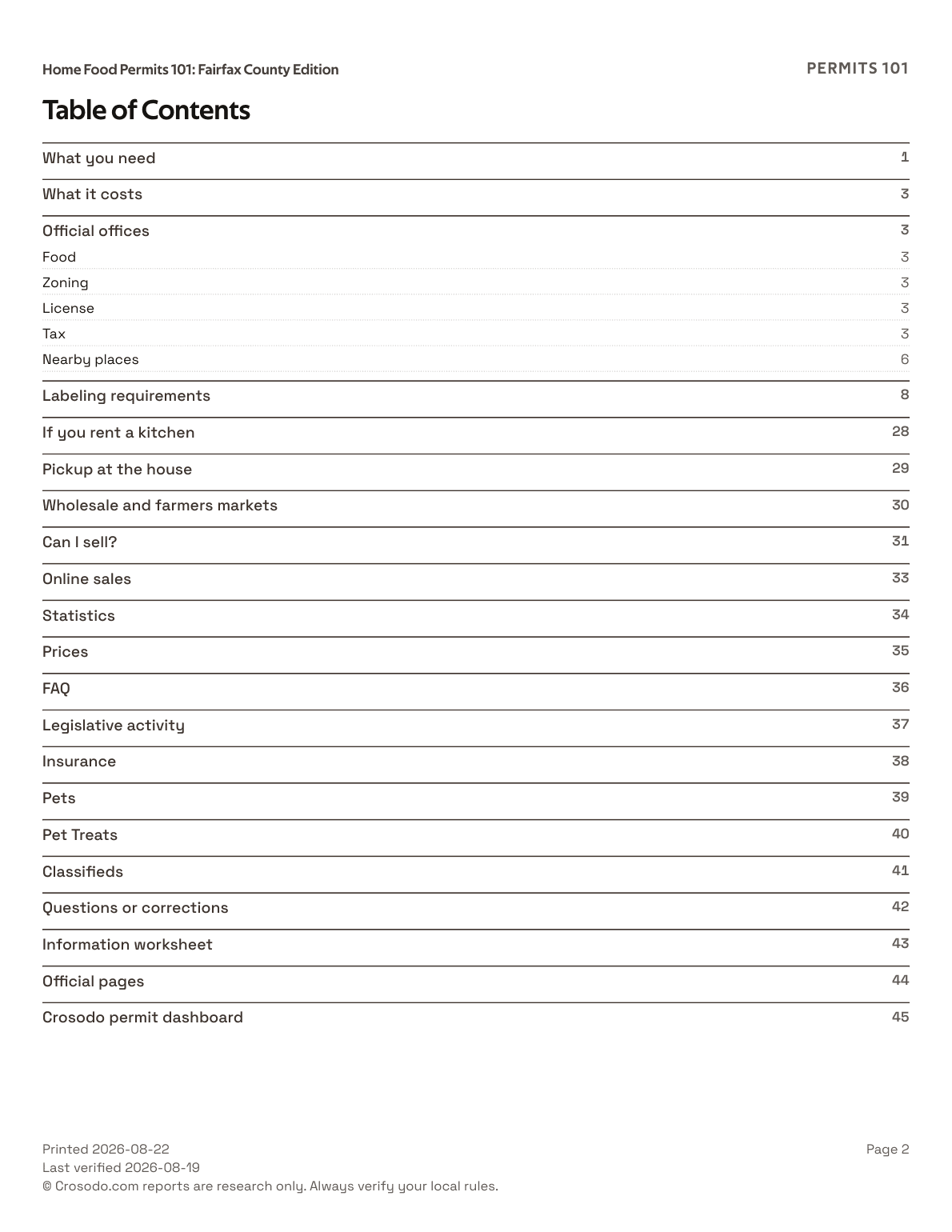
- Full Minnesota statute text with key provisions and official citation
- Allowed and prohibited foods, labeling rules, sales cap (78000)
- Registration and permit steps with direct state-agency links
- All 87 Minnesota counties with zoning + health department links
- 265-page guide with every official source URL, licensed to your address
What exactly am I buying?
The complete Minnesota License & Permit Guide — not the free 2-page preview above.
How do I receive it?
Stripe checkout. We email a cover letter, paid receipt, and the guide (PDF) licensed to your address.
Is it current?
Every report lists its official sources so you can verify against the current statute. See also the research-verified Minnesota guide.
Not ready? Get free Minnesota cottage-food updates instead.
Minnesota Statutes §28A.152 - Cottage Foods Exemption
Verbatim Excerpt28A.152 COTTAGE FOODS EXEMPTION. Subdivision 1. Licensing provisions applicability. (a) Except as provided in paragraph (d), the licensing provisions of sections 28A.01 to 28A.16 do not apply to the following: (1) a person who prepares and sells food that is not potentially hazardous food, as defined in Minnesota Rules, part 4626.0020, subpart 62, if the following requirements are met: the prepared food offered for sale under this clause is labeled to accurately reflect the name and the registration number or address of the person preparing and selling the food, the date on which the food was prepared, the ingredients and any possible allergens, and the statement "These products are homemade and not subject to state inspection."; and (2) a person who prepares and sells home-processed and home-canned food products if the following requirements are met: (i) the products are pickles, vegetables, or fruits having an equilibrium pH value of 4.6 or lower or a water activity value of .85 or less; (iii) the person displays at the point of sale a clearly legible sign or placard stating: "These products are homemade and not subject to state inspection."; and (iv) each container of the product sold or offered for sale under this clause is accurately labeled to provide the name and the registration number or address of the person who processed and canned the goods, the date on which the goods were processed and canned, ingredients and any possible allergens, and the statement "These products are homemade and not subject to state inspection." Subd. 2. Direct sales to consumers. (a) A person qualifying for an exemption under subdivision 1 may sell the exempt food: (1) directly to the ultimate consumer at a community event or farmers' market; (2) directly from the person's home to the ultimate consumer; or (3) through donation to a community event with the purpose of fundraising. (d) Food products exempt under subdivision 1 may be sold over the Internet. Subd. 3. Limitation on sales. A person selling exempt foods under this section is limited to total sales with gross receipts of $78,000 or less in a calendar year. Subd. 4. Registration. A person who prepares and sells exempt food under subdivision 1 must register annually with the commissioner. The annual registration fee is $30. Subd. 5. Training. A person who sells exempt food under this section and is required to pay the registration fee in subdivision 4 must complete a safe food handling training course that is approved by the commissioner before registering under subdivision 4.
Source: revisor.mn.gov/statutes/cite/28A.152 →
Non-potentially hazardous foods (those not requiring refrigeration) including baked goods, candies, condiments (honey, pickles, mustards, nut butters, salsas, sauces), dry goods (coffee, cereals, dried fruit/vegetables, herbs, pasta, spices, tea), pastries, preserves (jams, jellies, fruit butters, applesauce), snacks (granola, popcorn, chocolate-covered items), fermented foods, and juices. Home-processed and home-canned products with pH 4.6 or lower or water activity 0.85 or less (the original 'Pickle Bill' category) are also permitted.
Potentially hazardous foods requiring refrigeration, low-acid canned foods, chocolate-covered fruit, confections with alcohol, meat jerkies, and perishable baked goods. All canned goods and drinks must be non-potentially hazardous. Products in the home-canned category may not be sold outside of Minnesota.
Labels must accurately reflect: the name and registration number or address of the producer; the date on which the food was prepared; ingredients and any possible allergens; and the statement 'These products are homemade and not subject to state inspection.' At farmers markets and community events, a visible placard with the same statement must be displayed. Online sellers must display the statement on their website. Registration number may substitute for home address.
78000
Great (IJ Grade B+)
87
Minnesota Counties (87)
Cottage food registration usually happens at the county level. Click any county for local zoning, health department, and planning department links.
Where to verify Minnesota's rules
Data compiled from primary sources. Cottage food laws change — verify with your state agency before relying on this information.
Cottage food laws are amended every year. This is a starting reference, not legal advice. Verify with Minnesota Department of Agricultureand your local health department before relying on this data.