
Virginia Cottage Food Law PDF 2026 — Full Legal Text + Annotations
Full statute text, allowed foods, registration, sales cap Tiered, and all 134 Virginia counties with zoning + health department links. 432-page PDF with official sources. Free preview below — buy the complete guide for $44.
This page shows the first 2 pages + statute excerpt. One-time $44 · Yours to keep · Stripe checkout · Guide (PDF) emailed with receipt.
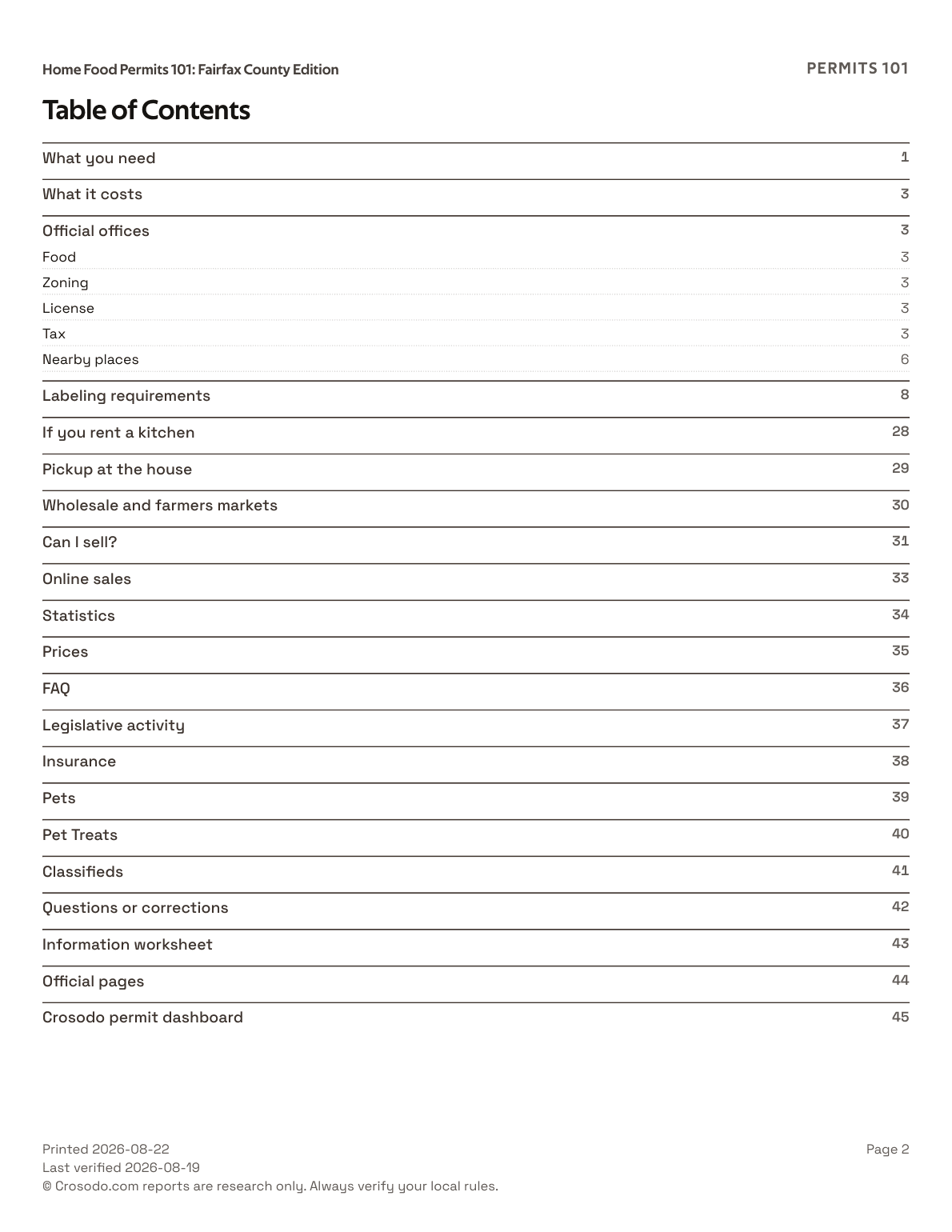
- Full Virginia statute text with key provisions and official citation
- Allowed and prohibited foods, labeling rules, sales cap (Tiered)
- Registration and permit steps with direct state-agency links
- All 134 Virginia counties with zoning + health department links
- 432-page guide with every official source URL, licensed to your address
What exactly am I buying?
The complete Virginia License & Permit Guide — not the free 2-page preview above.
How do I receive it?
Stripe checkout. We email a cover letter, paid receipt, and the guide (PDF) licensed to your address.
Is it current?
Every report lists its official sources so you can verify against the current statute. See also the research-verified Virginia guide.
Not ready? Get free Virginia cottage-food updates instead.
Code of Virginia, Title 3.2 Agriculture, Animal Care, and Food, Chapter 51 Food and Drink, §3.2-5130 Inspections required to operate food establishment
Verbatim ExcerptC. The provisions of subsections A and B shall not apply to: 3. Private homes where the resident processes and prepares candies, jams, and jellies not considered to be low-acid or acidified low-acid food products, dried fruits, dry herbs, dry seasonings, dry mixtures, coated and uncoated nuts, vinegars and flavored vinegars, popcorn, popcorn balls, cotton candy, dried pasta, dry baking mixes, roasted coffee, dried tea, cereals, trail mixes, granola, and baked goods if such products are (i) those that do not require time or temperature control after preparation; (ii) sold at any location, through the internet, or by phone to an individual in the Commonwealth for his own consumption and not for resale or consignment; (iii) delivered in person, by mail, or by delivery service to an individual in the Commonwealth for his own consumption and not for resale or consignment; (iv) not offered for sale to be used in or offered for consumption in retail food establishments; and (v) affixed with a label placed on the principal display panel or, for a product in packaging not large enough to bear such a label, offered for sale with a sign displaying the name, physical address or post office box number, and telephone number of the person preparing the food product, the date the food product was processed, and the statement "NOT FOR RESALE PROCESSED AND PREPARED WITHOUT STATE INSPECTION." Nothing in this subdivision shall prohibit a resident selling a food product in accordance with this subdivision from advertising such food product on the Internet. Amended 2026, c. 605 (HB 402), effective July 1, 2026.
Source: law.lis.virginia.gov/vacode/title3.2/chapter51/section3.2-5130/ →
Non-TCS shelf-stable foods from private homes including candies, jams, jellies (not low-acid/acidified), dried fruits, dry herbs, dry seasonings, dry mixtures, nuts, vinegars, popcorn, cotton candy, dried pasta, dry baking mixes, roasted coffee, dried tea, cereals, trail mixes, granola, and baked goods that do not require temperature control. Pickles and acidified vegetables with equilibrium pH 4.6 or lower are allowed with a $9,000 annual gross sales cap. Honey from own hives under 250 gallons per year is also allowed under a separate provision.
Time/temperature control foods (TCS foods) are prohibited. Pickles and acidified vegetables are subject to a $9,000 annual cap (among the lowest in the US). Products cannot be resold, consigned, or sold into retail food establishments. The general non-acidified cottage food category has no stated dollar cap.
Label on the principal display panel (or a sign for packages too small) must include: name of the person preparing the food, physical address or P.O. box number, telephone number, date the food product was processed, and the statement NOT FOR RESALE PROCESSED AND PREPARED WITHOUT STATE INSPECTION. HB 402 added the P.O. box option. Internet advertising is allowed.
Tiered
Good (IJ Grade C)
134
Virginia Counties (134)
Cottage food registration usually happens at the county level. Click any county for local zoning, health department, and planning department links.
Where to verify Virginia's rules
Data compiled from primary sources. Cottage food laws change — verify with your state agency before relying on this information.
Cottage food laws are amended every year. This is a starting reference, not legal advice. Verify with Virginia Department of Agriculture and Consumer Servicesand your local health department before relying on this data.