
Virginia cottage food law
Last updated: · Research verified · Full guide $44 lifetime (432 pages)
Tier: Good. Solid baseline with moderate restrictions — typically a high cap (often $50K+) and standard direct-to-consumer rules. Workable for most home bakers.
Full Virginia License & Permit Guide (432 pages). Statute, every county we have researched, and official source URLs. Stripe checkout. Cover letter, paid receipt, and the guide (PDF) licensed to your address.
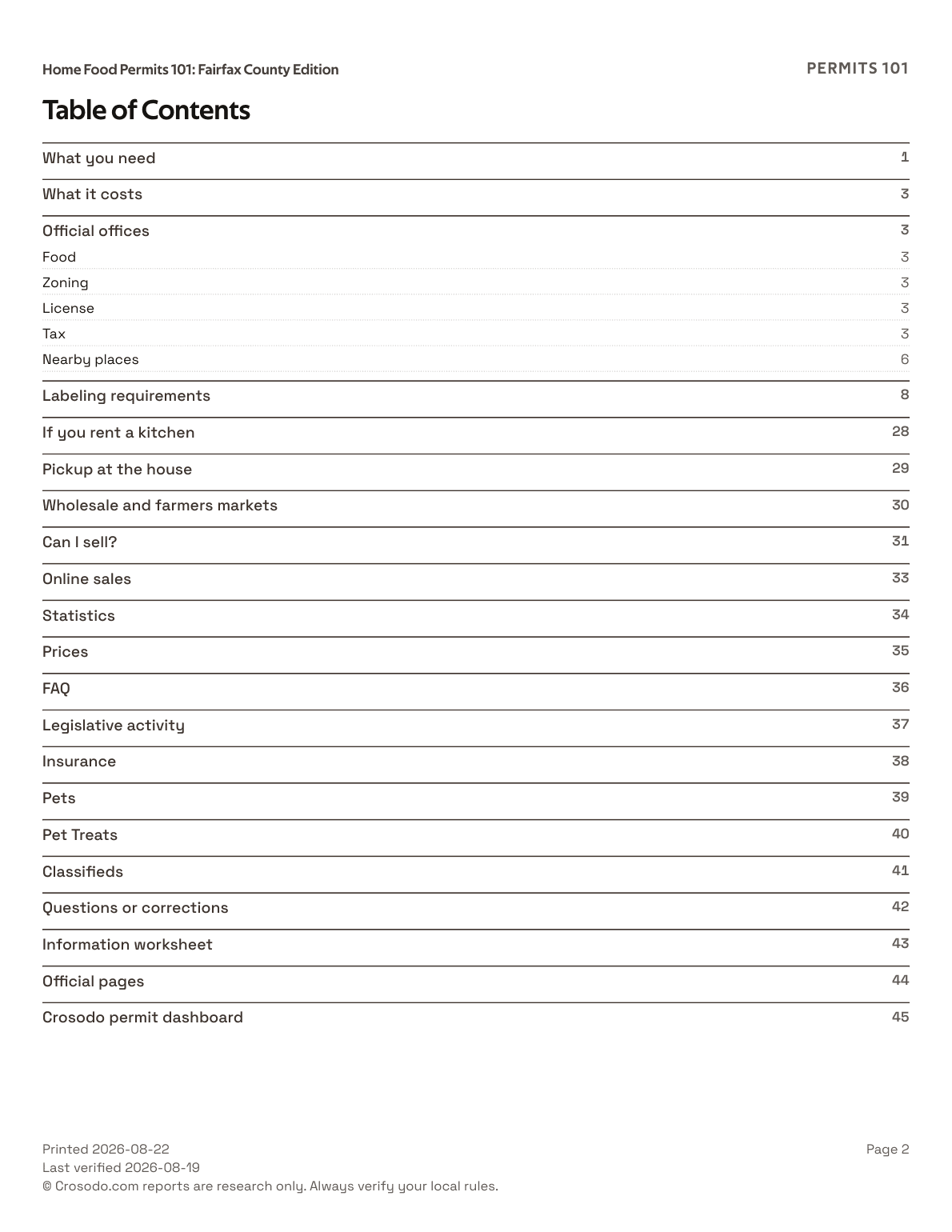
Unlimited Pass. Your journey to getting permitted for cottage food sales. Premium dashboard tools, unlimited state and county reports, and the 50-state label report. Lifetime access. Includes the full Virginia License & Permit Guide (432 pages).
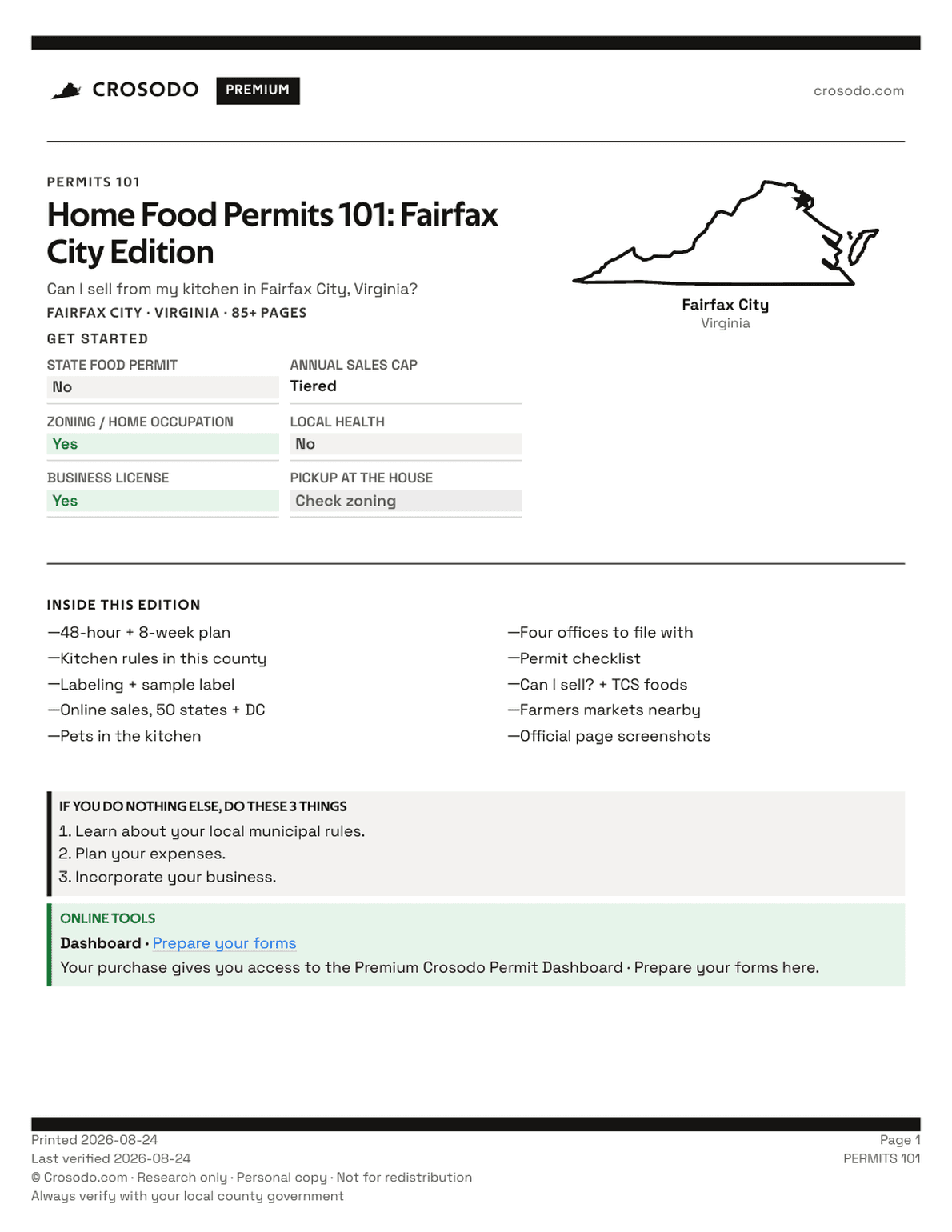
How to start in Virginia
A practical path from “am I allowed?” to first sale. Not legal advice — confirm every step with Virginia agencies and your local offices.
Cottage exemption and HFPO
Crosodo year one follows the home cottage exemption in Va. Code § 3.2-5130. That exemption is not a certification. VDACS does not issue a cottage certificate. A Home Food Processing Operation (HFPO) is a different path: inspection, permit, and a $40 annual fee on the official application. Local zoning, HBB, MHO, BPOL, and market insurance are separate papers. A market can require insurance without a state cottage certificate. Fairfax County porch pickup and HBB, and Fairfax City MHO, are local rules. They are not HFPO. The current Code allows internet and phone sales and in-state delivery or mail. The July 2024 kitchen FAQ still says no online checkout; that FAQ predates HB 402 / 2026 c. 605. Not legal advice. Confirm with VDACS and the market.
Confirm your products are allowed
Virginia allows Non-TCS shelf-stable foods from private homes including candies, jams, jellies (not low-acid/acidified), dried fruits, dry herbs, dry seasonings, dry mixtures, nuts, vinegars, popcorn, cotton candy, dried pasta, dry baking mixes, roasted coffee, dried tea, cereals, trail mixes, granola, and baked goods that do not require temperature control. Pickles and acidified vegetables with equilibrium pH 4.6 or lower are allowed with a $9,000 annual gross sales cap. Honey from own hives under 250 gallons per year is also allowed under a separate provision.. High-risk or refrigerated foods usually need a commercial kitchen — not a cottage exemption.
Choose sales channels you can actually use
Sales cap: Tiered. Indirect / wholesale-style sales: No. Farmers markets and direct-to-consumer pickup are the usual start. Check county and city rules before advertising porch pickup.
Clear local zoning, licenses, and tax IDs
State cottage food rules are the floor. Your city or county may still require a business license, home occupation approval, HOA permission, or sales tax registration. Do this before you print an address on Instagram.
Registration, training, and kitchen rules
State registration: No. Food handler / training: No. Kitchen inspection: No. Complete certificates the market or agency will ask for.
Build compliant labels
Use the Virginia label requirements on this site (and the free template). Match disclaimer language to the statute or agency guide before you print a batch.
Soft-launch, then first paid sales
Keep a simple sales log from day one so you stay under any annual cap. Soft-launch with pre-orders before a full market day.
Verify with official sources
Re-check the state cottage food page and your local health / planning office before you invest in equipment or marketing. Rules change.
What usually goes on the package
- Product name (common or usual name of the food)
- Business or producer name
- Producer address (or address alternative your state allows)
- Ingredients in descending order by weight
- Major allergen disclosures (e.g. wheat, milk, eggs, soy, tree nuts, peanuts, fish, shellfish, sesame)
- Net weight or quantity
- Home-kitchen disclaimer: “NOT FOR RESALE — PROCESSED AND PREPARED WITHOUT STATE INSPECTION”
This is a planning checklist compiled for home bakers. It is not legal, tax, or zoning advice.
Virginia vs neighboring cottage food laws
Tier and sales-cap snapshot for Virginia and nearby states. Click through for full rules, labeling, and county pages.
| State | Tier | Sales cap | Guide |
|---|---|---|---|
| VirginiaYou are here | Good | Tiered | This page |
| District of Columbia | Okay | None | District of Columbia law → |
| Kentucky | Okay | 60000 | Kentucky law → |
| Maryland | Good | 50000 | Maryland law → |
| North Carolina | Good | None | North Carolina law → |
| Tennessee | Good | None | Tennessee law → |
Need a compliant product label for Virginia? Open the Virginia label mockup.
Tiered
Non-TCS shelf-stable foods from private homes including candies, jams, jellies (not low-acid/acidified), dried fruits, dry herbs, dry seasonings, dry mixtures, nuts, vinegars, popcorn, cotton candy, dried pasta, dry baking mixes, roasted coffee, dried tea, cereals, trail mixes, granola, and baked goods that do not require temperature control. Pickles and acidified vegetables with equilibrium pH 4.6 or lower are allowed with a $9,000 annual gross sales cap. Honey from own hives under 250 gallons per year is also allowed under a separate provision.
Registration: No. Food handler cert: No.
Code of Virginia, Title 3.2 Agriculture, Animal Care, and Food, Chapter 51 Food and Drink, §3.2-5130 Inspections required to operate food establishment
Verbatim excerptC. The provisions of subsections A and B shall not apply to: 3. Private homes where the resident processes and prepares candies, jams, and jellies not considered to be low-acid or acidified low-acid food products, dried fruits, dry herbs, dry seasonings, dry mixtures, coated and uncoated nuts, vinegars and flavored vinegars, popcorn, popcorn balls, cotton candy, dried pasta, dry baking mixes, roasted coffee, dried tea, cereals, trail mixes, granola, and baked goods if such products are (i) those that do not require time or temperature control after preparation; (ii) sold at any location, through the internet, or by phone to an individual in the Commonwealth for his own consumption and not for resale or consignment; (iii) delivered in person, by mail, or by delivery service to an individual in the Commonwealth for his own consumption and not for resale or consignment; (iv) not offered for sale to be used in or offered for consumption in retail food establishments; and (v) affixed with a label placed on the principal display panel or, for a product in packaging not large enough to bear such a label, offered for sale with a sign displaying the name, physical address or post office box number, and telephone number of the person preparing the food product, the date the food product was processed, and the statement "NOT FOR RESALE PROCESSED AND PREPARED WITHOUT STATE INSPECTION." Nothing in this subdivision shall prohibit a resident selling a food product in accordance with this subdivision from advertising such food product on the Internet. Amended 2026, c. 605 (HB 402), effective July 1, 2026.
Source: law.lis.virginia.gov/vacode/title3.2/chapter51/section3.2-5130/ →
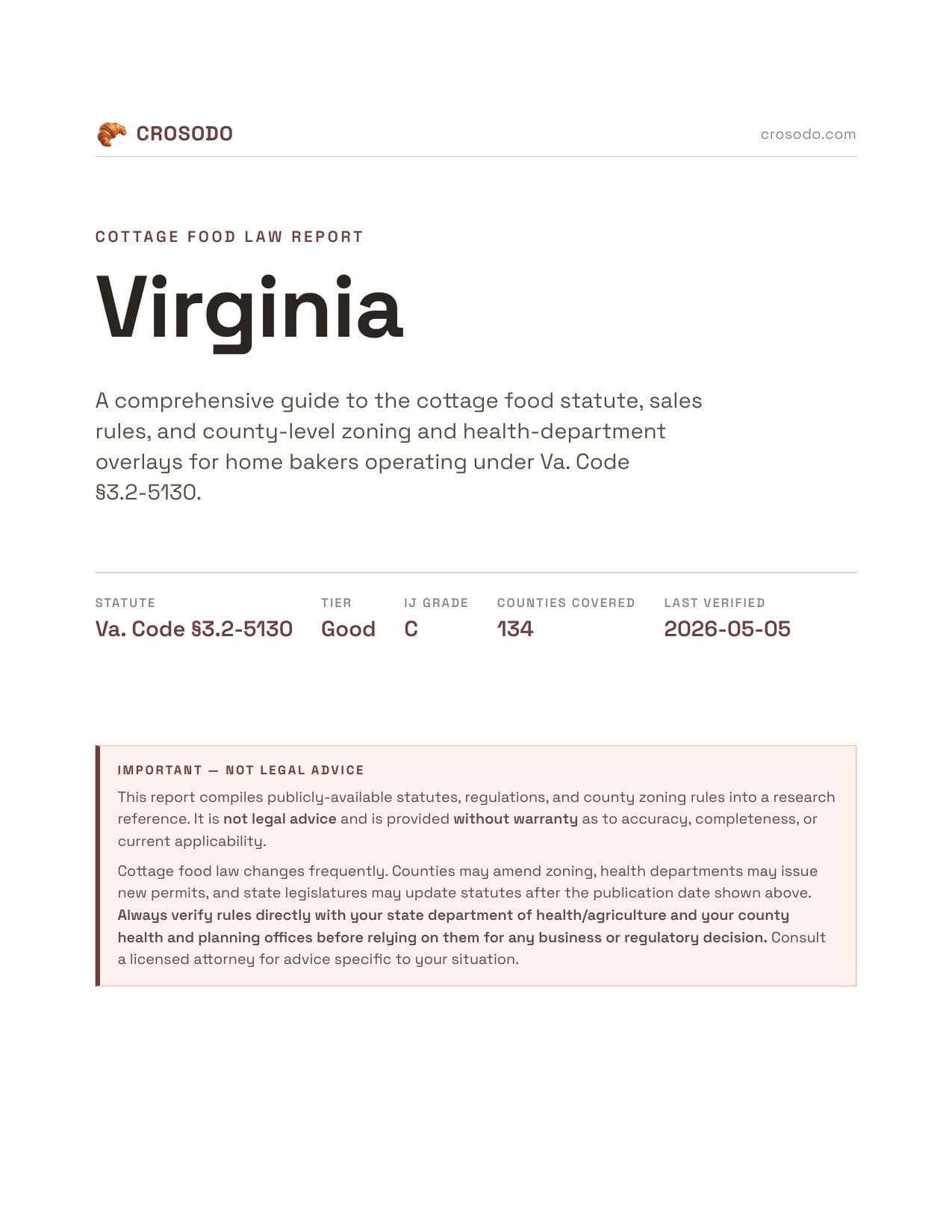
Virginia Cottage Food Law — 432 pages and 134 counties
The long report for this state (432 pages): statute, every county we've researched, and official source URLs. Stripe checkout. We email a cover letter, paid receipt, and the guide (PDF) licensed to your address.
Print Virginia labels for your first market
After the law page, this is the next thing most bakers need: a print-ready mockup with the Virginia home-kitchen disclaimer, allergen line, and net-weight fields.
NOT FOR RESALE — PROCESSED AND PREPARED WITHOUT STATE INSPECTION
- Product name, producer, and address (or allowed alternative)
- Ingredients by weight and major allergens
- Net weight / quantity
- Virginia home-kitchen / “not inspected” disclaimer
Not legal advice. Verify wording with the state agency before a production print run.
Where to verify Virginia's rules
Virginia’s Home Kitchen Food Processing Exemptions
Official agency guidance changes without notice. The text below is reproduced for reference only — always confirm current rules on the agency website before relying on it.
- Virginia Department of Agriculture and Consumer Services (VDACS)https://www.vdacs.virginia.gov/pdf/kitchenbillfaq.pdf
Food establishments, including private homes, that manufacture, process, pack or hold food for introduction into commerce (sale) are subject to the Virginia Food Laws as well as all applicable regulations. These laws and regulations are administered by the Virginia Department of Agriculture and Consumer Services (VDACS) and enforcement of these requirements includes regular periodic inspections of food establishments (including private homes). Additionally, establishments that are subject to periodic inspections are required to pay the agency an annual fee of $40.00. Section § 3.2-5130 of the Code of Virginia allows certain low risk foods, acidified vegetables, and honey to be made from a private home without VDACS inspection, with certain restrictions. This fact sheet addresses some frequently asked questions and requirements relating to the exemption. Please consult the Code of Virginia for specific requirements and if you have any questions contact the VDACS Food Safety Program by phone at 804-786-3520 or via email at [email protected].
I. Low Risk Foods
- Candies
- Jams and jellies not considered to be low-acid or acidified low-acid food products
- Dried fruits
- Dried herbs
- Dry seasonings
- Dry mixtures
- Coated and uncoated nuts
- Vinegars and flavored vinegars
- Popcorn and popcorn balls
- Cotton candy
- Dried pasta
- Dry baking mixes
- Roasted coffee
- Dried tea
- Cereals
- Trail mixes
- Granola
- Baked goods that do not require time or temperature control after preparation
- In your own private home
- Product packages are required to be labeled with information on the principal display panel as required by law: a label displaying the name, physical address, and telephone number of the person preparing the food product; the date the food product was processed; and the statement "NOT FOR RESALE — PROCESSED AND PREPARED WITHOUT STATE INSPECTION".
- If the product sold is too small to have an easily read label, and/or is sold to be consumed on-site, a sign at the area where the product is sold shall be an acceptable alternative to a label.
- In addition, this exemption does not preclude the need for standard labeling information on the product label (name of product, net weight statement, name and address of the manufacturer, list of ingredients and subingredients, and possibly nutritional information).
- From the private home where the product was manufactured, to an individual for his/her own consumption.
- At a farmers’ markets to an individual for his/her own consumption.
- At a temporary event that operates for a period of no more than 14 consecutive days.
- These products cannot be sold at any location other than the private home where they were manufactured, a farmers’ market, or a temporary event that operates for a period of no more than 14 consecutive days as described above.
- As such, these products cannot be sold at locations including: to other businesses (including retail establishments such as grocery stores, supermarkets, and restaurants); for resale; on the internet; across state lines.
- Yes. If using the home kitchen food processing exemption (Cottage Law), a business may advertise on the internet, but not “offer for sale” on the internet. The phrase “offered for sale” shall be interpreted by VDACS to mean the act of selling on the internet — see Question #7 below.
- An exempt business can, for example: maintain an online presence that provides lists, descriptions, photos, and video of their products; dates and locations of in-person sales opportunities; and price lists. Offer a telephone number, email address, or other messaging service (such as Messenger) where potential customers can reach the business and make arrangements for an in-person transaction (sale). During in-person transactions, accept electronic payment from customers, including via platforms such as PayPal, Venmo, Square, etc.
- No. If using the home kitchen food processing exemption (Cottage Law), a business cannot offer their products for sale online.
- An exempt business’s online presence can not: contain an order form that can be filled out electronically; accept payment electronically; offer shipping information to ship product to anyone. Product may not be shipped from the business to a customer by mail or other parcel courier.
- No. Although you are still required to comply with all applicable laws and regulations, since you are exempt from the agency’s periodic inspections, you will no longer be required to pay the annual fee. If you receive a bill from VDACS requesting that you pay the annual fee, please contact our agency at 804-786-3520 or [email protected] so that the matter can be resolved.
II. Acidified Foods
- Pickles that have an equilibrium pH of 4.6 or lower.
- Acidified vegetables that have an equilibrium pH of 4.6 or lower.
- Acidified vegetable products include pickled products, salsa, chow-chow, relishes and similar vegetables.
- In your own private home
- Canned fermented foods
- Canned foods that require refrigeration for safety
- Canned acid foods
- Canned fruits
- Low-acid canned vegetables
- Producers of acidified foods must not exceed $9,000 in total annual gross sales for all acidified products produced. Producers should carefully document the amount of product sales incurred on an ongoing basis so that the information will be available for examination by VDACS.
- To reduce the likelihood of foodborne illness, home-canned acidified food must have an equilibrium pH value of 4.6 or lower to inhibit the growth and formation of toxins from the bacteria that cause botulism. In order to ensure that your product achieves the proper pH, an electronic pH meter should be purchased so that you can test the product to make certain that it is at a pH of 4.6 or lower.
- The home food processor is responsible for determining whether the product is an acidified food. We strongly advise that you have your manufacturing process reviewed and validated by a competent process authority. Home processors are strongly encouraged to complete a recognized Better Process Control School course. Information can be found in the Helpful Links section below.
- Product containers are required to be labeled with information on the principal display panel as required by law: a label displaying the name, physical address, and telephone number of the person preparing the food product; the date the food product was processed; and the statement "NOT FOR RESALE — PROCESSED AND PREPARED WITHOUT STATE INSPECTION".
- In addition, this exemption does not preclude the need for standard labeling information on the product label (name of product, net weight statement, name and address of the manufacturer, list of ingredients and subingredients, and possibly nutritional information).
- From the private home where the product was manufactured, to an individual for his/her own consumption.
- At a farmers’ markets to an individual for his/her own consumption.
- At a temporary event that operates for a period of no more than 14 consecutive days.
- These products cannot be sold at any location other than the private home where they were manufactured, a farmers’ market, or a temporary event that operates for a period of no more than 14 consecutive days as described above.
- As such, these products cannot be sold at locations including: to other businesses (including retail establishments such as grocery stores or supermarkets); for resale; on the internet; across state lines.
- Yes. If using the home kitchen food processing exemption (Cottage Law), a business may advertise on the internet, but not “offer for sale” on the internet. The phrase “offered for sale” shall be interpreted by VDACS to mean the act of selling on the internet — see Question #10 below.
- An exempt business can, for example: maintain an online presence that provides lists, descriptions, photos, and video of their products; dates and locations of in-person sales opportunities; and price lists. Offer a telephone number, email address, or other messaging service (such as Messenger) where potential customers can reach the business and make arrangements for an in-person transaction (sale). During in-person transactions, accept electronic payment from customers, including via platforms such as PayPal, Venmo, Square, etc.
- No. If using the home kitchen food processing exemption (Cottage Law), a business cannot offer their products for sale online.
- An exempt business’s online presence can not: contain an order form that can be filled out electronically; accept payment electronically; offer shipping information to ship product to anyone. Product may not be shipped from the business to a customer by mail or other parcel courier.
- No. Although you are still required to comply with all applicable laws and regulations, since you are exempt from the agency’s periodic inspections, you will no longer be required to pay the annual fee. If you receive a bill from VDACS requesting that you pay the annual fee, please contact our agency at 804-786-3520 or [email protected] so that the matter can be resolved.
Additional Information Regarding pH
- pH is a measurement of acidity or alkalinity using a numerical scale between 1 and 14. A pH value of 1 is most acidic, a pH value of 7 is neutral and values above 7 are referred to as basic or alkaline.
- Electronic pH meters are very accurate and pocket-sized units are available for around $100.
- Paper strips are NOT accurate enough to measure acidity of home-canned and home-processed foods.
- The pH of a food product after the food acid (e.g., vinegar) is distributed equally throughout the product.
- For example, the initial pH of the pickled cucumber that has been recently canned, will not be the same hours or days later. It takes time for the vinegar (which is acid) to penetrate and distribute into the cucumbers. Therefore, testing the pH of only the brine (liquid) portion of a recently canned and processed product is not accurate.
- For foods canned and processed less than 2 months: food sample needs to be finely ground in a blender prior to pH testing.
- For foods with a process date greater than 2 months: pH may be taken of the brine only since all contents of the canned product should be in equilibrium.
- The person that processed the food as long as they are capable of performing an accurate pH test.
- When testing, follow the same recipe and procedures for each batch of food to be tested.
- A separate pH test is required for each different product offered for sale under this exemption.
- Private laboratories.
- Universities.
- Dill pickles (pH 2.6-3.8)
- Tomatoes (pH 3.7-4.9)
- Distilled water (pH 7)
- Garlic (pH 5.3-6.3)
III. Honey Processing
- Private homes where the resident processes and prepares pure honey produced by his own hives.
- The resident sells less than 250 gallons of honey annually.
- The resident does not process and sell other food products in addition to the honey, except as allowed above (low risk foods and acidified foods).
- In your own private home
- Infused honey products would not fall under the exemption as they are considered value-added honey products, not pure honey.
- The product is labeled “PROCESSED AND PREPARED WITHOUT STATE INSPECTION. WARNING: Do Not Feed Honey to Infants Under One Year Old.”
- In addition, this exemption does not preclude the need for standard labeling information on the product label (name of product, net weight statement, name and address of the manufacturer, list of ingredients and subingredients and possibly nutritional information).
- Currently there are not restrictions regarding where the products can be sold and who they may be sold to.
IV. Helpful Links
- Complete list of process authorities: https://www.afdo.org/directories/fpa/
- Virginia Tech: https://www.fst.vt.edu/extension/foodbiz.html
- University of Tennessee: https://foodscience.tennessee.edu/better-process-control-school-course
- Grocery Manufacturers Association: https://consumerbrandsassociation.org/about-us/programs-initiatives/%20better-process-control-school/
- USDA Complete Guide to Home Canning: https://nchfp.uga.edu/publications/publications_usda.html
- Please contact the VDACS Food Safety Program by phone: 804-786-3520 or by email: [email protected]
Reproduced from the official VDACS fact sheet (VDACS-FSP-HKFPE REV 07/2024).
Training & pet treat resources
Official agency guides with study materials, labeling rules, and pet treat requirements. See also the pet treat guidance hub.
Virginia Counties
134 counties tracked. Pick yours for the local zoning + health department links.
View all 134 counties →City zoning rules in Virginia
City zoning rules apply on top of the state cottage food law — home occupation, customer pickup, signage, and employees.
Permit Guide 101 — $26
This page is the free Virginia statute. Permit Guide 101 is the paid county packet — pick your county or independent city for the permit stack that is not on this directory page.
Pick your Virginia county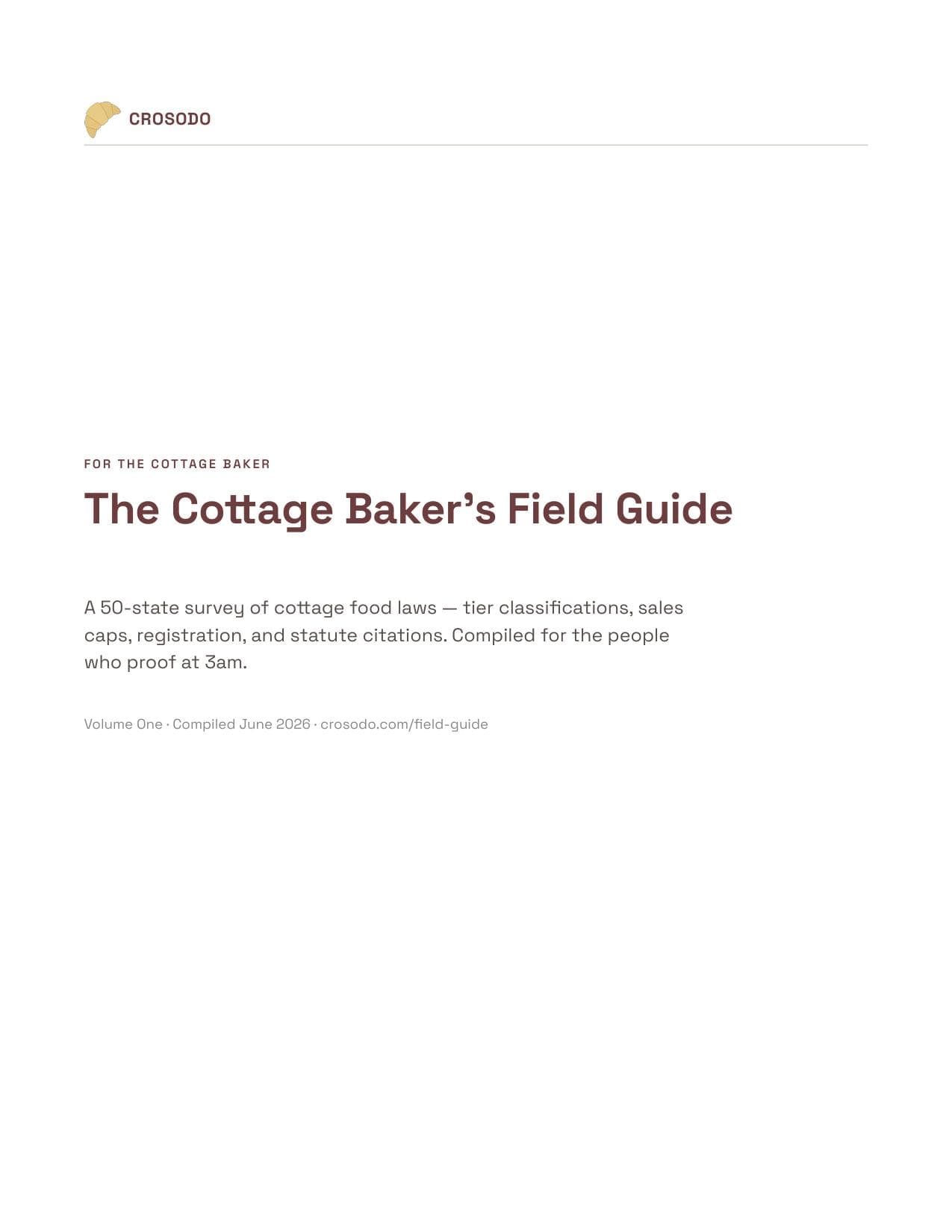
The Cottage Baker's Field Guide (PDF)
A 6-page reference covering all 51 jurisdictions with methodology and tier explainers — same data as this directory, ready to print and tape to your wall.
Download the PDFWas this page helpful?
Virginia cottage food law — FAQ
Do I need a license or permit to sell homemade food in Virginia?
Yes — No. Food handler certification: No.
What foods can I sell under the Virginia cottage food law?
Non-TCS shelf-stable foods from private homes including candies, jams, jellies (not low-acid/acidified), dried fruits, dry herbs, dry seasonings, dry mixtures, nuts, vinegars, popcorn, cotton candy, dried pasta, dry baking mixes, roasted coffee, dried tea, cereals, trail mixes, granola, and baked goods that do not require temperature control. Pickles and acidified vegetables with equilibrium pH 4.6 or lower are allowed with a $9,000 annual gross sales cap. Honey from own hives under 250 gallons per year is also allowed under a separate provision.
Is there a sales cap for cottage food in Virginia?
Tiered
How good is Virginia's cottage food law?
Virginia is a Good-tier cottage food state by Crosodo's rating criteria. Solid baseline with moderate restrictions — typically a high cap (often $50K+) and standard direct-to-consumer rules. Workable for most home bakers.
Keep exploring Virginia
Labels, product checks, county zoning, and local discuss — so one state page becomes a full readiness plan.
Market-day tees from the Crosodo collection — for the craft, not the algorithm.
What bakers ask about Virginia
Seed threads for markets, zoning, and labels — join the channel or ask the directory.
Farmers market process in Virginia?
Which markets welcome cottage bakers, what they charge, and label checks on day one.
Good label printers in Virginia?
Local print shops or home setups that handle home-kitchen disclaimers cleanly.
Zoning experience in Virginia counties?
Home occupation, pickup traffic, signage — what did your planning office actually require?
How I got legal in Virginia
Registration portal tips, food handler cert, and the county step nobody publishes.
Virginia label wording that passed review
Share real labels (blur personal info) and any county extras beyond the state minimum.
You might like these too
While you're deep in Virginia rules — vintage-varsity tees for booth days and bake nights.

Resources for cottage food and home bakers
Supplies, courses, insurance, farmers markets, kitchen rentals, and local services. To advertise here, visit crosodo.com/advertise. Browse all classifieds.
Advertise here
Packaging, labels, baking tools, bulk ingredients, and equipment for cottage food operators. Reach home bakers across the country.
crosodo.com/advertiseAdvertise here
Baking classes, cottage food business training, workshops, and food safety education. Reach home bakers across the country.
crosodo.com/advertiseAdvertise here
Product liability, home bakery, market vendor, and small food business insurance. Reach home bakers across the country.
crosodo.com/advertiseAdvertise in Virginia
Reach home bakers in Virginia. Supply stores, farmers markets, kitchen rentals, co-packer referrals, and bakery services are welcome.
Learn about placementsYour business here
Local cottage food listings, community kitchens, farmers market dates, and non-profit events can be submitted for review.
Submit a community listingAds are paid placements. Crosodo does not endorse listed vendors. Verify all product, service, course, insurance, and legal information independently.
Cottage food laws are amended every year. This is a starting reference, not legal advice. Verify with Virginia Department of Agriculture and Consumer Services and your local health department before relying on this data.