Maryland cottage food law
Last updated: · Research verified · Full guide $44 lifetime (82 pages)
Tier: Good. Solid baseline with moderate restrictions — typically a high cap (often $50K+) and standard direct-to-consumer rules. Workable for most home bakers.
Full Maryland License & Permit Guide (82 pages). Statute, every county we have researched, and official source URLs. Stripe checkout. Cover letter, paid receipt, and the guide (PDF) licensed to your address.
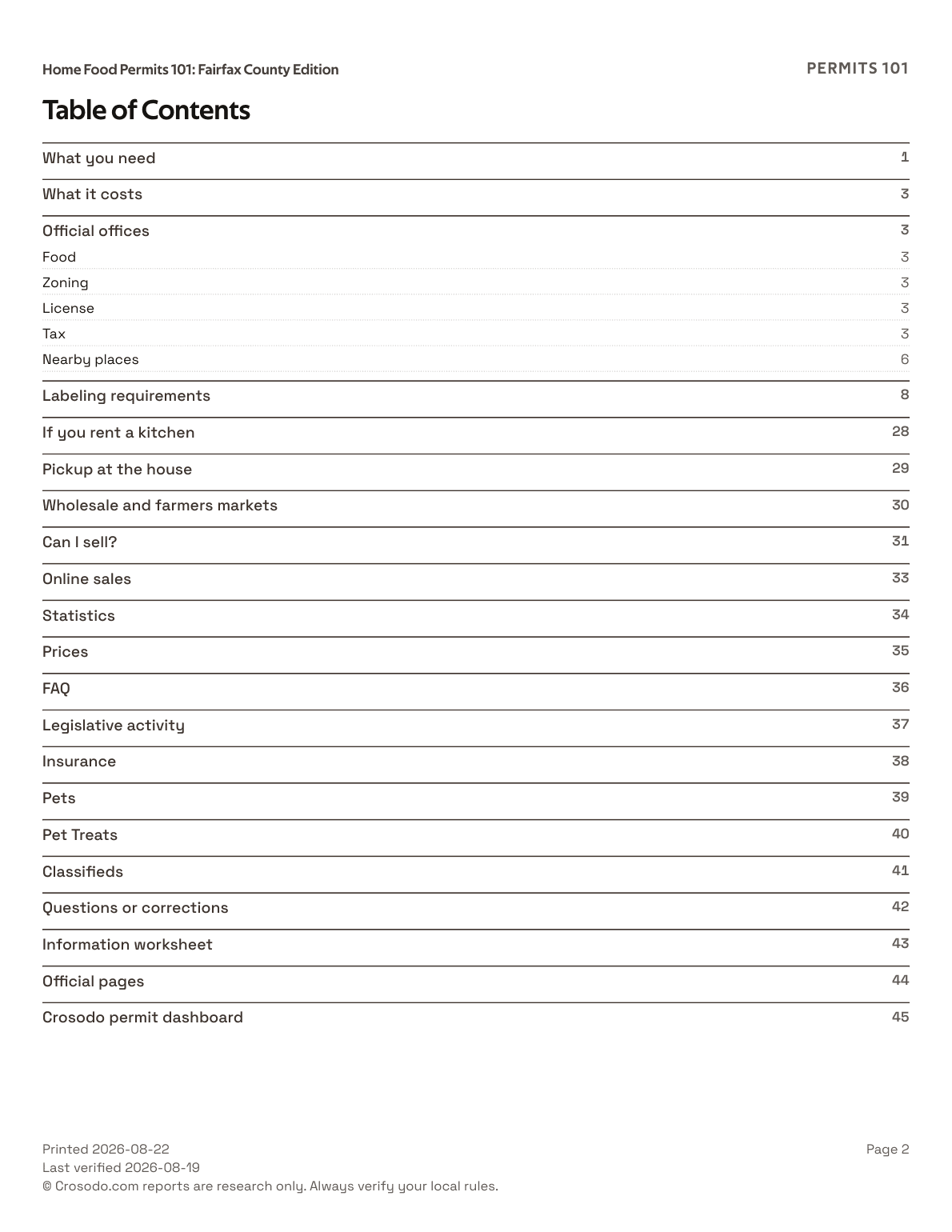
Unlimited Pass. Your journey to getting permitted for cottage food sales. Premium dashboard tools, unlimited state and county reports, and the 50-state label report. Lifetime access. Includes the full Maryland License & Permit Guide (82 pages).
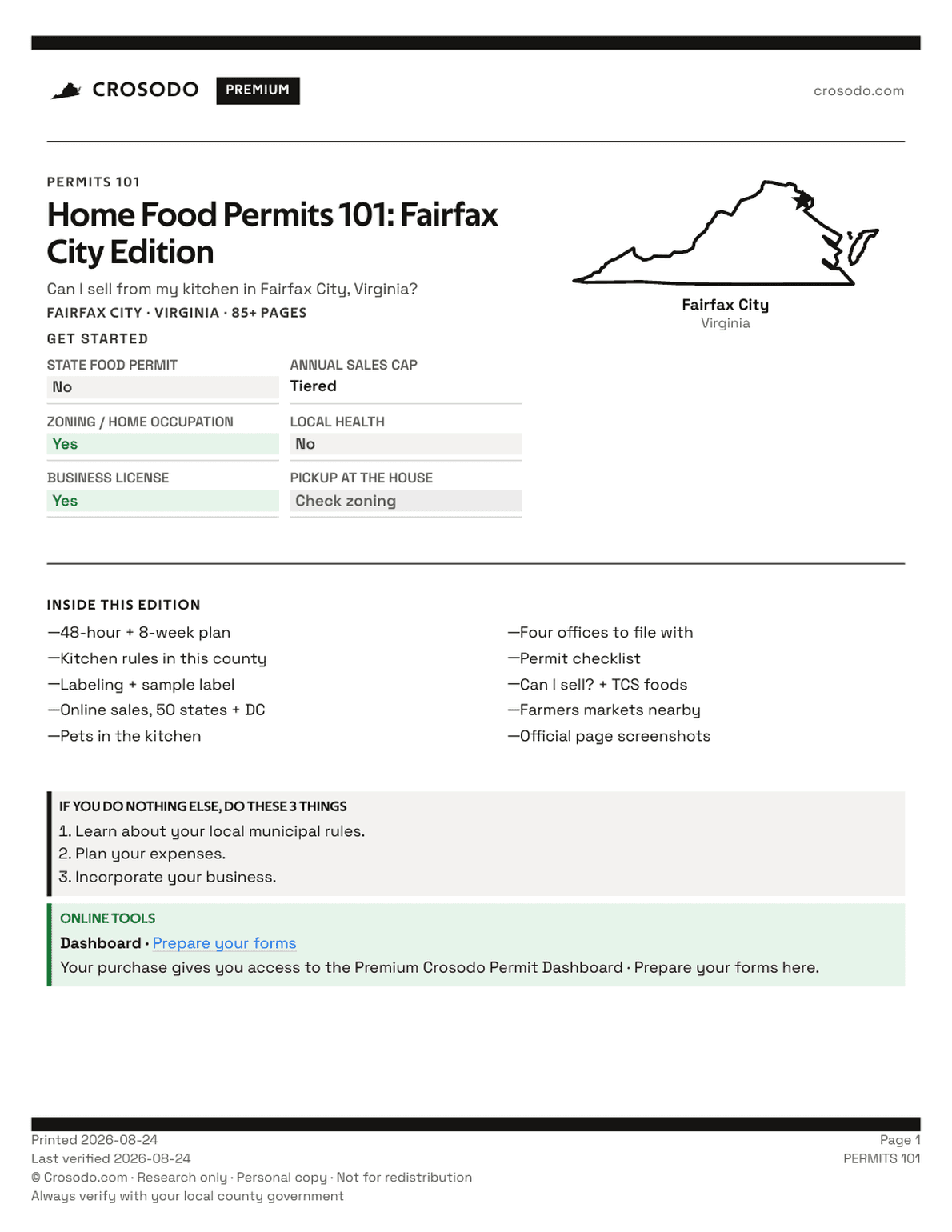
How to start in Maryland
A practical path from “am I allowed?” to first sale. Not legal advice — confirm every step with Maryland agencies and your local offices.
Confirm your products are allowed
Maryland allows Non-potentially hazardous foods prepared in a residential kitchen, including non-PHF baked goods (breads, cookies, cakes, pies without perishable fillings), non-PHF candy (hard candies, brittles), acid-fruit jellies, jams, preserves and butters from enumerated fruits, and all other non-PHF foods produced by a licensed entity. Dry goods (spice blends, coffee, teas) and certain snacks (kettle corn, granola) are also permitted.. High-risk or refrigerated foods usually need a commercial kitchen — not a cottage exemption.
Choose sales channels you can actually use
Sales cap: $50,000. Indirect / wholesale-style sales: Limited (see notes). Farmers markets and direct-to-consumer pickup are the usual start. Check county and city rules before advertising porch pickup.
Clear local zoning, licenses, and tax IDs
State cottage food rules are the floor. Your city or county may still require a business license, home occupation approval, HOA permission, or sales tax registration. Do this before you print an address on Instagram.
Registration, training, and kitchen rules
State registration: Depends. Food handler / training: Recommended. Kitchen inspection: Upon-complaint. Complete certificates the market or agency will ask for.
Build compliant labels
Use the Maryland label requirements on this site (and the free template). Match disclaimer language to the statute or agency guide before you print a batch.
Soft-launch, then first paid sales
Keep a simple sales log from day one so you stay under any annual cap. Soft-launch with pre-orders before a full market day.
Verify with official sources
Re-check the state cottage food page and your local health / planning office before you invest in equipment or marketing. Rules change.
What usually goes on the package
- Product name (common or usual name of the food)
- Business or producer name
- Producer address (or address alternative your state allows)
- Ingredients in descending order by weight
- Major allergen disclosures (e.g. wheat, milk, eggs, soy, tree nuts, peanuts, fish, shellfish, sesame)
- Net weight or quantity
- Home-kitchen disclaimer: “Made by a cottage food business that is not subject to Maryland's food safety regulations.”
This is a planning checklist compiled for home bakers. It is not legal, tax, or zoning advice.
Maryland vs neighboring cottage food laws
Tier and sales-cap snapshot for Maryland and nearby states. Click through for full rules, labeling, and county pages.
| State | Tier | Sales cap | Guide |
|---|---|---|---|
| MarylandYou are here | Good | 50000 | This page |
| Delaware | Good | None | Delaware law → |
| District of Columbia | Okay | None | District of Columbia law → |
| Pennsylvania | Good | None | Pennsylvania law → |
| Virginia | Good | Tiered | Virginia law → |
| West Virginia | Good | None | West Virginia law → |
Need a compliant product label for Maryland? Open the Maryland label mockup.
50000
Non-potentially hazardous foods prepared in a residential kitchen, including non-PHF baked goods (breads, cookies, cakes, pies without perishable fillings), non-PHF candy (hard candies, brittles), acid-fruit jellies, jams, preserves and butters from enumerated fruits, and all other non-PHF foods produced by a licensed entity. Dry goods (spice blends, coffee, teas) and certain snacks (kettle corn, granola) are also permitted.
Registration: Depends. Food handler cert: Recommended.
Code of Maryland Regulations 10.15.03.27 - Farmer's Market, Bake Sales, and Cottage Food Business
Verbatim excerptA. A cottage food business may offer for sale the homemade foods specified in §B of this regulation when the foods are: (1) Made in a private home kitchen; and (2) Offered or sold only in the State: (a) Subject to the requirements of §C(6) and (7) of this regulation, at a retail food store; or (b) Directly to a consumer: (i) At a farmer's market; (ii) At a bake sale; (iii) At a public event; (iv) By personal delivery; or (v) By mail order. B. The Department shall allow the preparation and sale of the following foods in accordance with §A: (1) Non-potentially hazardous hot-filled canned acid fruit jellies, jams, preserves, and butters; (2) Fruit butters made only from apples, apricots, grapes, peaches, plums, prunes, quince, or another fruit or fruit mixture that will produce an acid canned food; (4) Non-potentially hazardous baked goods; (6) Non-potentially hazardous candy. C. (1) The Department shall allow the owner of a cottage food business to sell only cottage food products processed and packaged in Maryland that are: (a) Produced or packaged in a residential kitchen; (b) Stored on the premises of the cottage food business; and (c) Prepackaged with a label that contains: name and address of the cottage food business or name, phone number, and identification number assigned by the Department; name of the product; ingredients in descending order by weight; net weight or volume; allergen information; nutritional information if any claim is made; and printed in 10 point or larger type: "Made by a cottage food business that is not subject to Maryland's food safety regulations." (6) Before the owner of a cottage food business may sell a cottage food product to a retail food store, the owner shall submit to the Department documentation of the owner's successful completion of a food safety course in the past 3 years approved by the Department and the American National Standards Institute.
Source: regs.maryland.gov/us/md/exec/comar/10.15.03.27 →
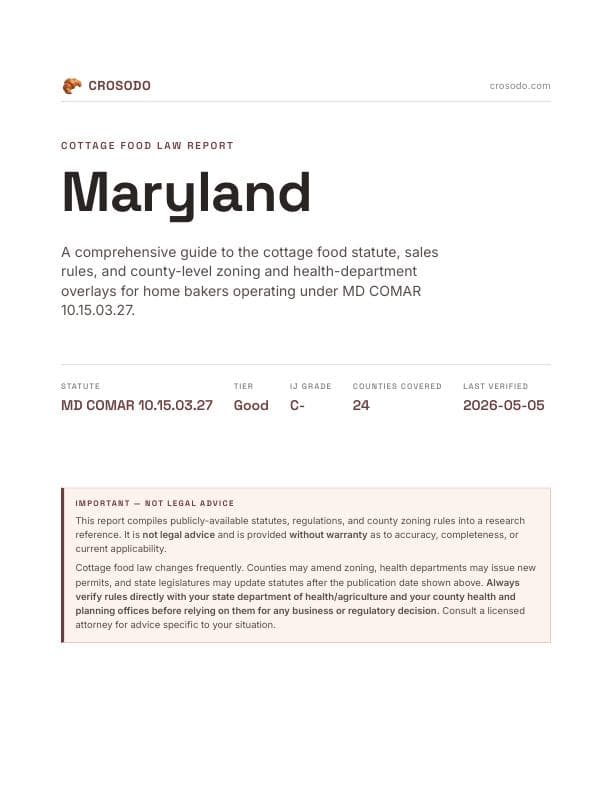
Maryland Cottage Food Law — 82 pages and 24 counties
The long report for this state (82 pages): statute, every county we've researched, and official source URLs. Stripe checkout. We email a cover letter, paid receipt, and the guide (PDF) licensed to your address.
Print Maryland labels for your first market
After the law page, this is the next thing most bakers need: a print-ready mockup with the Maryland home-kitchen disclaimer, allergen line, and net-weight fields.
Made by a cottage food business that is not subject to Maryland's food safety regulations.
- Product name, producer, and address (or allowed alternative)
- Ingredients by weight and major allergens
- Net weight / quantity
- Maryland home-kitchen / “not inspected” disclaimer
Not legal advice. Verify wording with the state agency before a production print run.
Where to verify Maryland's rules
Guidelines for Cottage Food Businesses
Official agency guidance changes without notice. The text below is reproduced for reference only — always confirm current rules on the agency website before relying on it.
- Maryland Department of Healthhttps://health.maryland.gov/phpa/OEHFP/OFPCHS/Documents/Updated_CF_Guidelines_2025.pdf
This document provides guidance for allowable foods that may be produced and sold by a Maryland Cottage Food Business. COMAR 10.15.03.02B(17-1) defines a cottage food business that "(a) produces or packages cottage food products in a residential kitchen in Maryland; and (b) has annual revenues from the sale of cottage food products in an amount not exceeding $50,000." A cottage food product is a non-potentially hazardous food sold in Maryland directly to a consumer from a residence, at a farmer's market, at a public event, by personal delivery, or by mail delivery; or directly to a retail food store. Interstate sales or sales outside of Maryland are prohibited.
Allowable Foods
- "Potentially hazardous foods" are more likely to need special handling (for example, refrigeration) because at room temperature they are more likely to support the growth of harmful bacteria that can cause foodborne illness.
- A non-potentially hazardous/non-perishable food, when stored under normal conditions without refrigeration, will not support the growth of microorganisms (e.g., bacteria) that can cause foodborne illness. A food's water activity (i.e., available water) and pH (acidity) determine whether it is considered potentially hazardous.
- Baked breads, cookies and pastries without potentially hazardous topping or fillings: pies, turnovers, and fruit tarts from fruits with a natural pH of 4.6 or less; bread, biscuits, tortillas, and muffins; cakes and cupcakes.
- Hot-filled canned acid foods such as fruit jelly, jam, and preserves from fruits with a natural pH of 4.6 or less; fruit butters from apple, apricot, grape, peach, plum, prune, quince.
- Non-potentially hazardous candy.
- For a complete list of example foods, refer to the Allowable Foods list in Appendix A of the official guidelines.
- Baked goods that require any type of refrigeration (e.g., meringue pies, pecan pies, pumpkin pies, cheesecakes, cream and custard pies, and pies and cakes or pastries with cream cheese/buttercream icings or fillings).
- Low-acid canned foods.
- Acidified foods/pickled products such as corn relish, pickles, salsa, pepper jelly, barbeque sauce, mustard, or condiments.
- Garlic and/or fresh/dried vegetables in oil mixtures.
- Raw-seed sprouts, including but not limited to alfalfa sprouts or bean sprouts.
- Fish or shellfish products.
- Meat or meat products.
- Poultry or poultry products.
- Milk and dairy products.
- Beverages.
- For a comprehensive list, refer to the Not Allowed Foods list in Appendix B of the official guidelines.
- Icings, frosting and glazes with added water or containing potentially hazardous ingredients (such as cream cheese, milk, butter, etc.).
- Moist quick fruit breads with a natural pH above 4.6 such as banana, pumpkin, and zucchini breads.
- Baked goods in which alcohol is added after baking.
- Federal and state food regulations state that a shelf-stable product that does not require refrigeration must have a water activity ≤ 0.85 and/or a pH ≤ 4.6. If lab results are not within the non-potentially hazardous parameters, your product is potentially hazardous and therefore not allowable under cottage foods.
Labeling
- The name and address* of the cottage food business.
- The name of the cottage food product.
- The ingredients (and sub-ingredients) of the cottage food product in descending order of the amount of each ingredient by weight.
- The net weight, count, or net volume of the cottage food product.
- Allergen information as specified by federal labeling requirements.
- Nutritional information as specified by federal labeling requirements, if any health or nutritional information claim is made.
- Printed in 10 point or larger type in a color that provides a clear contrast to the background of the label: "Made by a cottage food business that is not subject to Maryland's food safety regulations".
- The phone number of the cottage food business.
- The e-mail address of the cottage food business.
- The date the product was made.
- A cottage food business may request from the Maryland Department of Health a unique identification number (ID#) to use on the label as an alternative to a business address. If a unique ID# is used, the label must additionally include the name and phone number of the cottage food business.
- Labels must be either one piece or two-piece labels.
- All labels must be in English.
Sampling Cottage Foods
- Cottage foods may be sampled if the product meets the requirements in this Cottage Food guidance document and is a non-potentially hazardous food.
- Samples must be prepackaged in the home kitchen (e.g., if the cottage food operator wants to offer samples of bread at a farmer's market, the bread cannot be cut at the market, but it can be cut in the home kitchen and individually wrapped or packaged into sample cups with lids).
- An individual label for each sample is not needed, but the packaged products on display must be properly labeled so the customer can review the ingredient list and required information.
- The product cannot be cooked or prepared in a way that makes it a potentially hazardous food (e.g., a dried dip mix added to sour cream or serving anything that cannot be kept safely at room temperature).
- Foods requiring temperature control would require a food license from the local health department.
Selling to a Retail Food Store
- Before a cottage food business can sell to a retail food store (e.g. a grocery store, convenience store, retail market, retail bakery, or food cooperative) the business must submit the following information to the Maryland Department of Health via the ID and Retail Sales Request Form:
- The label that will be affixed to the cottage food product (products must include the labeling details for sales to a retail food store); and
- Documentation of the owner's successful completion of a basic food safety course in the past 3 years that is approved by the Department and the American National Standards Institute which includes, at a minimum, the following subjects: basic food safety; cleaning and sanitizing; personal hygiene; pest control and prevention; and receiving, storing, preparing, and serving food.
- This information will be reviewed for compliance with the cottage food laws and regulations.
- The owner of a cottage food business may not sell or offer for sale a cottage food product to a retail food store until notified by the Maryland Department of Health, in writing, that the requirements of the regulation are satisfactorily met.
Definitions
- A "major food allergen" is defined by COMAR 10.15.03.02B(44) and means: milk; egg; fish (such as bass, flounder, or cod) crustacea (such as crab, lobster, or shrimp); tree nuts (such as almonds, pecans, or walnuts); wheat; peanuts; soybeans; sesame; and a food ingredient that contains protein derived from milk, egg, fish, tree nuts, wheat, peanuts, soybeans or sesame.
- A "potentially hazardous food" is defined by COMAR 10.15.03.02B(55) and means a natural or synthetic food that requires temperature control because the food is in a form capable of supporting the rapid and progressive growth of infectious or toxigenic microorganisms; the growth and toxin production of Clostridium botulinum; or in raw shell eggs, the growth of Salmonella Enteritidis.
- A "potentially hazardous food" does not include a hard-boiled shell egg that has been air-cooled with the shell intact; food with an aw value of 0.85 or less; food with a pH level of 4.6 or below when measured at 75°F; commercially sterile food in a hermetically sealed container; or food for which laboratory evidence demonstrates that the rapid and progressive growth of infectious and toxigenic microorganisms or the growth of Salmonella Enteritidis in eggs or Clostridium botulinum cannot occur.
- A "retail food store" is defined by COMAR 10.15.03.02B(68-1)(a)-(b) as: "a licensed food service facility that sells prepackaged food items either fresh, refrigerated, frozen, or shelf-stable. A retail food store includes a grocery store, convenience store, retail market, retail bakery, or food cooperative."
- COMAR 10.15.03.02B(68-1)(c) further defines a retail food store to not include: "a restaurant, mobile food service facility, coffee shop, cafeteria, short order café, luncheonette, tavern sandwich shop, produce stand that only offers whole, uncut fresh fruits and vegetables, or an establishment that offers only prepackaged non-potentially hazardous foods."
Reproduced from the official Maryland Department of Health Cottage Food Business Guidelines (Last Updated 11/2025). Verify current rules with MDH Office of Food Protection.
Maryland Counties
24 counties tracked. Pick yours for the local zoning + health department links.
View all 24 counties →City zoning rules in Maryland
City zoning rules apply on top of the state cottage food law — home occupation, customer pickup, signage, and employees.
Permit Guide 101 — $26
This page is the free Maryland statute. Permit Guide 101 is the paid county packet — pick your county or independent city for the permit stack that is not on this directory page.
Pick your Maryland county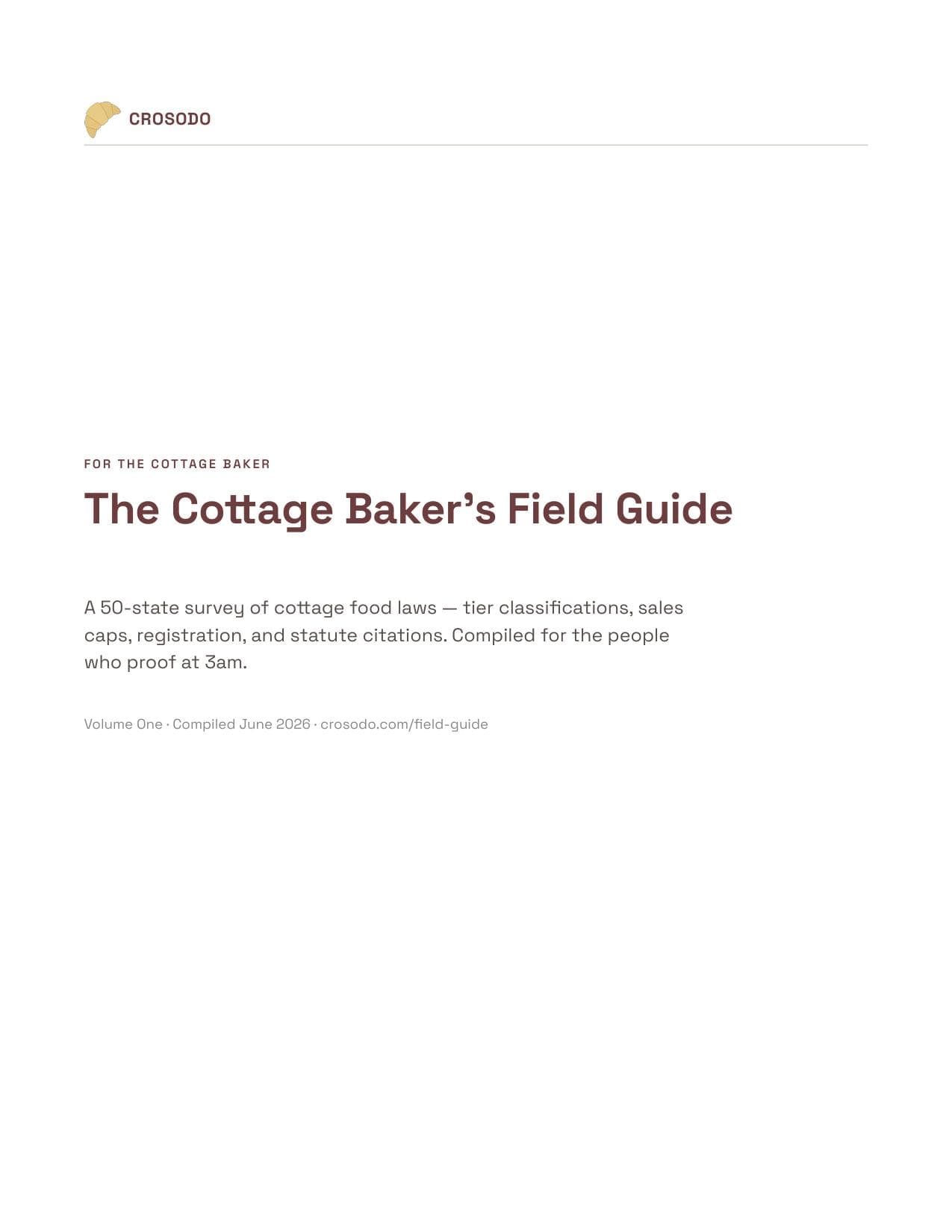
The Cottage Baker's Field Guide (PDF)
A 6-page reference covering all 51 jurisdictions with methodology and tier explainers — same data as this directory, ready to print and tape to your wall.
Download the PDFWas this page helpful?
Maryland cottage food law — FAQ
Do I need a license or permit to sell homemade food in Maryland?
Yes — Depends. Food handler certification: Recommended.
What foods can I sell under the Maryland cottage food law?
Non-potentially hazardous foods prepared in a residential kitchen, including non-PHF baked goods (breads, cookies, cakes, pies without perishable fillings), non-PHF candy (hard candies, brittles), acid-fruit jellies, jams, preserves and butters from enumerated fruits, and all other non-PHF foods produced by a licensed entity. Dry goods (spice blends, coffee, teas) and certain snacks (kettle corn, granola) are also permitted.
Is there a sales cap for cottage food in Maryland?
50000
How good is Maryland's cottage food law?
Maryland is a Good-tier cottage food state by Crosodo's rating criteria. Solid baseline with moderate restrictions — typically a high cap (often $50K+) and standard direct-to-consumer rules. Workable for most home bakers.
Keep exploring Maryland
Labels, product checks, county zoning, and local discuss — so one state page becomes a full readiness plan.
Market-day tees from the Crosodo collection — for the craft, not the algorithm.
What bakers ask about Maryland
Seed threads for markets, zoning, and labels — join the channel or ask the directory.
Farmers market process in Maryland?
Which markets welcome cottage bakers, what they charge, and label checks on day one.
Good label printers in Maryland?
Local print shops or home setups that handle home-kitchen disclaimers cleanly.
Zoning experience in Maryland counties?
Home occupation, pickup traffic, signage — what did your planning office actually require?
How I got legal in Maryland
Registration portal tips, food handler cert, and the county step nobody publishes.
Maryland label wording that passed review
Share real labels (blur personal info) and any county extras beyond the state minimum.
You might like these too
While you're deep in Maryland rules — vintage-varsity tees for booth days and bake nights.
Resources for cottage food and home bakers
Supplies, courses, insurance, farmers markets, kitchen rentals, and local services. To advertise here, visit crosodo.com/advertise. Browse all classifieds.
Advertise here
Packaging, labels, baking tools, bulk ingredients, and equipment for cottage food operators. Reach home bakers across the country.
crosodo.com/advertiseAdvertise here
Baking classes, cottage food business training, workshops, and food safety education. Reach home bakers across the country.
crosodo.com/advertiseAdvertise here
Product liability, home bakery, market vendor, and small food business insurance. Reach home bakers across the country.
crosodo.com/advertiseAdvertise in Maryland
Reach home bakers in Maryland. Supply stores, farmers markets, kitchen rentals, co-packer referrals, and bakery services are welcome.
Learn about placementsYour business here
Local cottage food listings, community kitchens, farmers market dates, and non-profit events can be submitted for review.
Submit a community listingAds are paid placements. Crosodo does not endorse listed vendors. Verify all product, service, course, insurance, and legal information independently.
Cottage food laws are amended every year. This is a starting reference, not legal advice. Verify with Maryland Department of Health and your local health department before relying on this data.